Research — July 17, 2026
$3.8B long-term care deal a sign of reinsurance market's evolution
By Husain Rupawala, Jason Woleben, and Tim Zawacki
Life reinsurers continue to broaden their appetite for a more diverse array of liabilities, including expansion into new geographies and lines of business that some may have previously eschewed.

With its July 6 agreement to assume approximately $3.8 billion in statutory reserves of Unum Group's individual long-term care (LTC) business, reinsurer Fortitude Reinsurance Company Ltd. will more than double the size of a relationship it entered in 2025. The structure of the transaction, however, will limit The Carlyle Group Inc.-backed company's exposure to a business that has proven challenging for insurers and reinsurers, alike, over the past two decades.
US life insurers reported $110.82 billion of reserve credits and modified coinsurance reserves associated with individual and group long-term care business as of year-end 2025, according to data reported on Schedule S, Part 3, Section 2 of annual statements. That figure includes $28.43 billion in reserves associated with relationships that took effect from the start of 2022 onward such as the first pact involving Unum Life Insurance Company of America and Fortitude Re.
With many large US life insurers already having reinsured in-force blocks of individual annuity business as well as entered forward flow transactions for new annuity business production, reinsurers have taken a multifaceted approach to continue to drive growth, including through strategies such as outright acquisitions of direct liability origination platforms, significant allocation of capital and resources to the pursuit of block deals in Japan and select other Asian markets, and increased appetite for risks like long-term care and universal life with secondary guarantees (ULSG).

US life insurers reported $47.72 billion in reserve credits and modco reserves ceded to Fortitude as of year-end 2025 in the life, annuity and accident and health business lines, including $3.50 billion in individual LTC and long-term disability liabilities associated with the first Unum LTC transaction. Corebridge Financial Inc. and Lincoln National Corp. ranked as Fortitude's largest two US cedants with aggregate liabilities of $24.70 billion and $15.68 billion, respectively, from arrangements that took effect in 2017 and 2023. Fortitude also assumes US business from USAA Life Insurance Co. Outside the US, Fortitude Re has entered multiple transactions with Japanese counterparties.
All told, Fortitude reported $70.40 billion in total net GAAP reserves and insurance liabilities as of March 31, with 53.5% involving annuities and 34.4% involving universal life and ULSG business. The annuities tally includes the assumed Unum long-term care business, which Fortitude classifies among non-life-contingent payout annuities as it retrocedes all but the underlying spread-based risks to an unnamed "highly rated global reinsurer."
The latest Unum deal contemplates a similar structure as Fortitude intends to retrocede the associated biometric risk. It comes as the fourth such multi-billion-dollar reinsurance agreement that has taken effect in the past three years, according to disclosures contained within Schedule S, Part 3, Section 2 of the annual life statutory filings and inclusive of the parties' 2025 transaction
The other transactions involved Manulife Financial Corporation's John Hancock and its agreements with KKR & Co. Inc.'s Global Atlantic Financial Group Ltd. and Reinsurance Group of America Inc., which were completed in 2024 and 2025, respectively. The two transactions allowed John Hancock to take combined reserve credits of $6.14 billion in 2025.
Notably, the latest transaction only involves LTC business; the aforementioned block deals pared LTC liabilities with more commonly reinsured risks such as structured settlement annuities.
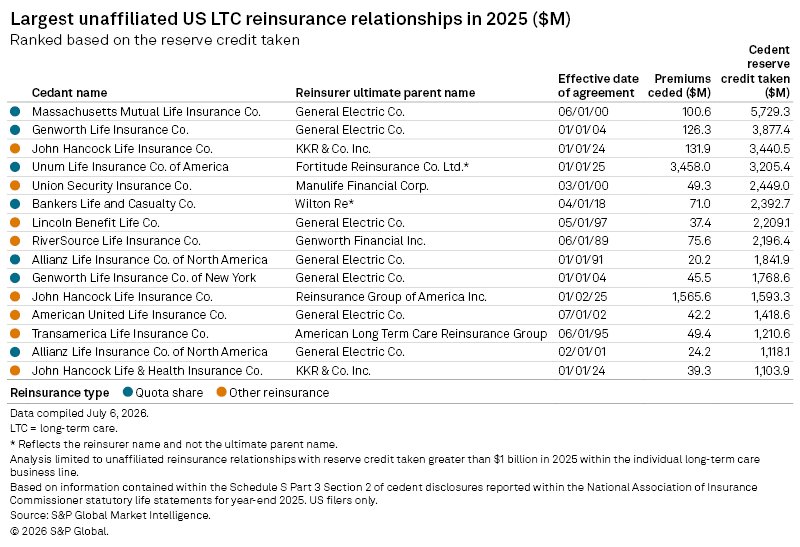
The largest swath of LTC reinsurance cessions by US life insurers, or 46.5% of the $110.82 billion total, involves affiliated transactions like the one between Unum and Vermont captive Fairwind Insurance Co. that will be partially recaptured so as to execute the new Fortitude deal as well as various intercompany arrangements. The insurance subsidiaries of General Electric Co. reinsured more than $21 billion in US LTC reserves as of Dec. 31, 2025, largely involving decades-old structures predating the company's mid-2000s separation with Genworth Financial Inc.
Demand among insurers and certain reinsurers for additional solutions undoubtedly exists, given the challenges associated with the LTC business generally, which include various faulty assumptions around policyholder morbidity, mortality and lapse rates that have required multiple rounds of large rate increases for many products. But the benefits of shedding the risks are not devoid of cost, as deals may involve negative ceding commissions and other considerations such as an experienced volatility cover of up to $125 million to be provided by a Unum subsidiary.
"When you boil it down, this transaction will cost us $650 million of holding company excess capital, which is well balanced with the derisking that we achieved," said Unum President and CEO Richard McKenney during a July 6 conference call.
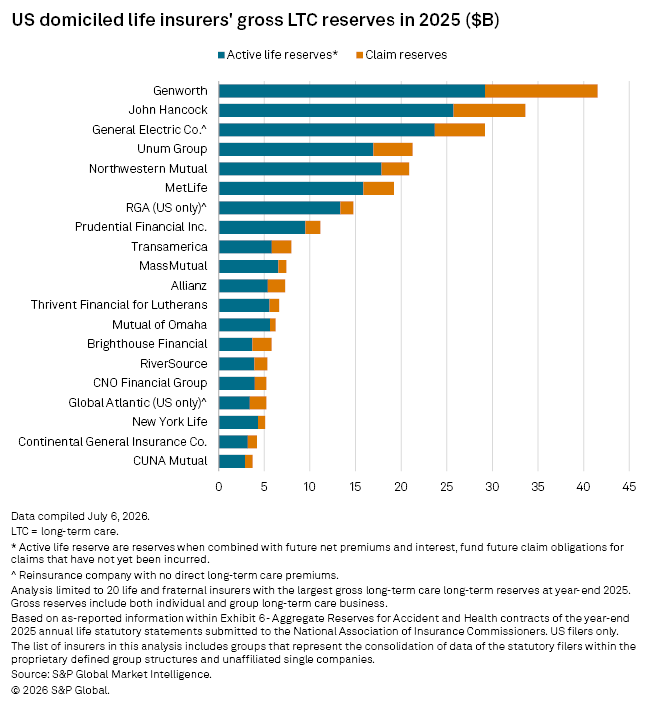
Unum's gross long-term care policy and claims reserves of $21.26 billion ranked as the fourth-highest total among US life groups at the end of 2025, according to disclosures in life insurers' statutory filings, trailing only Genworth, John Hancock and the remaining GE insurance subsidiaries. The ranking captures business assumed by the likes of the GE entities along with RGA and Global Atlantic but does not adjust for business that those reinsurers may retrocede to affiliated and unaffiliated offshore entities. It also excludes the substantial LTC reserves held by non-life entities such as CNA Financial Corporation.
Unum's net statutory basis total for long-term care reserves is considerably lower than the $14.8 billion pre-transaction tally the company reported on July 6 as business ceded to Fairwind is outside the scope of our US data. The relationship with Fairwind, originally known as UnumProvident International Ltd., dates back to 2003. Unum took reserve credits of $3.44 billion on individual business and $7.03 billion in group business ceded to the captive at year-end 2025, according to its statutory filing.
This article was published by S&P Global Market Intelligence and not by S&P Global Ratings, which is a separately managed division of S&P Global.