Research — June 18, 2026
No margin for error: How copper projects lost their price buffer

By Jason Holden
This article is the first in a three-part series examining how base-case commodity price assumptions, used in mining feasibility studies, compare to prevailing market prices at the time of publication. This article uses a dataset of 573 base-case copper price assumptions from studies published between 2004 and 2026, benchmarked against the London Metal Exchange (LME) Copper Grade A Cash annual averages. The analysis explores whether copper study pricing is systematic, cyclical or opportunistic, and what that means for investors evaluating project economics. Parts two and three of this series examine the same aspects for gold and lithium, respectively.

➤The traditional 30%-50% price buffer in copper feasibility studies collapsed to single digits in 2023–24.
➤Developers now routinely model five-figure copper prices, reflecting electrification narratives over cyclical caution.
➤Studies published during downturns anchor above spot prices but lag during bull markets, creating pricing anomalies.
➤If the copper price corrects to $8,500-$9,000 per metric ton, projects approved at over $10,000 base cases will face a margin squeeze.

Historically, the mining industry has relied on a standard approach to project development: stress-testing new assets using highly conservative commodity prices. During the commodity supercycle of the 2000s and early 2010s, it was standard practice for feasibility studies to use copper prices 30% to 50% below the spot market. This built-in buffer ensured that projects could survive cyclical downturns and deliver resilient margins.
However, a review of recent feasibility study data indicates a shift. The traditional buffer between copper price assumptions and actual LME prices has virtually disappeared. Today, project developers are adopting long-term prices that mirror — and occasionally exceed — current market forecasts. To understand this shift, we compare the base-case copper prices used in historical feasibility studies against the LME three-month average for those respective years. This analysis draws on 573 development studies for primary copper projects published between June 2004 and April 2026, sourced from S&P Capital IQ Pro.
Before examining price trends, we need to understand the composition of the study dataset. Of the 573 copper studies in the sample, 263 (46%) are preliminary economic assessments (PEAs), which are early-stage scoping studies that typically carry the widest range of accuracy, between 35% and 50% by convention. Prefeasibility studies in the sample account for 105 (18%), feasibility studies 155 (27%) and mine plans 50 (9%). The dominance of PEAs reflects the broad funnel of project development, as many projects are evaluated at a preliminary level but never advance to feasibility. This matters for price assumption analysis because PEAs, being earlier-stage and often generally optimistic regarding project economics, may use different pricing methodologies than bankable feasibility studies, which could bias assumptions upward in some periods.
2006–12 bull market: Severe conservatism
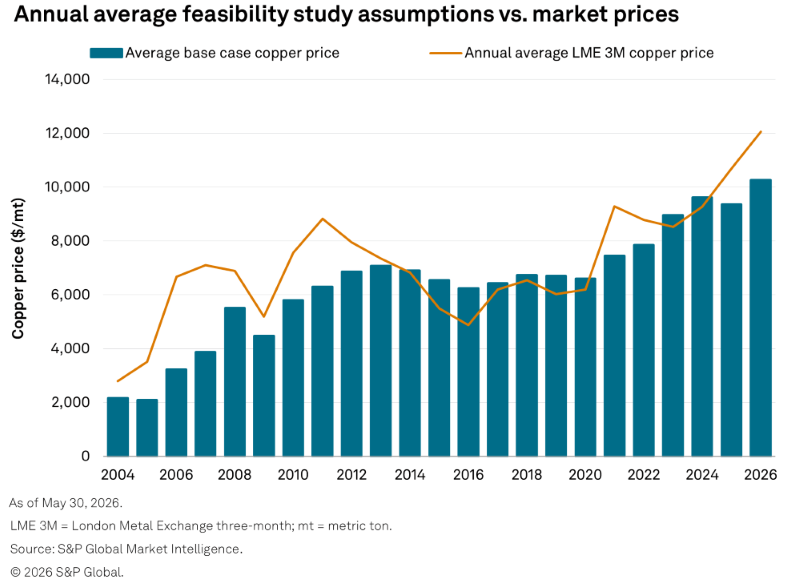
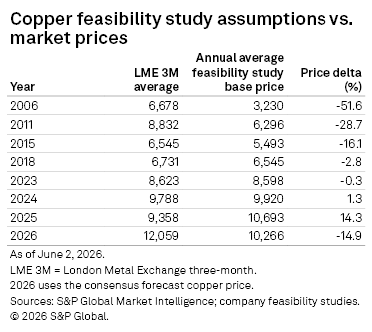
The most striking feature of the copper dataset is the magnitude of the discount applied during the commodity supercycle of 2006–12. When LME copper spot hit an annual average of $6,735/mt in 2006, the lone study published that year used an assumption of $3,230/mt — a 52% discount. By 2011, with spot price averaging $8,820/mt, study assumptions averaged just $5,445/mt — a discount of 38%. Even in 2012, with spot price still elevated at $7,954/mt, assumptions averaged $6,612/mt — 17% below market. The pattern is unambiguous: Across the entire bull run, copper study assumptions lagged spot price by 17%-52%. This is materially more conservative than the gold dataset over the same period, where the equivalent discount ranged from 10% to 27%, and reflects the greater volatility of copper prices and the industry's memory of the sharp reversals that followed previous copper price spikes.
2013–20: Convergence, then optimism
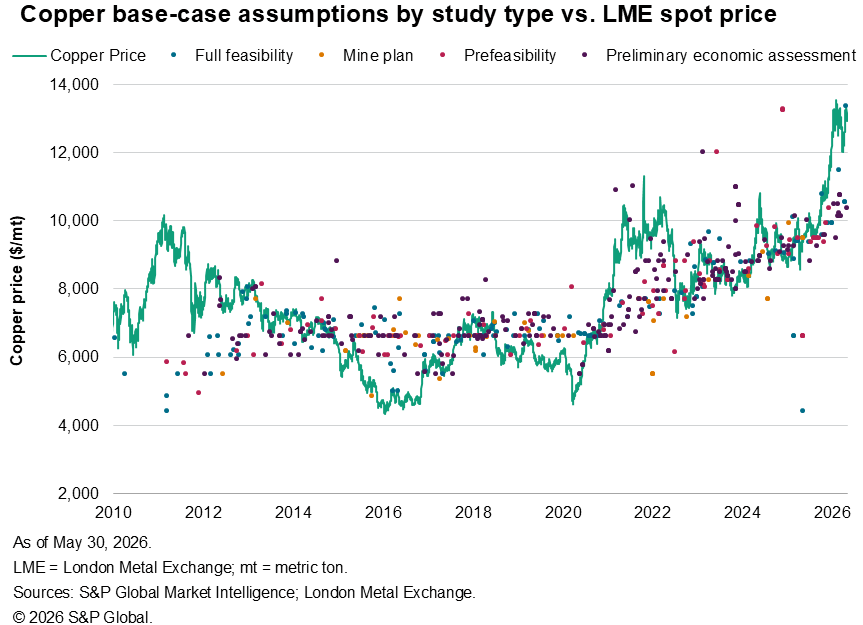
After copper prices peaked and retreated, the relationship between assumptions and spot prices shifted. By 2013, assumptions averaged $7,004/mt against a spot price of $7,330/mt — a discount of just 4%. By 2014, the gap had effectively closed, with study assumptions at $6,878/mt essentially matching spot price at $6,863/mt. What followed is more interesting: as copper declined sharply in 2015–16 — with spot falling to $5,509/mt and then $4,871/mt — study assumptions proved sticky, holding at $6,608 and $6,375/mt, respectively, implying premiums of 20% and 31% above spot. This is the same anchoring behavior observed in the lithium data during its 2019–20 downturn: companies building long-life projects are reluctant to embed cycle-trough prices into base-case scenarios, when doing so would make projects look uneconomical. From 2017 to 2020, with spot prices stabilizing in the $6,000/mt to $6,200/mt range, assumptions tracked closely, staying within a 10% band in either direction.
A notable feature of the dataset is the concentration of assumptions at exactly $3.0/lb ($6,614/mt), which appears in 104 studies across multiple companies and study types between 2011 and 2020. This reflects not individual company judgment but a shared industry consensus long-run price that was the dominant benchmark used throughout that period, meaning that much of the conservatism during the 2011–2020 period was institutional rather than project specific.
2021 onward: Conservative but moderate recent cycle
The copper bull market of 2021, when spot jumped to $9,317/mt, triggered a return to conservatism, though more moderate than the 2006–12 episode. Studies published in 2021 averaged $7,599/mt — an 18% discount to spot prices. As spot prices eased slightly in 2022–23 before climbing again in 2024–26, assumptions have been closing the gap; by 2023 and 2024, they sat within 5%-6% of spot prices. The most recent data for 2026, where LME copper has averaged approximately $12,970/mt year to date, shows study assumptions averaging $10,647/mt, an 18% discount. With copper increasingly framed as a critical mineral for electrification and spot prices hitting record levels, the degree of conservatism currently embedded in copper feasibility studies understates project economics at prevailing prices. Whether that conservatism proves rational depends on the sustainability level of the current price environment.
In recent years, we have seen some highly optimistic base-case prices that reflect this. For example, the 2024 averages indicate that studies in that year used an average base-case price of $9,614/mt, marking one of the first years when the industry consensus formally modeled prices above the $9,500/mt threshold. Recent feasibility data, between January 2026 and April 2026, shows developers are now comfortably modeling five-figure copper prices.
For example, Lundin Mining Corp. and BHP Group Ltd.'s Josemaria copper-gold project in San Juan, Argentina — a large-scale open-pit development at feasibility-stage — used a base-case copper price of $10,141/mt in its 2026 updated study. Similarly, Blue Moon Metals Inc.'s Nussir copper project in northern Norway — a smaller-scale underground mine with a completed definitive feasibility study (DFS) — adopted a base-case price of $10,538/mt in its recent economic update.
Implications for capital allocation
Copper feasibility study pricing reflects a commodity market that moves in large, sustained cycles. The discount of 17%-52% during the supercycle, followed by above-spot assumptions during the 2015–16 trough, suggests that study pricing lags the market on the upside and downside. For investors, this creates a recurring pattern. Studies published during bull markets understate value at prevailing prices, while studies published during price troughs may overstate returns relative to what the market can deliver. The current environment, with spot price approaching historical highs and assumptions running at an 18% discount, puts copper in a position similar to 2021. In this position, projects look better at spot than their base-case economics suggest, but the gap between assumption and reality also means there is a price at which the conservatism becomes insufficient.
The path forward hinges on which scenario materializes. If spot prices are sustained above $12,000/mt, current base-case assumptions will once again appear conservative, and development capital should flow more freely. However, if prices correct to the $8,500-$9,000/mt range, projects approved at above $10,000 base-case scenarios face margin pressure and potential write-downs. A third possibility — technological or regulatory shifts that fundamentally lower extraction costs — could see the traditional buffer reemerge organically without requiring price assumptions to retreat.
Until long-term consensus prices catch up to these new incentive realities, or one of these scenarios decisively reshapes the cost-price dynamic, the industry will remain in a holding pattern — exacerbating the very structural deficit that developers are relying on.
This article was published by S&P Global Market Intelligence and not by S&P Global Ratings, which is a separately managed division of S&P Global.