Research — June 06, 2026
Net interest margin expansion could peter out for community banks
By Nathan Stovall and Zain Tariq
Community banks will find it harder to expand their net interest margins in 2026 as the competition for deposits remains fierce.

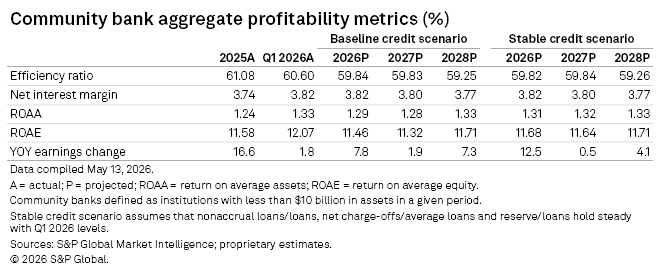
US community banks recorded strong earnings growth in 2025, buoyed by strong margin expansion. Community banks will no longer receive a tailwind from margin expansion and face an additional headwind from incrementally higher credit costs. However, we expect favorable results to continue and result in attractive returns that are not necessarily reflected in community bank valuations, in part due to concerns over the macroeconomic environment spurred by the threat of artificial intelligence to the labor force and the US-Israel war with Iran.

Click here to access data exhibits and the US community bank aggregate's projections template.
Further deposit cost relief tougher to find
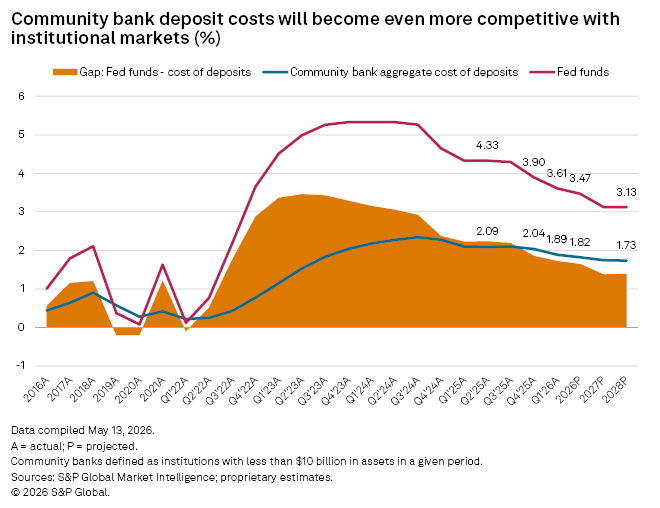
Community banks have reported significant decline in deposit costs from the peak witnessed in the third quarter of 2024, but additional decreases will be much slower due to fewer rate cuts by the Federal Reserve and renewed competition for core funding.
Community banks deposit costs began to decline late in 2024 as the highest cost deposits, often certificates of deposits (CDs) originated when rates were lower, matured and repriced at lower rates.
CD pricing peaked in the second quarter of 2024 before the Fed's first rate cut in September. Since many CDs carry one-year terms, the highest cost CDs at many institutions matured in the first half of 2025. Once those CDs rolled over at lower rates, costs held steady in the second and third quarters.
CDs have declined modestly over the last three quarters, falling 2.4% at community banks in aggregate since the end of the second quarter of 2025, but remain large portions of community banks' deposit bases at 26.9% of deposits. That is roughly flat with year-end 2019 before excess liquidity rushed into the system during the pandemic.
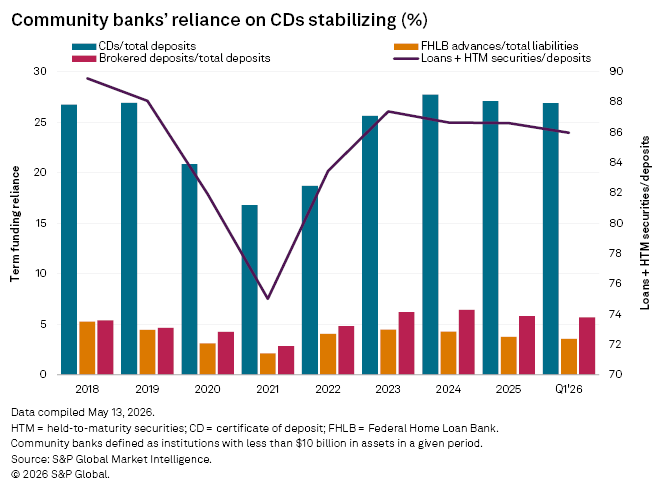
Banks are unlikely to back off CDs too much since it remains one of the most attractive products, at least from a rate standpoint, that institutions can offer customers when compared to alternatives in the Treasury and money markets. Keeping in close stead with those markets has been critical during periods of heightened deposit competition during this rate cycle and many bankers contend that attracting deposits remains not only difficult but important to their strategies.
Recent CD pricing shows that competition might have picked up recently. The number of US banks marketing rates of more than 3.5% on a one-year $10,000 CD fell from 1,006 at the end of June 2025, to 583 as of March 27, 2026. However, the number has ticked up slightly in the second quarter through May 15, to 595 banks, with a handful of institutions returning to offering rates above 4%.
Community banks have become competitive with the institutional markets in recent quarters as evidenced by the narrowing spread between the average fed funds rate and community banks' cost of deposits. That gap narrowed further in the first quarter of 2026 and should shrink modestly during the remainder of the year as community banks balance cutting deposit costs with the desire to grow their deposit bases.
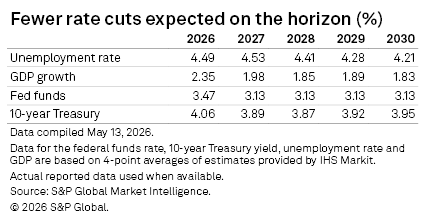
We expect community banks' deposit costs to decline modestly over the last nine months of 2026 unless the Fed cuts more aggressively than expected. The central bank is expected to cut rates again later in 2026 by as much as 50 basis points by year-end.
Lower rates will also lead to pressure on floating-rate loan yields. That pressure will be somewhat mitigated by attractive reinvestment rates in community banks' securities portfolios as well as newly originated loans still carrying favorable rates when compared to a few years ago.
Fundamentals results defy credit concerns
While asset quality has held up through the first quarter of 2026, investors remain laser-focused on the potential for credit deterioration. The extended length of the credit cycle, worries about credit slippage among nonbanks, including private credit firms, the impact of AI on the broader economy and the potential for a prolonged war with Iran all have created a wall of worry. Those fears have weighed on bank stock valuations this year, with the KBW Bank Index falling 5% since early February, while the Regional Bank Index dropped 5.7%. The S&P 500 Index, meanwhile, has risen 8% during that time frame.
But, banks say they see few cracks in the credit armor. Community banks across the country, including Springfield, Missouri-based Great Southern Bancorp Inc., Tyler, Texas-based Southside Bancshares Inc., Denver-based FirstSun Capital Bancorp, Baton Rouge, Louisiana-based Business First Bancshares Inc., Chicago-based Byline Bancorp Inc., Indiana, Pennsylvania-based S&T Bancorp Inc., Los Angeles-based Preferred Bank, Marietta, Ohio-based Peoples Bancorp Inc., Knoxville, Tennessee-based SmartFinancial Inc., and Wichita, Kansas-based Equity Bancshares Inc., sounded a similar tone on credit during first-quarter earnings call, describing the health of their loan portfolios as strong or at stable. Management teams emphasized prudent underwriting, disciplined risk management, and proactive portfolio monitoring during earnings season and provided cautiously optimistic outlooks.
Still, some argue that the current credit cycle is long in the tooth, with the industry not having a significant credit event in more than 10 years. Others push back against that argument, however, noting that the banks heavily scrutinized and stress-tested their portfolios during the pandemic, the liquidity crunch of 2023 and after historically high tariffs emerged in the spring of 2025.
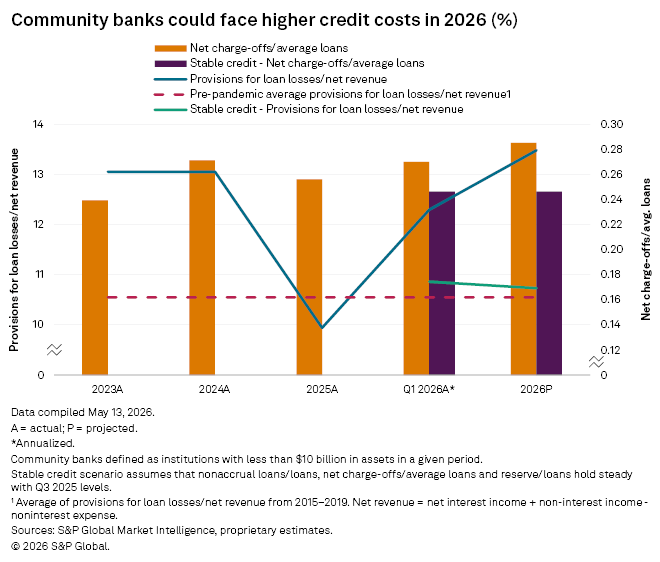
We expect credit quality to normalize from current levels due to weakness in the US consumer and some stress in commercial portfolios, leading to a higher level of losses. Consumer delinquencies have risen from historical lows but have shown signs of stabilization in recent months. Still, the emergence of higher oil prices and weakness in the labor market could further test the consumer, which drives the US economy.
Consumers have remained resilient in part because they took advantage of historically low rates to refinance their mortgages before the Fed began raising rates, reducing the impact that rate hikes would have on their debt service. Some consumers are also expected to benefit from larger tax refunds in 2026 since withholdings were not changed to reflect lower tax rates.
Some skeptics argue that lenders have downplayed credit quality deterioration by modifying loans and extending maturities further out the horizon, particularly in the commercial real estate portfolios, invoking the phrase "extend and pretend." There is evidence that extensions have occurred in the CRE market, with the number of CRE mortgages estimated to mature declining in 2025 when compared to estimates a year earlier. What remains to be seen is whether those extensions offered borrowers enough breathing room to weather the storm and if recent rate declines position them to service their debts.
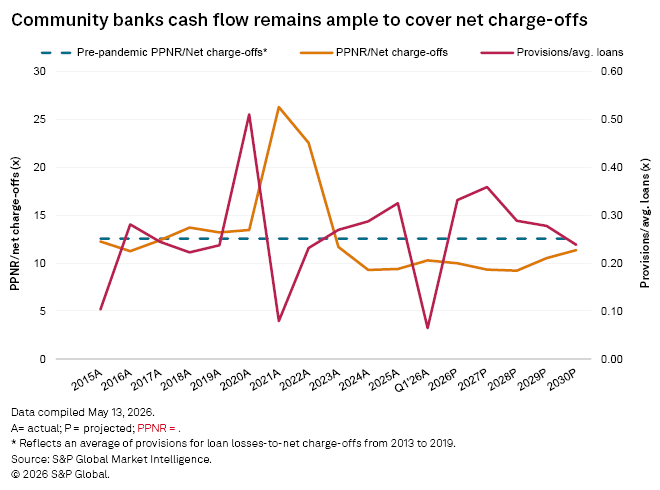
We expect higher loss content in the future, but to date, few problems have occurred. In our baseline scenario, we expect provisions to rise to 12.3% of net revenue in 2026 from 9.9% in the first quarter of 2026, but fall from 13.1% in 2025. That ratio is expected go to 13.5% in 2027 as banks prepare for tougher sledding ahead.
The higher level of provisioning will serve as a modest headwind, but earnings are still expected to jump 7.8% year over year in 2026 and then rise slightly in 2027, increasing 1.9% year over year.
Many bankers and members of the sell-side community expect credit trends to remain stable. If that occurred, bank earnings would grow 12.5% in 2026 and another 0.5% in 2027.
We expect net charge-offs to rise modestly in 2026, but losses and the reserves required to fund them should serve as a modest headwind to earnings rather than a severe downturn. Banks are also expected to produce ample cash flows to cover losses that ultimately materialize.
Looking ahead
The fundamental environment heading into 2026 was favorable for US community banks, punctuated by favorable returns, benign credit quality trends and stronger valuations that gave institutions more options to pursue restructuring and growth, including through M&A. A friendlier regulatory was also expected to support far greater deal activity. Some of those positives remain in place. The regulatory environment has changed. Previously announced acquisitions have received speedier regulatory approval, while larger banks have come back into the acquisition arena.
Still, some strategic actions are on hold amid the volatility in the markets. March of 2026 brought "March Madness" back to the bank stock market once again, with fears over the macroeconomy leading to market volatility and pressure on bank valuations. The volatility in March 2026 followed similar market moves in previous years: March of 2025 when the Trump administration unveiled a broad suite of tariffs; the regional bank crisis that erupted in March 2023, the onset of rate hikes by the Federal Reserve along with Russia's invasion of Ukraine in March 2022, and the beginning of the pandemic in March 2020.
Markets have stabilized in recent months but volatility negatively impacted deal activity. Just 36 bank deals surfaced in the first quarter, down significantly from 51 deals in the fourth quarter of 2025 and 58 deals in the third quarter. The second quarter began slow as well, with just 12 deals announced in April, putting it on roughly the same monthly pace as January, February and March. However, transaction activity seems to have increased, with 11 deals already surfacing in May, suggesting that the second quarter could end with 39 deals, which would still fall short of the activity witnessed in the second half of 2025.
The drivers of bank deals remain in place, and more transactions will ultimately come to fruition as institutions seek scale, face shareholder activism and seek to act while they have the capital and investor and regulatory support to do so. Community banks still have many would-be sellers in their ranks, but deal pricing can be a sticking point. While we expect favorable returns for community banks, many institutions still are not earning their cost of capital and could risk losing relevance in their market.
This article was published by S&P Global Market Intelligence and not by S&P Global Ratings, which is a separately managed division of S&P Global.
This article was published by S&P Global Market Intelligence and not by S&P Global Ratings, which is a separately managed division of S&P Global.