Research — June 25, 2026
High health insurance utilization hits less hard in Q1 2026
By Jason Woleben and Tim Zawacki
Key measures of health insurance utilization reached new first-quarter highs to start 2026, but the industry appears to have mostly adapted to what amounts to a new reality.

Ambulatory encounters, a key measure of utilization in annual and quarterly statutory filings which include routine medical visits and other outpatient care, continued to rise relative to enrollment levels across major coverages, with particular pressure in the Medicare Advantage business.
Unlike in the first quarter of 2025 when utilization spikes took the industry by surprise, however, carriers have taken a variety of actions to protect and expand margins. Several leading publicly traded health insurers reported during their first-quarter earnings conference calls success through tighter execution on pricing, better risk selection and the inroads they have made to gain deeper visibility into underlying claim drivers. These actions contributed to lower medical claims ratios and higher net underwriting gains despite the challenges around utilization.
But relatively easy year-over-year comparisons in future quarters provide an opportunity to build momentum, high utilization will require continued vigilance.

The US health insurance industry generated its lowest net underwriting gain in the Affordable Care Act era in 2025 with its result plunging to $9.17 billion from $16.99 billion in 2024 and $34.51 billion in 2023. The claim and claim adjustment expense ratio of 93.5% rose from 92.2% in 2024 and compared unfavorably to an ACA-era annual average of 89.6%. Health industry results reflect the aggregation of data filed with the National Association of Insurance Commissioners and the California Department of Managed Health Care. They exclude, however, results filed by life insurers that primarily provide managed care products.
Higher rates of ambulatory encounters in the Medicare, Medicaid and comprehensive individual and group lines of business during 2025 and the trailing-12-month period ended March 31, 2026, contributed to the bottom-line woes. Other measures of utilization, including inpatient admissions per member and hospital patient days per member, have also been historically elevated.
The public US health insurers conference call commentary shows progress, but not resolution. UnitedHealth Group Inc. is targeting Medicare margins of 2% to 4% despite expected 2027 medical trend remaining above funding levels, while CVS Health Corp. said recent rate adjustments are insufficient and its improved 2025 Medicare business still produced an adjusted operating loss. Humana Inc. reported Medicare Advantage performance in line to better than guidance, and Molina Healthcare, Inc.'s 91.1% consolidated medical cost ratio was modestly favorable to expectations. Those expectations in several cases had been for higher levels of utilization relative to the more distant past. Select insurers such as Clover Health Investments Corp. reported "meaningfully lower" inpatient utilization, which helped counterbalance elevated outpatient utilization.
The key focus areas for health insurers will be identifying which types of medical encounters and cost drivers are accelerating, tightening adjudication and payment integrity to limit avoidable leakage, and testing whether utilization deceleration actually holds as 2025 experience rolls into 2026. Some insurers indicated that they are employing artificial intelligence to assist with these efforts. The industry expects to treat medical cost ratio and claims trend effectively as leading indicators of margin recovery and evaluate how quickly plans can convert early signals into targeted management actions without triggering downstream utilization.
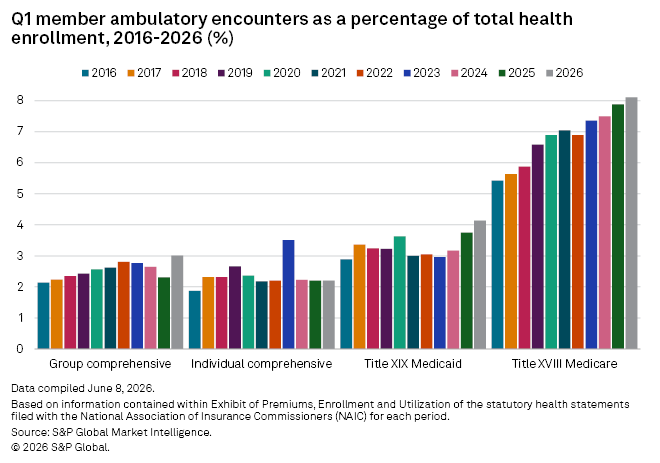
Statutory data flags utilization in the Medicare Advantage line as a worsening problem. Title XVIII Medicare encounters as a share of total health enrollments in the first quarter of 2026 ran well above the 2016-2025 range for comparable periods, rising from 5.4% in 2016 to 7.9% in 2025 and 8.1% in 2026. Title XIX Medicaid increased modestly from 2.9% in 2016 to 4.1% in 2026. On a last-12-months basis, Title XVIII Medicare encounters reached 30.2% in 2026 versus 21.8% in 2016, clearly showing that pressures have not normalized.
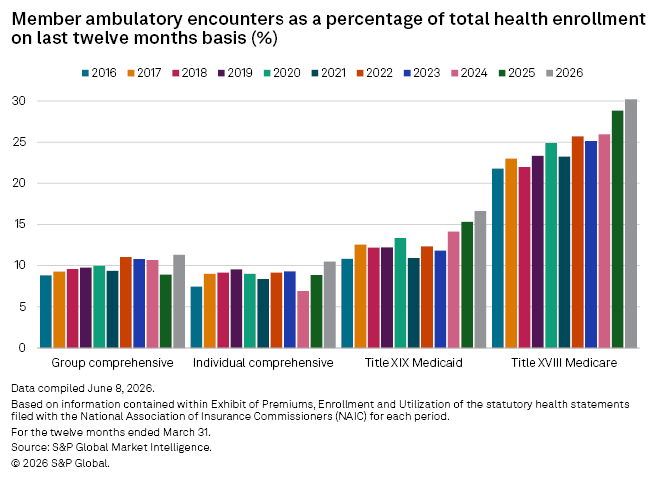
The utilization curve has not shown a clean reversion, even with pockets of deceleration discussed by management on conference calls. Medicare remains the main margin risk where ambulatory driven utilization intensity, downstream testing and specialist follow on care, and risk adjustment economics all interact. Health insurers need sustained level control of the ambulatory care pathway while using medical cost ratio and claims trend monitoring as leading indicators to determine whether 2025 levels mature into 2026 stabilization.
Higher ambulatory encounter volumes increase opportunities for Hierarchical Condition Category (HCC) capture and can support revenue, but they also raise governance exposure. HCC is a risk adjustment model used by the Centers for Medicare & Medicaid Services to predict future cost. Title XVIII Medicare shows the largest encounter acceleration both year to date and last 12 months in 2026, making encounter driven documentation a direct loss and revenue lever. That helps explain why insurers emphasize claims monitoring, payment integrity, and anomaly detection to limit avoidable leakage while protecting administrative processes that otherwise can convert into denials and later medical cost.
This article was published by S&P Global Market Intelligence and not by S&P Global Ratings, which is a separately managed division of S&P Global.