Research — June 12, 2026
FIFA World Cup 2026 set for record commercial impact
By John Paul O’Sullivan and Michael Johnson
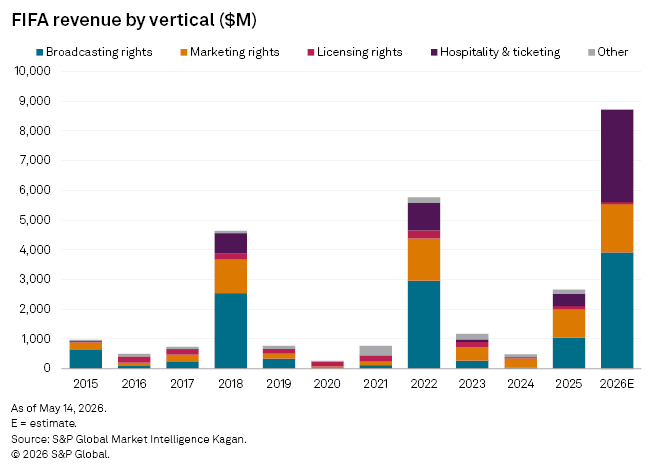
FIFA World Cup 2026 gets underway on June 11 after a structural overhaul that will make a record commercial impact. The tournament marks Fédération Internationale De Football Association's first format expansion in 28 years and will be its inaugural three-nation-hosted event, generating an estimated $9 billion for soccer's governing body this year, including $3.9 billion in media rights.

➤ FIFA's most commercially ambitious tournament to date will comfortably exceed Qatar 2022.
➤ The tournament expands from 32 to 48 participating nations as total games go from 64 to 104.
➤ World Cup 2026 will feature the tournament's largest-ever geographic footprint, hosted by 16 North American cities spanning three nations.

FIFA's annual revenue
The present quadrennial World Cup year is expected to yield record revenue, driven by broadcasting rights rising to about $3.9 billion, growth in marketing rights, and a surge in hospitality and ticketing revenue, with the US market particularly favorable to premium‑priced live events.
The commercial elevation of the Women's World Cup, youth tournaments, and the FIFA World Club Cup will support revenue growth outside of men's World Cup years. This was evident in 2025 through a $1 billion rights contract with DAZN Ltd. alongside several marketing rights deals for a successful World Club Cup in the US. The Women's World Cup event will benefit from a new USA and Canada streaming deal with Netflix Inc. starting in 2027.
FIFA's four-year cycle
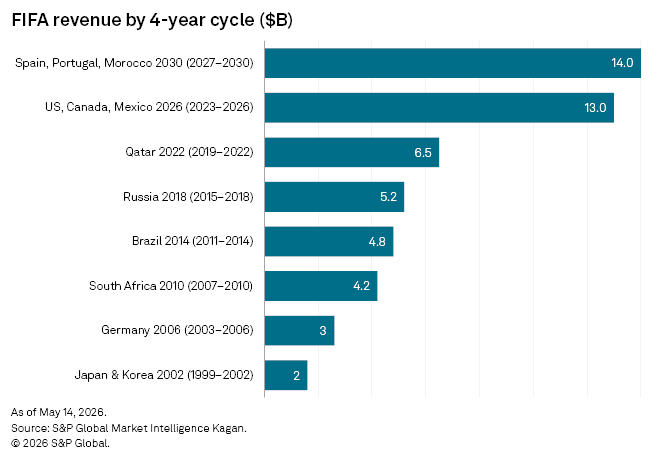
FIFA operates a four-year planning cycle ahead of the World Cup to facilitate pre-qualification tournaments across the regional federations. Commercially, it allocates tier 1 marketing rights for the entire four-year period, with additional opportunities within a World Cup year.
The federation has significant commercial confidence in the US, Canada and Mexico as hosts. Ticketing and hospitality will be well ahead of Qatar 2022, due to the unmatched price elasticity of sports events in the US market. FIFA expects ticketing for 2026 to be $950 million higher than for World Cup 2030 in Spain, Portugal and Morocco, making this event a generational opportunity.
Looking ahead, total revenue for the next cycle leading to the World Cup 2030 should be $1 billion higher, or 7.7%., with growth coming from media and marketing and licensing, rather than ticketing and hospitality.
World Cup Final viewership
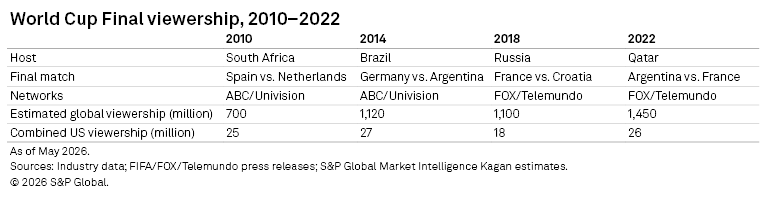
FIFA is forecasting 6 billion global engagements across TV, streaming and digital platforms for the entire tournament, up from 5 billion during Qatar 2022.
The 2022 final between Argentina and France attracted an estimated 1.5 billion viewers from over 200 countries. This figure encompasses traditional television audiences and viewers via streaming services, social media and live digital broadcasts, highlighting the event's expanding reach and the growing trend of younger fans tuning in via streaming platforms.
By comparison, the 2018 Russia final drew 1.1 billion viewers, and the 2014 Brazil final reached 1.12 billion. The surge in 2022 underscores the rapid growth of digital media consumption.
As the 2026 tournament unfolds across the US, Canada and Mexico, audience numbers are expected to soar even higher. The expanded format of three host nations, favorable broadcast times for viewers in the Americas, and the rising popularity of soccer in the US all support increased global viewership. FIFA also projects that over five million fans will attend the more than 100 matches in person, surpassing the attendance record set at USA '94, the last time the World Cup was hosted in the US.
US World Cup media rights
In the US, Fox Corp.'s Fox Sports holds exclusive English-language rights, while Comcast Corp.'s Telemundo Communications Group Inc. is the Spanish-language broadcaster. Together, they will air all 104 matches via linear television and streaming platforms. Notably, a record 40 matches will be broadcast in prime time, including 21 on FOX (US) and 19 on FOX Sports 1 (US), maximizing viewership opportunities. Every knockout match from July 4 onward, including the quarterfinals, semifinals, third-place match and Final, will be featured live on FOX.
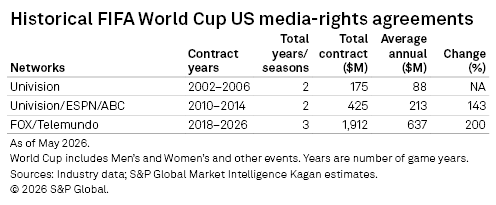
Fans can stream all 104 English-language matches on FOX One, while Comcast's Peacock will stream all games in Spanish. Telemundo is set to deliver an unprecedented 700 hours of World Cup programming, making it the most comprehensive Spanish-language broadcast in the tournament's history.
In Canada, Bell Media Inc. holds broadcast rights, ensuring comprehensive coverage for Canadian viewers across both television and digital platforms. Meanwhile, in Mexico, TelevisaUnivision Inc. and TV Azteca SAV de CV will air every match free-to-air, fitting the nation's role as host of the tournament's opening match at Estadio Azteca in Mexico City.
It's also notable that FIFA renewed its broadcasting rights contracts with FOX, Comcast's NBCUniversal Media LLC and Bell Media for the US and Canada back in February 2015, securing these key partnerships well in advance and without opening the process to competing bids.
Looking ahead, the tournament's continued growth is expected to spark intense competition for future US media rights beginning with the 2030 cycle. Several major broadcasters and streaming platforms — including Apple Inc., Amazon.com Inc. and Netflix — are expected to be strong contenders. Netflix has already secured rights to the 2027 and 2031 Women's World Cup.
Leading global deals
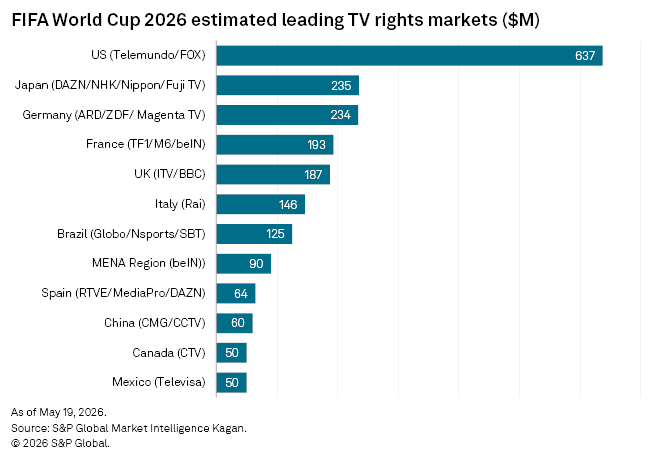
Our estimates indicate that just 12 markets generate well over half of FIFA's media deals, spanning TV, radio, digital and internet, led by the Fox-Telemundo arrangement in the US.
Valuations in Europe are constrained by free-to-air obligations for national team games, which are deemed culturally important. As such, there is a growing trend of terrestrial broadcasters holding rights to key games, with other matches going to commercial or subscription channels. An example of this occurs in Germany, where Magenta TV, a video offer from local operator Deutsche Telekom AG, purchases the local rights and licenses matches of the German national side to public broadcasters ARD and Zweites Deutsches Fernsehen, while retaining the rest exclusively for its own customers.
FIFA's pivotal, down-to-the-wire media rights deals in China and India mark a major boost to the World Cup's global reach, connecting billions of viewers in two of the world's largest markets. China Media Group secured exclusive coverage for four men's and women's tournaments through 2031 across TV and digital platforms, while Zee Entertainment Enterprises Ltd. will broadcast and stream 39 FIFA events in India from 2026 to 2034, including both World Cups.
TV rights buyers by territory
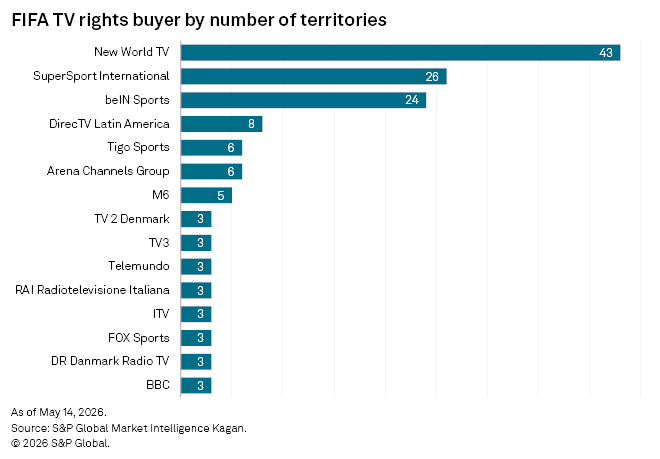
The largest deal by territory is held by the New World TV (NWTV) network, spanning 43 markets in sub-Saharan Africa. NWTV is a private Togo-based media company that secured funding from African Export-Import Bank (Afreximbank) in 2024 to pursue the acquisition of media licensing rights in the region. It plans to sublicense 34 free‑to‑air matches across its footprint and distribute them on pay TV in French-speaking regions. Supersport International Holdings Ltd., a subsidiary of South Africa operator MultiChoice Group Ltd., shares some rights with NWTV. They have the second-largest number of markets, while beIN Media Group controls most of the Middle East and North Africa (MENA) markets.
DIRECTV Latin America LLC has rights in eight markets across Latin America and Caribbean, Millicom International Cellular SAs Tigo Sports has six more South American markets, Arena Sports LLC controls six Balkan countries, and Fox Sports distributes in Puerto Rico and American Samoa as well as the US. Other buyers with just three territories tend to be related to markets with dependencies: for example, the United Kingdom's ITV PLC and British Broadcasting Corp. also pick up the Channel Islands and the Isle of Man, and Denmark's DR (Denmark Radio) holds rights in Greenland and the Faroe Islands. In addition, more than 100 buyers have a footprint in just one or two territories.
Economics of Networks is a regular feature from S&P Global Market Intelligence Kagan.
This article was published by S&P Global Market Intelligence and not by S&P Global Ratings, which is a separately managed division of S&P Global.
Content Type
Theme
Segment
Language