Research — June 3, 2026
Burberry set for FY27 growth recovery as China and US demand stabilize

By Cristalina Pinto
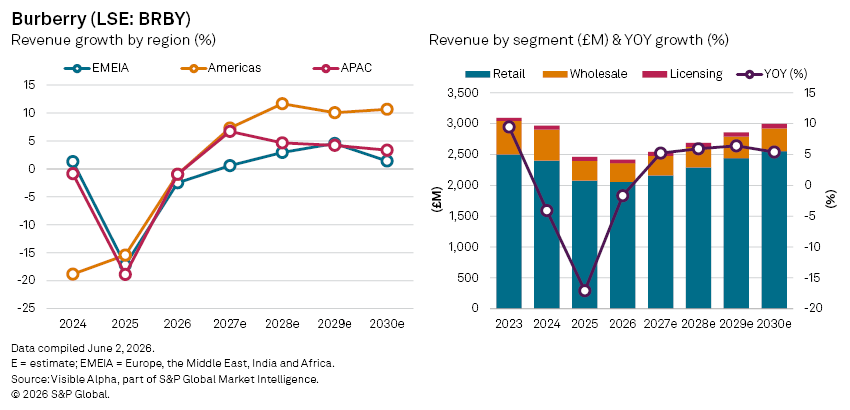
Burberry (LSE: BRBY) is set to return to growth in fiscal 2027 after three consecutive years of revenue declines, as the British luxury group attempts to reset its positioning in a cooling but normalizing global luxury market.
According to Visible Alpha consensus estimates, revenue is expected to rise 5.2% year-on-year to £2.5 billion in 2027, as the company leans on a recovery in key international markets and a strategic repositioning under its turnaround plan.
The rebound is expected to be driven by a recovery in both retail and wholesale channels. Retail revenue is forecast to increase 5.1% to £2.2 billion, while wholesale is projected to grow 4.4% to £316 million.
Geographically, APAC, is expected to lead growth, with revenues forecast to rise 6.7% year-on-year to £1.1 billion, reflecting expectations of improving consumer sentiment especially in Greater China, which has been volatile for global luxury brands since the post-pandemic reopening. Revenues from the Americas is also projected to rebound strongly, with sales up 7.3% to £542 million. By contrast, EMEIA sales are expected to remain broadly flat, growing just 0.6% to £826 million, although still recovering from declines seen over the last three years.
The recovery outlook comes as Burberry seeks to reposition itself more firmly within the core of the luxury market, refocusing on heritage categories such as outerwear, including its signature trench coats, while reasserting its British luxury identity. The group has also stepped back from heavy discounting and outlet-led growth, prioritizing tighter inventory control and a greater share of full-price sales in an effort to rebuild brand equity and support margins.
This article was published by Visible Alpha, part of S&P Global Market Intelligence and not by S&P Global Ratings, which is a separately managed division of S&P Global.
Content Type
Products & Offerings
Segment

