


Research — May 15, 2026
US bank fundamentals, returns stand up to market volatility
By Zain Tariq and Nathan Stovall
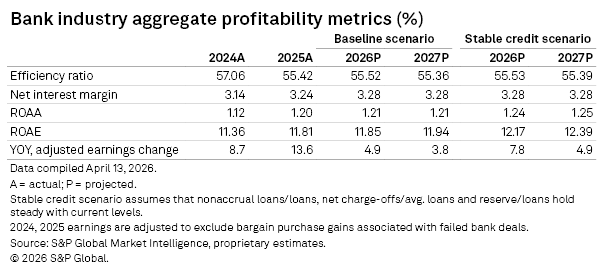
While banks will continue to benefit from the remixing of balance sheets, further net interest margin expansion could prove more challenging as the greatest relief funding costs are in the rear-view mirror. Still, even as credit quality continues to normalize, US bank returns will hold up amid economic uncertainty.

US bank earnings have continued to grow as strong margin expansion and benign credit quality supported performance. While credit costs should continue to normalize, we expect favorable results to continue, buoyed by consistently higher margins and steady loan growth. The positive fundamental landscape and a friendlier regulatory environment were expected to support stronger bank M&A activity, as acquirers saw deals as an attractive, faster way to gain scale. The fundamental environment remains conducive to deals, but recent market volatility has put some transactions on ice for now.

Click here to access the US Bank Market Report.
Click here to access data exhibits and the US banking industry's projections template.
Credit trends continue to normalize as the macro environment tests the consumer
The outlook for the fundamental environment for US banks was quite rosy heading into 2026. Bank market watchers expected continued net interest margin expansion, improving loan growth as deregulation and lower capital requirements took hold, and benign credit quality.
The positive sentiment began to turn in February, however, after a handful of losses in the private credit space and the gating of redemptions at business development companies emerged. Some investors questioned whether banks could have greater credit risks than previously realized, given the strong growth in loans to nondepository financial institutions over the last year. That pressure grew after a Citrini Research report outlined an economic scenario of what could go wrong if successful AI adoption has overly negative side effects, and it only grew further after the US-Israel war with Iran escalated and sent oil prices far higher. While bankers have acknowledged those risks, they have strongly downplayed the severity of those concerns and have maintained that their borrowing bases and US consumers have held up amid uncertainty.
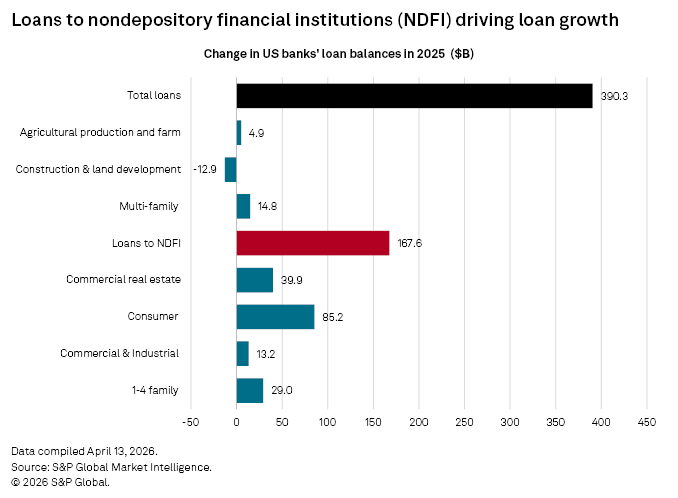
Banks continue to say they are sticking to strong underwriting standards and lending disciplines, and they continue to downplay their exposure to private credit. They also maintain that the US consumer remains in good shape despite a slower labor market and concerns in the market. We think loan growth could slow from 2025 levels as banks eye potential risks on the horizon and continue to face scrutiny over their exposure to private credit and loans to nondepository financial institutions. Loans to nondepository financial institutions (NDFI) drove much of the loan growth in 2025, causing some market watchers to question loan demand in more traditional lending segments.
We expect credit quality to normalize from current levels due to weakness in the US consumer and some stress in commercial portfolios, leading to a higher level of losses. Consumer delinquencies have risen from historical lows but have shown signs of stabilization in recent months. Still, the emergence of higher oil prices and recent weakness in the labor market could further test the consumer. Some argue that the current credit cycle is also long in the tooth, with the industry not having a significant credit event in more than 10 years. Others push back against that argument, however, noting that the banks heavily scrutinized and stress-tested their portfolios during the pandemic, the liquidity crunch of 2023 and after historically high tariffs emerged in the spring of 2025.
Banks also contend that the consumer and small businesses remain resilient. Many consumers took advantage of historically low rates to refinance their mortgages before the Fed began raising rates, reducing the impact that rate hikes would have on their debt service. Consumers and other borrowers are also expected to receive more relief in the form of additional rate cuts. Banks have seen delinquencies in their commercial and industrial and commercial real estate loan portfolios rise off of historical lows, but delinquencies showed signs of stabilization throughout 2025. Banks have reduced their exposure to CRE and have arguably benefited from private credit firms growing their market share and helping support the asset class.
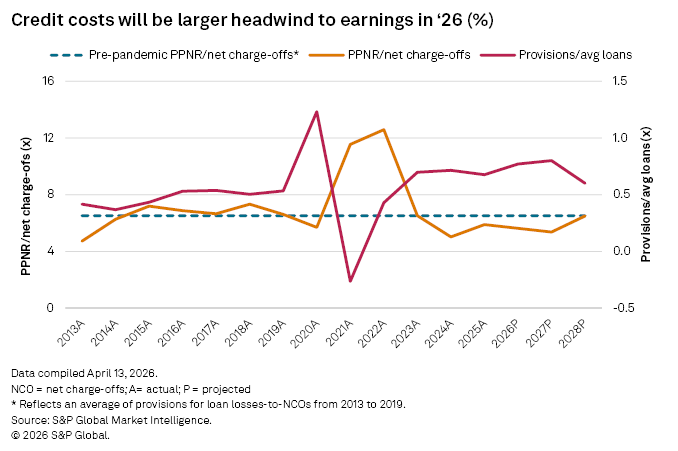
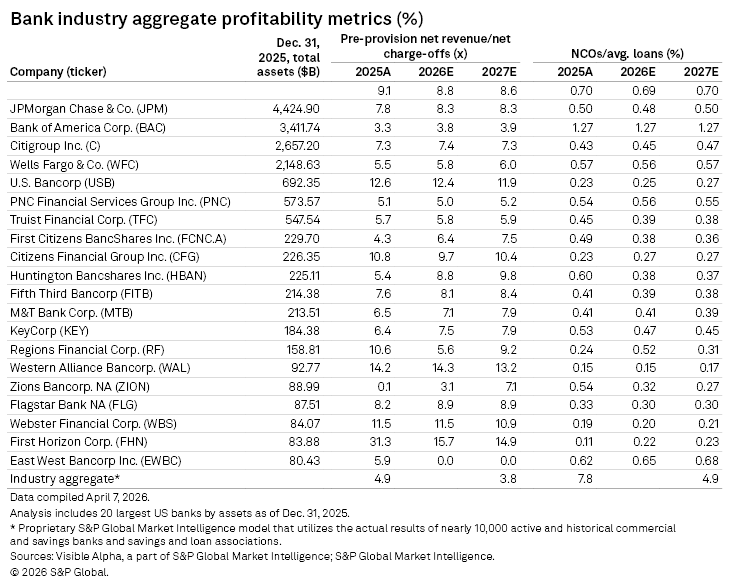
We expect higher loss content in the future, but to date, few problems have occurred. Provisions could grow to 21.1% of net revenue in 2026 from 18.7% in 2025. That ratio is expected to increase to 21.8% in 2027 as banks eye economic uncertainty. On average, from 2013 to 2019, banks' provisions equated to 14.6% of net revenue. The higher level of provisioning will serve as a modest headwind, but earnings are still expected to rise 4.9% year over year in 2026 and grow another 3.8% in 2027.
Many bankers and members of the sell-side community expect credit trends to remain stable. If that occurred, bank earnings would grow 7.8% in 2026 and another 4.9% in 2027. Many banks have already set aside considerable reserves for the most troubled projects. Reserves fell to 1.65% of loans in 2025 from 1.75% in 2024. We expect net charge-offs to rise modestly in 2026, but losses and the reserves required to fund them should serve as a modest headwind to earnings rather than a severe downturn. Banks are also expected to produce ample cash flows to cover losses that ultimately materialize.
Additional deposit cost relief could be modest
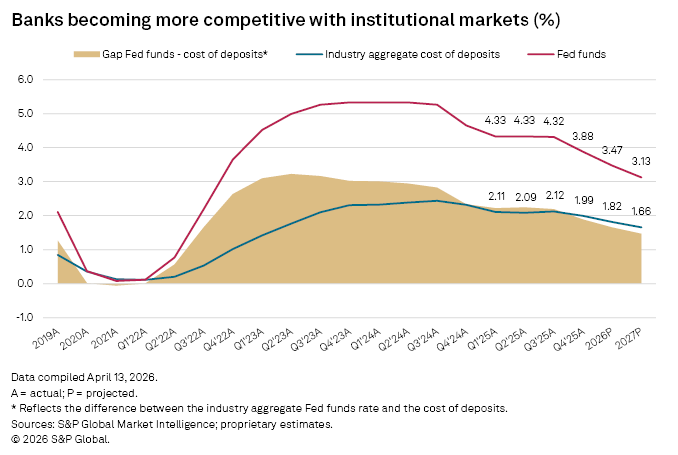
Deposit costs declined in the fourth quarter of 2025 as the impact of Federal Reserve rate cuts began to take effect and should decline further in the coming quarters, but additional decreases should come at a slower pace.
As short-term rates moved lower, banks became far more competitive with alternatives in the Treasury and money markets. The difference between the average fed funds rate and the industry's cost of deposits narrowed further in the fourth quarter of 2025 to the smallest gap recorded since the third quarter of 2022, when the Fed was still early in its tightening campaign. That gap should narrow modestly in 2026 as banks seek to lower their deposit costs while staying competitive with higher-yielding alternatives to grow their deposit base. Many banks that have reported first-quarter earnings managed notable declines, with the median cost of deposits falling 14 basis points quarter over quarter among nearly 200 banks. We expect declines in future quarters to be smaller.
A key driver of deposit costs will be the maturity schedule and market rate for certificates of deposits. Most institutions have significantly increased their reliance on CDs for funding since the Fed started raising short-term rates early in 2022. Many CDs carry one-year terms, meaning that many of the highest cost CDs originated when deposit pricing was at its peak, have already matured. When CDs mature, most banks have to meet market rates to retain the deposits. CD rates began declining late in the third quarter of 2025, and few institutions now offer products at rates above 4%. The number of institutions offering rates above 3.5% held steady through the end of 2025 but began to drop more notably in the first quarter of 2026. The number of banks marketing one-year CDs over 3.5% included 590 institutions as of March 27, down from 710 institutions as of Jan. 2, 2026, and 988 institutions as of Sept. 26, 2025.
Deposits should grow further as bank rates become more competitive with alternatives. We expect deposits to grow 4.25% in 2026 and for non-interest-bearing deposits to become a larger portion of banks' funding bases after declining for four straight years. Between year-end 2021 and year-end 2025, non-interest-bearing deposits fell 29%, while interest-bearing deposits grew 14%. The decline pushed the industry's non-interest-bearing concentration down to 20.1% of total deposits at year-end 2025 from 25.9% at year-end 2022 and 28.9% at year-end 2021. We expect non-interest-bearing deposits to rise to 20.3% of deposits by year-end 2026.
Looking ahead
The fundamental environment heading into 2026 was favorable for US banks, punctuated by improving net interest margins, relatively benign credit quality trends and stronger valuations that gave institutions more options to pursue restructuring and growth, including through M&A. A friendlier regulatory environment was also expected to support far greater deal activity. Some of those positives remain in place. The regulatory environment has changed. Previously announced acquisitions have received speedier regulatory approval, while larger banks have come back into the acquisition arena. Some banks will also record some benefit from the remixing of balance sheets as lower-yielding assets roll off and are replaced with higher-yielding new loans or securities.
Some strategic actions are on hold amid the volatility in the markets, but the drivers of bank deals remain in place, and more transactions will ultimately come to fruition as institutions seek scale, face shareholder activism and seek to act while they have the capital and investor and regulatory support to do so. The industry still has plenty of would-be sellers as well. While we expect favorable returns across the industry, many institutions still are not earning their cost of capital and could risk losing relevance in their market. For many other institutions, fundamentals remain positive, and the healthy performance and positive credit quality are expected to continue throughout 2026, even as interest rates are likely to remain higher than previously expected. Still, 2026 could prove a show-me story for banks as some investor fears will persist until results counter the bear case.
This article was published by S&P Global Market Intelligence and not by S&P Global Ratings, which is a separately managed division of S&P Global.