Research — May 28, 2026
Progressive now No. 1 US private auto insurer for full 12 months, estimates show
By Husain Rupawala, Jason Woleben, and Tim Zawacki
There is a new US private auto market share leader on a 12-month basis for the first time since World War II, S&P Global Market Intelligence estimates.

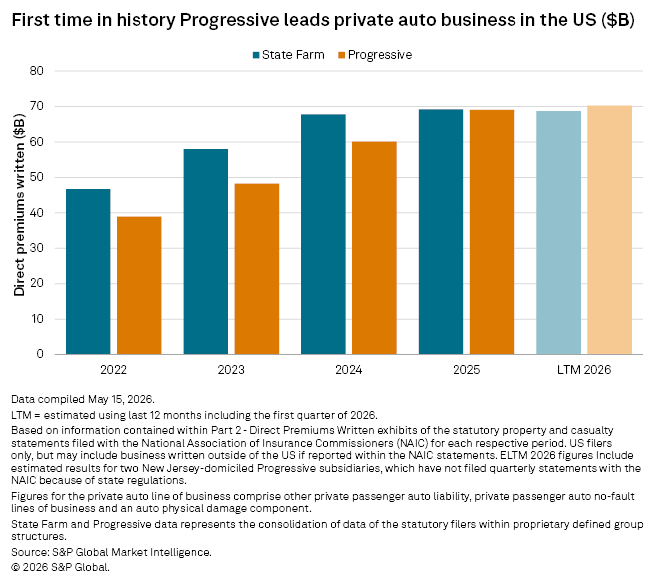
Private direct premiums written for the trailing-12-month period ended March 31 by the US subsidiaries of The Progressive Corp. surpassed those generated by the group led by State Farm Mutual Automobile Insurance Co. by more than $1.57 billion, based on our analysis of disclosures in first-quarter 2026 statutory financial statements and select, limited proprietary estimates. This marks the first time that Progressive's market share over a 12-month span has surpassed that of State Farm, which had ranked as the No. 1 US private auto insurer since 1942 — five years before Progressive's founding.
We previously estimated that Progressive outpaced State Farm in the third quarter of 2025, but seasonality in individual private auto books of business often leads to considerable variability in quarterly volumes.
Disparate growth rates for the two insurers made it seemingly inevitable that Progressive would surpass State Farm on a full-year basis in 2026 after the latter entity held onto the No. 1 spot in 2025 by only a razor-thin margin. Progressive has continued to expand its private auto writings at much faster rates than most of its peers and the US property and casualty industry as a whole in recent years, and its first-quarter results imply that trend has persisted into 2026.

Methodology and estimates
S&P Global Market Intelligence plans to post first-quarter statutory results on or about May 20, with trailing-12-months' data scheduled for posting the following day. When the data becomes available, it will show State Farm continuing to maintain a slight lead over Progressive on a trailing-12-month basis. However, Progressive's publicly available quarterly results are artificially depressed by the absence of data for two New Jersey-domiciled subsidiaries that generated combined 2025 private auto direct premiums written of $2.45 billion. Public dissemination of quarterly statements for New Jersey-domiciled insurers is prohibited by state statute, requiring us to rely on past-calendar-year results and other inputs to estimate the two entities' contributions.
To collect the as-reported data, we used an internal tool to extract direct premiums written data from Part 2 of the March 31 quarterly statements for all Progressive and State Farm entities that wrote any direct private auto business in 2025. We then independently verified all extracted data using hard copies of the filings posted on S&P Capital IQ Pro.
Based on the aggregation of available statutory results from 43 entities, we calculate that Progressive generated private auto direct premiums written of $18.11 billion in the first quarter, compared with $17.07 billion for the eight private auto writing State Farm entities. This marks the first time that Progressive passed State Farm in a single quarter on an unadjusted basis. For the trailing 12 months ended March 31, as-reported results show Progressive and State Farm with private auto direct premiums written of $67.76 billion and $68.68 billion, respectively.
When we adjust the Progressive results to incorporate production estimates for the two New Jersey companies, we arrive at ranges of $18.64 billion to $18.72 billion for the first quarter and $70.15 billion to $70.22 billion for the trailing-12-month period. The low end of the estimated ranges assumes quarterly seasonality consistent with the levels reported by Progressive Garden State Insurance Co. and Drive New Jersey Insurance Co. when their quarterly data was available in years prior to 2010. The high-end estimate allocates an equal 25% share of the companies' full-year 2025 direct premiums written to the second, third and fourth quarters of 2025. In both scenarios, we very conservatively assume flat direct premiums written growth for the first quarter relative to estimated volumes from the year-earlier period.
We presume that our methodology understates Progressive's lead for both time frames, given that the New Jersey companies saw a 41.2% spike in private auto direct premiums written in full-year 2025, with as-reported Progressive first-quarter results showing growth of 7.2%. Progressive reported $18.91 billion in net premiums written in its personal agency and direct vehicle lines in its first-quarter 10-Q filing. Our analysis of company disclosures in monthly earnings releases finds trailing-12-month personal vehicle net premiums written of $70.83 billion, an 11.6% increase relative to the comparable period ended March 31, 2025. State Farm, in contrast, saw its private auto business contract by 2.8% in the first quarter and by 0.1% for the trailing-12-month period.
Progressive gained 210 basis points of market share on State Farm in 2025, leaving the companies with only 4 basis points of separation at year-end. The two groups combined to account for 37.2% of the industry's private auto premium volume, an increase from 35.5% in 2024.
On a standalone basis, Progressive added 187 basis points of market share in 2025, while State Farm lost 13 basis points, following a 21-year high in 2024 of more than 18.8%.
Historically favorable underwriting results in the private auto business in 2025 have brought a significant increase in competition in a market that saw considerable retrenchment amid elevated loss-cost inflation from the second half of 2021 through the first part of 2024.
Progressive leapfrogged Berkshire Hathaway Inc.'s Geico Corp. as the nation's No. 2 private auto insurer in 2022. While Geico has emphasized profitability over growth in recent years, it, too, had long aspired to the top position that its rival has now attained. The Allstate Corp. was State Farm's closest private auto competitor from a market-share perspective before being surpassed in the second-place spot by Geico in 2013.
Over the past 30 years, Progressive has leveraged evolution in technology and consumer behavior to transition from largely a nonstandard auto insurer to a standard-market powerhouse in both the independent agency and direct-to-consumer distribution channels. During that time, the company's private auto market share has expanded by upwards of 16 percentage points, positioning it as the industry leader — a status it already attained in the commercial auto market more than a decade ago.
This article was published by S&P Global Market Intelligence and not by S&P Global Ratings, which is a separately managed division of S&P Global.