Research — May 21, 2026
North America renewable energy trends: Shifting winds, sunnier skies

By Tanya Peevey, PhD
Renewable energy's success in North America hinges not just on building more power plants to meet growing power demand, but also on the sun and the wind themselves. A deep dive into 35 years of climate data reveals notable regional trends, showing that some areas are trending sunnier and windier, directly impacting the potential for future energy generation. While large-scale solar and wind capacity is mostly concentrated in a few key states, a review of historical climate highlights potential opportunities and challenges across the continent.
Solar
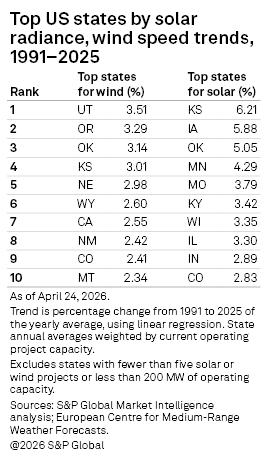
Between 1991 and 2025, solar radiation increased across most of North America, with only five locations experiencing a decrease, all in the Northeastern US totaling 5.3 GW in operating capacity. Great Plains states of Kansas, Iowa and Oklahoma had the largest increases, each above 5%, though operating solar capacity in the three states was limited, led by Iowa at just 700 MW. US annual solar radiation fluctuated during the period, ranging from a 2.5% positive deviation from the climatological average in 2022 to a negative 2.2% deviation in 1991.
Solar radiation increased in Canada and Mexico by almost 2%. All states and provinces analyzed in this study grew a minimum of 1%, with Alberta and Mexico's Coahuila seeing the highest growth of 2.6%.
Recent scientific research has found that some of the imbalance in Earth's solar energy budget — the balance between the amount of energy entering and leaving the Earth system — can be attributed to changes in global cloud cover. Satellite weather imagery over 35 years showed that the tracks of the midlatitude storms shifted toward the poles, shrinking cloud coverage.
Wind
The western half of the US increased in 100-meter wind speeds during the period. Wind speeds trended upward the most in Utah, rising almost 4%, and all but one of the states in the region experienced an increase of at least 1%. In the Great Plains, wind powerhouses Kansas and Oklahoma — with total wind capacities of 9.6 GW and 13.7 GW, respectively — also experienced a minimum wind speed growth of 3%. Whereas states surrounding the Great Lakes, some with comparable total wind capacity, had a wind speed increase of less than 1%. Annual wind speed departures from climatology were lowest for Kansas and Oklahoma in 1992, with a negative deviation of about 3.0%, and highest in 2022, with values close to 5%.
Our earlier research in 2022 showed wind speeds increasing across the whole US, but that study leveraged 22 years of data rather than 35 years. With the expanded dataset, increases in the wind speeds is less pronounced across the US, especially in the Northeast. This could be attributed to the recent shift in the phase of the Pacific Decadal Oscillation — a decadal-scale ocean-atmosphere climate variability pattern centered over the mid-latitude North Pacific — from positive to negative, which is attributed to a slowdown prevailing westerly winds over the US.
Canada's wind speed increased over the 35-year period in all provinces as per available data, growing fastest in the eastern provinces, with Quebec, Prince Edward Island and New Brunswick trending upward by more than 2%. In western Canada, British Columbia also experienced an increasing wind trend of 2.5%. In Mexico, changes in wind speed were nominal in three states. Oaxaca had the country's highest wind capacity of 2.8 GW and a decreasing trend of negative 3.2%. Yucatán also had slowing wind speeds, with a trend of negative 3.3%.
US summary
The Northeastern US experienced an overall decrease in wind speed and solar radiation over the 35-year period relative to climatology, whereas the Western US showed consistent growth in both. The Great Plains and Midwest led the nation in solar radiation growth, followed by the Southeastern US. Wind speed changes in the Southeast could not be determined, as our methodology requires four or more power plants with at least 200 MW of capacity to be operating in the state. Hawaii showed minimal change in solar radiation but a decrease in wind speed of negative 12%, the largest of all the states.
The wind speed and solar radiation trend of about 2% growth across the US equates to capacity factor increases of 4 percentage points for wind and 1.6 percentage points for solar, bolstering the financial outlook for existing and future power plants. This relationship — a 1% increase in wind speed and solar radiation translates to 2% and 0.8% respective capacity factor increases — is derived from existing monthly power plant data and the coincident weather data across the US and thus cannot be applied to other countries.
Solar radiation is the mean surface downward shortwave radiation flux, from the fifth-generation European Centre for Medium-Range Weather Forecasts reanalysis. This variable includes direct and diffuse solar radiation and is the model equivalent of global horizontal irradiance — the value measured by a pyranometer, a solar radiation measuring instrument. The solar radiation variable in this dataset does not include the effects of aerosols, such as ash from fires, in its computation. Wind speed is the value 100 meters above the ground from the same dataset.
The data is available at quarter-degree latitude and longitude intervals, with a spacing of slightly more than 27.5 km. This analysis compares annual average data from 1991 to 2025 with the climatology, defined as the 30-year average from 1991 to 2020. Reported trends are based on the percentage change in annual values from 1991 to 2025, calculated using linear regression. All capacity figures in this article are based on utility-scale projects tracked by S&P Global Market Intelligence.
Data visualization by Jonathan Lalgee.
For wholesale prices and supply and demand projections, see the S&P Global Market Indicative Power Forecast.
Regulatory Research Associates is a group within S&P Global Energy.
S&P Global Energy produces content for distribution on S&P Capital IQ Pro.
Kristin Larson contributed to this article.
This article was published by S&P Global Market Intelligence and not by S&P Global Ratings, which is a separately managed division of S&P Global.
Regulatory Research Associates is a group within S&P Global Energy.
S&P Global Commodity Insights produces content for distribution on S&P Capital IQ Pro.
For a full listing of past and pending rate cases, rate case statistics and upcoming events, visit the S&P Capital IQ Pro Energy Research Home Page.
For a complete, searchable listing of RRA's in-depth research and analysis, visit the S&P Capital IQ Pro Energy Research Library.
This article was published by S&P Global Market Intelligence and not by S&P Global Ratings, which is a separately managed division of S&P Global.