Blog — 09 May, 2026
MWC 2026: Non-terrestrial networks shift from hype to commercial reality

Article Highlights
- In the near term, D2D may remain a niche service for messaging and emergencies rather than a true extension of the mobile broadband experience.
- According to GSMA Intelligence, as of December 2025, 118 mobile operators had established satellite service partnerships, with 33 of those services already live — an increase of five in the last quarter alone.
- The adoption of 3GPP standards, with Release 19 being a key milestone, was repeatedly cited at MWC's NTN Summit as essential for achieving the economies of scale necessary for mass-market adoption.
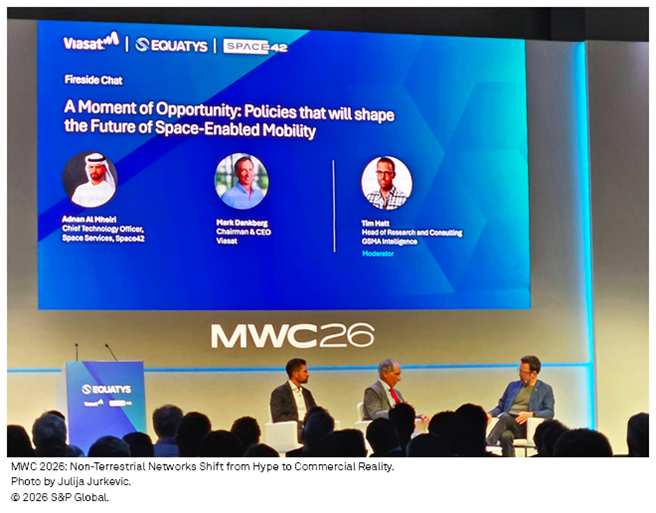
At Mobile World Congress 2026, held March 2–5 in Barcelona, Spain, the conversation around non-terrestrial networks (NTN) reached a new level of maturity, shifting from future-gazing to near-term commercial strategy. The consensus across keynotes, panels and private discussions was that the industry has moved past proof-of-concept and is now entering the era of deployment. The industry tone is now pragmatic: Operators, vendors and satellite providers are focused on capacity limits, integration architectures and credible business models rather than marketing slogans. As Antonio Franchi, head of the space for 5G and 6G strategic program at the European Space Agency SA, stated in his keynote address, NTN is "no longer complementary, but... foundational" to the global network architecture.
'Go time' for commercialization
The industry has reached an inflection point, with speakers consistently framing 2026 as "go time" for NTN services. This sentiment is backed by market data and operator announcements. According to GSMA Intelligence, as of December 2025, 118 mobile operators had established satellite service partnerships, with 33 of those services already live — an increase of five in the last quarter alone.
This momentum is set to accelerate. Iridium Communications Inc. announced that its 3GPP standards-based NTN service will go live in the second half of 2026, with commercial customers and beta testers already being brought on board. The launch of a direct-to-device (D2D) service by KDDI Corp. and Space Exploration Technologies Corp. in Japan in April 2025, which has attracted 3.5 million subscribers by August, shows strong early demand for the service, particularly in large markets with challenging geography. The central question at MWC was no longer if NTN would become a reality, but how it would be deployed and monetized at scale.
Performance and capacity
Right now, D2D services remain effectively "3G-like." Spectrum for satellite-to-handset is scarce, and phone antennas are not optimized for space links, constraining throughput and forcing careful traffic management. Operators such as KDDI have introduced "satellite mode" to throttle background traffic and restrict app usage, improving stability but making the experience anything but seamless. In the near term, D2D may remain a niche service for messaging and emergencies rather than a true extension of the mobile broadband experience.
The monetization challenge
While launches are imminent, the question of revenue models remains largely unresolved. Speakers across multiple sessions acknowledged that mobile network operators (MNOs) are still grappling with the economics. Brian Aziz, vice president of global sales at Iridium, noted that MNOs are "wrestling with" the monetization question, observing the market's reaction to early efforts like T-Mobile US Inc.'s in the United States.
Two primary models are being considered:
- A premium service: charging consumers an additional fee for ubiquitous satellite connectivity. The "willingness to pay" for such a service was a frequent topic of debate, with no clear consensus emerging.
- A value-add for churn reduction: bundling basic satellite connectivity, such as emergency SOS and two-way messaging, into existing plans as a retention tool. That improves churn metrics but does little to offset the heavy operating expenditures and capital expenditures of integrating NTN into the mobile core and radio stack.
Convergence of standards and technology
Underpinning the commercial push is a significant convergence in technology and standards. The adoption of 3GPP standards, with Release 19 being a key milestone, was repeatedly cited at MWC's NTN Summit as essential for achieving the economies of scale necessary for mass-market adoption. Standardization allows NTN capabilities to be integrated into the same chipsets and devices used for terrestrial networks, avoiding the high cost and friction of proprietary satellite phones and modems.
Beyond the handset: IoT-NTN convergence
While D2D for consumer smartphones was a popular buzzword, a substantial part of the NTN discussion focused on enterprise and internet of things applications. Brian Aziz of Iridium was particularly "bullish on IoT and NTN," explaining that standards-based connectivity opens up vast, cost-sensitive markets like smart metering and agriculture that were previously unreachable with expensive proprietary hardware. The ability to use a single SIM and a single device to connect to both terrestrial and satellite networks is a key enabler for massive IoT deployments where coverage is not guaranteed. George Kanuck, COO of Mariota, echoed this, noting his company's strategy is to design satellite performance around specific IoT use cases, as demonstrated by its Hyperpulse 5G NTN network.
Antonio Franchi of the European Space Agency and other speakers also identified critical markets set to rely on NTN, including automotive, maritime, aviation, government and military sectors, where resilient, secure, and truly global connectivity is a requirement.
Neutral host/MNE model
One architecture that kept coming up in discussions is the neutral host, or mobile network enabler (MNE), model. In this setup, the satellite operator effectively behaves like a "cell tower in the sky," using the MNO's licensed spectrum so that subscribers never formally leave the operator's domain. This model is attractive to MNOs because it allows them to maintain "customer sovereignty," as the user never technically roams onto a different network. It also addresses national interests in data sovereignty by keeping communications within a country's or region's established network framework.
For an overview of Tower Summit at MWC 2026, please see this article.