Research — April 9, 2026
US E&S industry growth rate dips into single digits in 2025
By Jason Woleben, Husain Rupawala, and Tim Zawacki

➤ US domestic excess and surplus direct premiums surpassed the $100 billion mark for the first time; however, growth has slowed to its lowest level since the 5.3% year-over-year increase in 2017. The industry’s total direct E&S premiums written nationwide reached $105.31 billion, up 7.8% from the prior year. This is the first time in six years that the industry has not achieved a double-digit annual growth rate. For more information on what we consider to be E&S business, please see the methodology note at the end of this article.
➤ A tale of two stories within the E&S property market in 2025, reflecting cyclical dynamics. E&S commercial property shifted from a growth engine to a drag in 2025. Increased competition accelerated renewal pricing declines that contributed to premiums decreasing for the first time since 2017. The combined commercial property business lines (fire, allied lines and non-liability portion of the commercial multiperil line) declined 2.8% to $27.69 billion in direct premiums written during 2025. In sharp contrast, E&S homeowners direct premiums written surged to $4.14 billion, up 29.5% over 2024, underscoring continued displacement from the admitted market and sustained demand for non-admitted solutions.
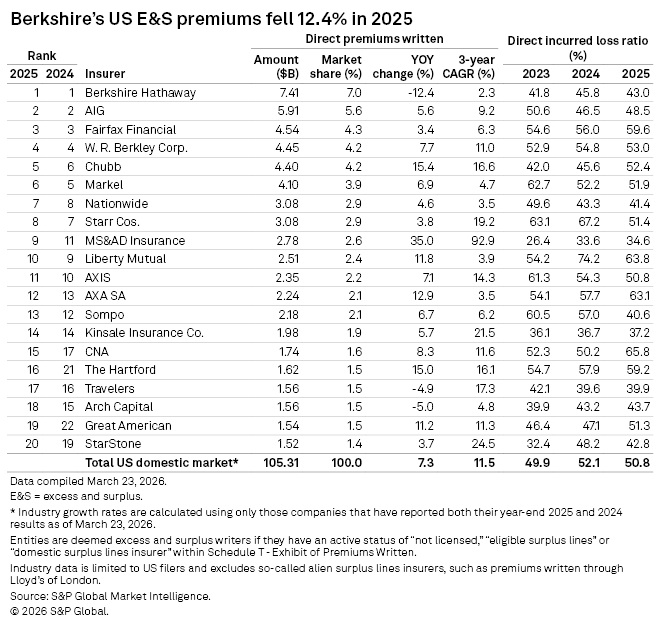
➤ Berkshire Hathaway Inc.'s sharp pullback from the E&S property market led to a 12.4% decline in its overall E&S premiums in 2025, the largest drop among major E&S insurers. Its total E&S property business line premiums dropped 22.7% to $3.10 billion, with the most significant decline occurring in commercial multiperil non-liability, which decreased 70.3% year-over-year to $192.6 million. Despite these declines, Berkshire Hathaway remains the nation's largest E&S underwriter, with $7.41 billion in direct premiums written.

The 2025 result represented a marked slowdown from the double-digit growth rate in each of the past six years. We limited the comparison to entities that have filed 2025 results so as to not artificially understate the growth rate. At the time of publication, there were about a dozen insurers representing roughly $500 million in direct premiums written in 2024 that have yet to file their most recent year results.
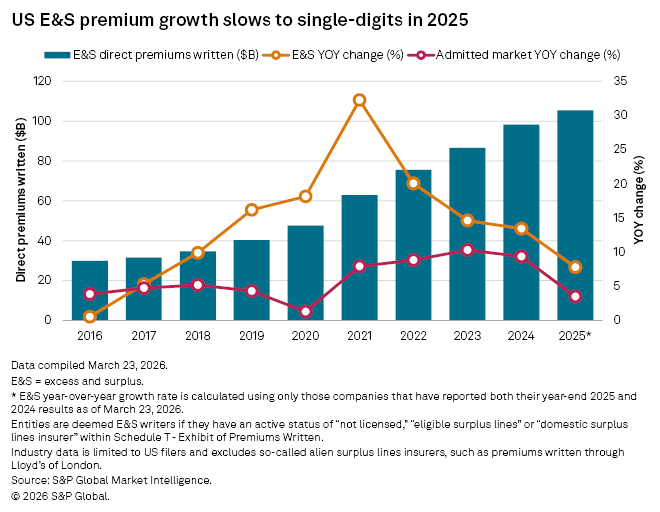
Even as we await data for those companies, the US-domiciled E&S market reached $105.31 billion in 2025, the first time the market surpassed $100 billion in direct premiums written. The premiums mainly flowed into three coverage buckets, various liability and casualty coverages (54.9%), several property lines of business (30.2%) and commercial auto (5.6%).
Property business lines
Exceptional premium growth within the E&S property market contributed significantly to the overall growth in the space over the past several years. However, increased competition in the commercial property market among admitted and non-admitted insurers drove down pricing in 2025, which contributed to the year-over-year declines in premiums written within the market.
The declining commercial property renewal rates occurred throughout the year, but the fourth quarter "marked an intensification of some of these property pricing trends", according to Janice Hamilton, CFO of wholesale E&S-focused distributor Ryan Specialty Holdings Inc. during its fourth-quarter earnings call.
Hamilton noted large account rate decreases ranged from 25% to 35% during the quarter, a larger drop then seen earlier in the year and a trend that is expected to continue. She also mentioned that some small commercial businesses began moving back to the admitted market, although the shift has not been significant.
E&S underwriter Kinsale Capital Group Inc.'s segment-level results may have been indicative of broader trends in the E&S market as the company reported its commercial property gross premiums decreased to $374.4 million in 2025 from $456.2 million the previous year, while small commercial property rose 33.4% to $102.4 million.
Kinsale's commercial property segment underwrites property such as first-party coverage on manufacturing facilities, government and municipal buildings, professional buildings, offices and general commercial properties, vacant properties, as well as entertainment and retail facilities.
The E&S direct premiums written within the aggregated commercial property business lines were $27.69 billion in 2025, a decrease of 2.8% from the prior year. Allied lines and fire are considered commercial property within S&P Global Market Intelligence classifications, but those business lines may include business related to personal property as well. The statutory data does not differentiate between the various types of property covered within the reported business lines.
A further breakdown of the individual statutory commercial property lines reveals that allied lines experienced the largest decline, with direct premiums falling 5.4% to $9.68 billion. Fire premiums decreased by 4.0%, totaling $12.13 billion in 2025. In contrast, commercial multiperil non-liability premiums increased by 4.7%, reaching $5.88 billion.
While commercial property experienced overall decline in premiums for the year, the homeowners business line continues to grow at a robust rate. The E&S homeowners market is becoming an important and growing area, particularly in response to industry volatility, carrier retreats from the admitted market and climate impacts in catastrophe prone states such as California, Colorado, Florida and Texas.
The US-domestic E&S market surged to $4.14 billion in 2025, compared to $3.20 billion during the prior year. This marks the third straight year the growth rate was above 20%, reflecting a three-year compound annual growth rate of almost 34%.
Berkshire's E&S premiums fall by double-digits
Berkshire Hathaway's statutory results showed lower premiums across each the statutory reported property business lines, leading to its double-digit decline in E&S volume. The 70.3% year-over-year decrease in commercial multiperil non-liability was the most significant, with reported direct premiums of $192.6 million in 2025 versus $648.2 million the prior year.
In aggregate, Berkshire's E&S property business line had $3.10 billion in direct premiums written in 2025, a decrease of 22.7% from the previous year. The two other major E&S business lines to post year-over-years declines were the claims-made and occurrence components of the other liability line, which fell 12.8% and 2.6%, respectively. Berkshire's commercial auto E&S direct premiums showed that largest annual gains for the carrier, rising 34.9% to $327.8 million.
Despite Berkshire's double-digit premiums decline, the insurer remains the nation's largest E&S underwriter in 2025, with $7.41 billion in direct premiums. New York-based American International Group Inc. remained the second-largest E&S underwriter in the US and grew its E&S direct premiums to $5.91 billion during the year, up from $5.60 billion in 2024.
Among the country's 20 largest E&S underwriters, The Travelers Cos. Inc. and Arch Capital Group Ltd. were the only carriers to report lower premiums in 2025 apart from Berkshire. Arch Capital's direct E&S premiums were $1.56 billion, down 5.0%, while Travelers' premiums declined 4.9% to $1.56 billion.
Methodology
E&S results are derived from an S&P Global Market Intelligence template that scans Schedule T of annual and quarterly statutory statements for individual entities to identify those companies that list their status as "not licensed," "eligible surplus lines" or "domestic surplus lines insurer." They exclude those entities whose active status in a particular geography shows as "licensed or chartered," "non-domiciled risk-retention group" or "qualified or accredited reinsurer."
Data is limited to US filers and excludes so-called alien surplus lines insurers, which cover US risks but are domiciled in other countries and do not file annual statutory statements with the NAIC.
This article was published by S&P Global Market Intelligence and not by S&P Global Ratings, which is a separately managed division of S&P Global.
"Street Talk" is a podcast hosted by S&P Global Market Intelligence that takes a deep dive into issues facing financial institutions and the investment community.