Research — April 30, 2026
Simandou's iron ore shipments signal major industry shift
By Jason Holden and Althea Keziah Liwanag
The departure of the first iron ore shipments from Guinea's new deepwater port at Morebaya is more than just a milestone — it is a signal that China's multi-decade push for resource security is entering a new phase. As the world's largest untapped source of high-grade ore, Simandou Blocks 1 & 2 and Simandou Blocks 3 & 4 sit at the heart of efforts to diversify supply away from Australia and Brazil and drive the green steel transition. While official timelines have always been ambitious, independent vessel tracking now offers confirmation that progress is happening on the ground.
Using Commodities at Sea's vessel tracking data, this article provides an assessment of the project's initial ramp-up.

➤The first wave of iron ore shipments from Guinea's Morebaya Terminal confirms that the project has officially moved from development to operational status.
➤ All initial cargoes are destined for major Chinese ports, with some shipments going directly to end users, such as steel giant China Baowu Steel Group Co. Ltd., confirming the project's strategic offtake agreements are in effect.
➤ The key stakeholders, Rio Tinto PLC and Winning International Group Pte Ltd.., are actively chartering large Capesize and Newcastlemax vessels, signaling a large-scale operation from the outset.

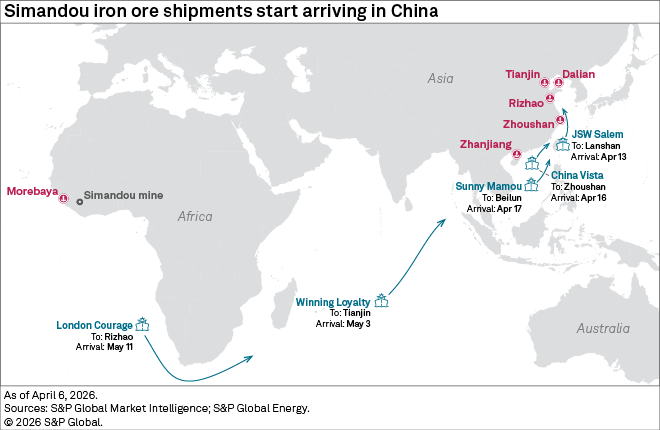
A steady stream of shipments has been departing from the new Morebaya Terminal. A look at recent vessel movements reveals a flow of Capesize and Newcastlemax bulk carriers, each laden with substantial cargoes. The initial shipment carried by Winning Youth departed Guinea on Dec. 2, 2025, arriving at Majishan Port in Zhejiang, China, on Jan. 17, 2026.
Subsequently, the Sunny Mamou departed in late February with 202,170 metric tons of iron ore, followed shortly by the China Vista carrying 88,112 mt. The involvement of key project stakeholders is clear, with vessels such as RTM Cartier loading 201,397 mt and ships linked to Winning International, such as the Winning Spirit, carrying another 175,629 mt. These shipments are destined exclusively for major Chinese ports, including Yantai, Shanghai and Qingdao, underscoring Simandou's strategic role. Critically, some cargoes have been received directly by end users, with the Great Sui and Winning Youth delivering a combined total of more than 282,000 mt to the Majishan Ore Terminal, operated by steel giant China Baowu Steel.
Company guidance and ramp-up trajectory
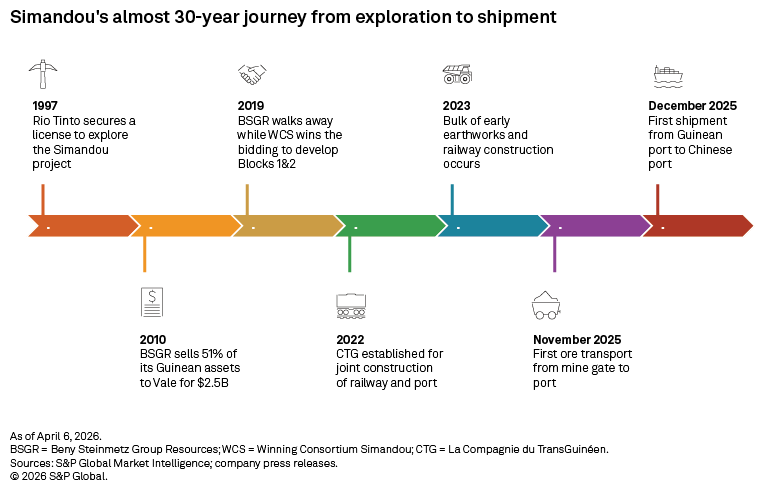
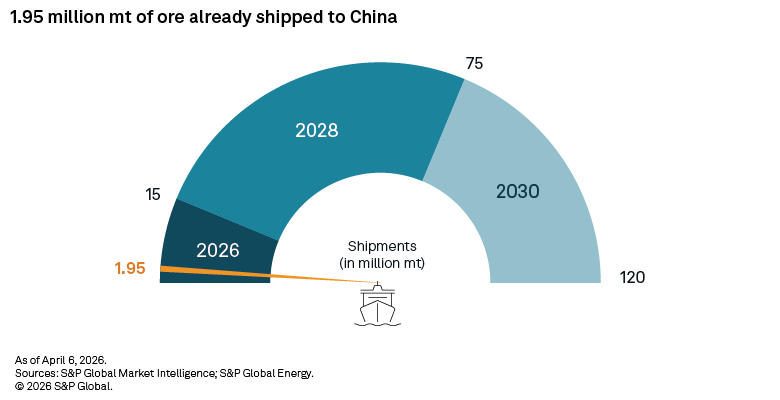
The shipping activity observed aligns with the official project timelines from the two main consortia, Rio Tinto's Simfer SA and Winning Consortium Simandou Pte Ltd. This aligns with guidance from both consortia, targeting a combined total capacity of 120 million mt/y, with each operation contributing 60 million mt/y. The first ore shipments in January 2026 confirm that this crucial milestone has been met, transitioning Simandou from a development project to a producing asset. The current shipments represent the initial phase of a multiyear ramp-up. Since most of the ships utilized for Simandou exports are in-house, they have not yet shown up on the Capesize market. The key question is how quickly the project can scale from these inaugural cargoes to the sustained, high-frequency pace required to meet its ambitious annual targets.
Strategic implications: China, green steel and geopolitical risk
Beyond the immediate tonnage, these initial shipments from Simandou carry profound strategic implications for the global steel industry. For China, the primary recipient, this represents a tangible success in its multi-decade quest to diversify iron ore sources and reduce its heavy reliance on Australia and Brazil, thereby gaining greater influence over long-term pricing. The strategic value is amplified by the ore's quality; this is not just more volume, but high-grade material essential for the industry's decarbonization. Its properties make it ideal for boosting blast furnace efficiency and, more importantly, with a slight upgrade, for use in direct-reduced iron production, a key pathway to greener steel. However, while the shipping data confirms operational progress, the project's long-term trajectory remains tethered to geopolitical risk. The ultimate success and stability of this massive supply chain will depend on the enduring political climate within Guinea, a factor that will keep a risk premium on the project for the foreseeable future.
The scale of the challenge: Quantifying the 120-million mt/y target
Translating the project's ambitious 120-million mt/y target into logistical reality reveals the immense scale of the undertaking. If we use the observed average shipment size — approximately 173,000 mt per vessel — the project would require around 693 vessel departures annually to meet its production goal. This equates to roughly 58 shipments per month or nearly two vessel departures every day from Guinea. Maintaining this operational tempo will demand world-class port and logistics infrastructure and will significantly increase Capesize vessel demand, especially on the Guinea-to-China route. The forecast shipping rates underscore the lasting impact of Simandou's ramp-up on global bulk shipping and iron ore supply chains.
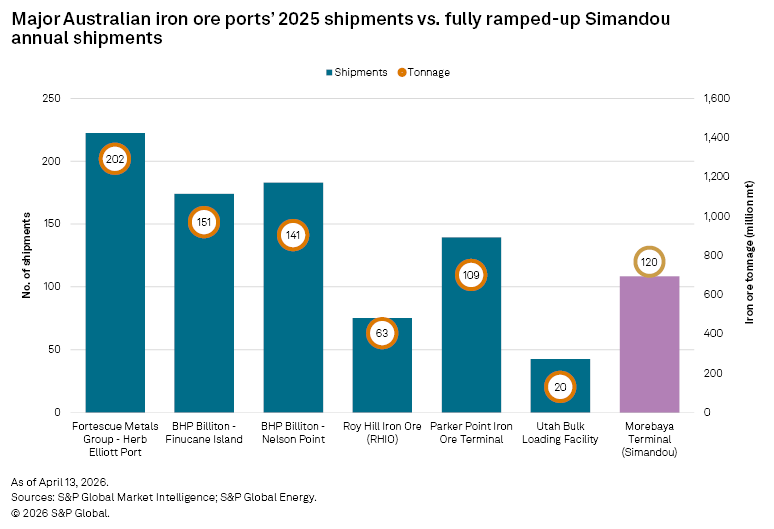
To place this 120-million mt/y target into perspective, a port-by-port analysis shows that the projected full capacity of Simandou's Morebaya Terminal is comparable to some of the largest individual iron ore terminals in Australia. Its projected annual tonnage is on par with BHP Group Ltd.'s Nelson Point terminal, which recorded 141.10 million mt. Simandou is likely to utilize larger average vessel sizes to achieve its tonnage targets, as its projected 693 annual shipments are fewer than those at major Australian ports. By comparison, Rio Tinto's Parker Point requires more than 200 additional shipments — 892 in total — to transport a slightly lower volume. Consequently, this analysis indicates that Simandou will become a tier 1 supply source upon its full ramp-up, competing with and even surpassing some of Australia's major individual export terminals in terms of export capacity.
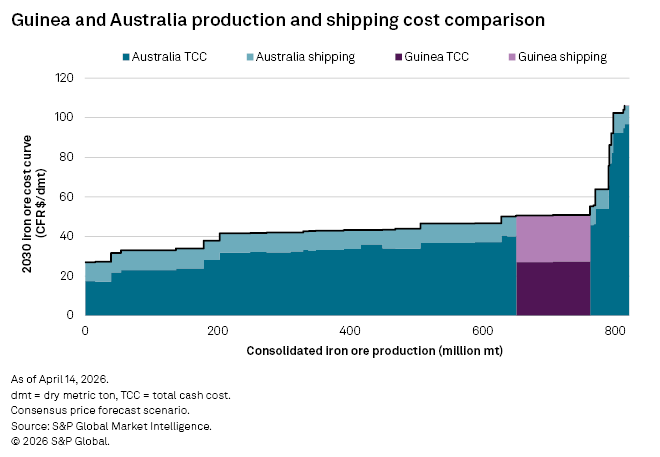
Looking at our 2030 cost forecasts, the dynamic between iron ore from Australia and Guinea is a classic trade-off between geology and geography. The most significant difference is in shipping; our data shows Guinea's seaborne costs from Simandou are forecast at approximately $23.56/dry metric ton, more than double the $9-$10/dmt we see for most major Australian producers. However, that is only half the story. On an FOB basis, the Simandou project is set to be incredibly competitive, with cash costs in the $27-$28/dmt range. It is the high shipping expense that ultimately levels the playing field, bringing Guinea's final delivered (CFR) cost into a similar bracket as many of its Australian rivals.
Simandou's market entry marks the beginning of a major shift, but its full impact will be shaped by the interplay of these powerful economic, environmental and geopolitical forces.
This article was published by S&P Global Market Intelligence and not by S&P Global Ratings, which is a separately managed division of S&P Global.