Research — April 30, 2026
No sign of a Middle East chill in Q1 2026 fintech funding

The joint US-Israeli strikes in Iran may have tested risk appetite, but fintech funding data in the first quarter show no immediate alarm.
Venture capital investors deployed $9.76 billion across 379 fintech funding rounds in the recent quarter, according to S&P Global Market Intelligence data, up from $8.25 billion and 388 rounds in the first quarter of 2025. The year-over-year picture remains familiar. Capital expands even as dealmaking mildly contracts, pushing the average check size higher and concentrating risk in fewer, larger bets.
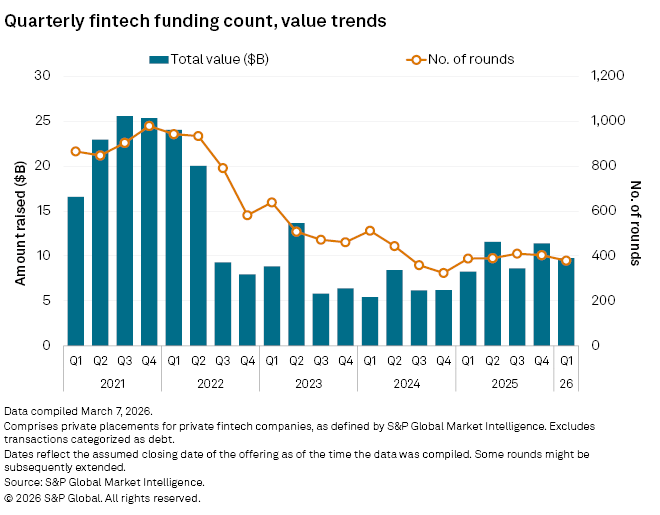
Access data in Excel format.

Against the backdrop of war, the absence of a fintech funding shock may partly reflect data lag. Venture rounds are negotiated over weeks, often months, and closing is more a function of term-sheet momentum than real-time sentiment.
For now, capital appears to be concentrating in themes that feel infrastructural and defensible. Among them are AI-native insurance and benefits platforms that automate regulated workflows, as well as vertical fintechs embedding payments or credit into industry-specific software to raise switching costs as horizontal software as a service becomes easier to replicate in an AI era.
With geopolitical risk rising, investors are tilting toward safer jurisdictions and away from liquidity-dependent emerging markets. Most constraining is the exit environment: IPOs may become scarcer, and venture depends on exits to recycle capital. We therefore expect a more selective market through 2026, even if headline quarterly totals occasionally flatter to deceive.

Middle East: Two big checks, little visible chill
Middle East fintech funding rounds slipped only marginally to 17 from 20 in the first quarter of 2025, hardly the signature of a market in retreat. The dollar volume in the Middle East region doubled during the period to $610 million. One explanation for the resilience is that venture funding is often a lagging indicator. But there may also be a structural explanation.
The quarter's two most eye-catching Gulf rounds, both in the UAE, offer a clue: one for a payments-infrastructure platform and another for an AI-native Islamic digital bank.
Blackstone Inc.-backed funds invested $250 million into Advanced Digital Gaming Technology, a newly established payments and data-intelligence platform launched from the UAE, in partnership with Raya Holding and gaming payments specialists NRT Technology Corp. and Sightline Payments LLC. The UAE has been positioning itself as a global hub for regulated digital markets. Financing a rails-and-data platform is a way to capture growth regardless of which consumer brands win.
In another example of a large check into a newly established platform, Mal raised $230 million to launch what it describes as the world's first AI-native Islamic digital bank. Backed by Abu Dhabi-based asset manager BlueFive Capital, Mal positions itself at the intersection of banking infrastructure, AI operating models and Shariah-compliant finance. A long-duration bet becomes easier when local capital is patient and aligned with the regulatory policy.
Notable VC themes
1. Vertical fintechs
The quarter's notable rounds included a trio of vertical fintechs, each embedding payments and credit into industry-specific workflows. As horizontal SaaS is commoditized by AI, defensible economics are likely shifting to platforms that own the customer relationship and the transaction.
– Inkind Cards Inc (USA, $450 million): Raised a massive round to expand its restaurant-focused commerce enablement and financing platform.
– Make Cents Technologies Inc. (USA, $110 million): Focused on the laundry sector, Make Cents demonstrates how vertical SaaS can use Payfac models to increase stickiness and formalize revenue.
– Vuelo Financial Services UK Ltd. (UK, £56 million): The round was raised to launch an AI-native travel booking platform, aiming to disrupt the agency and online travel agency (OTA) model by embedding payments, credit and insurance into the booking workflow.
2. AI-driven insurtechs
AI-driven insurance technology firms were a clear magnet for capital in the quarter, with rounds spanning the value chain from brokerage to underwriting, claims and benefits. A common thread is using AI to automate document-heavy, rules-bound processes and to scale distribution without linear head count growth. Some examples include:
– Harper Group ($47 million, seed plus Series A): An AI-native insurance brokerage for small and midsized businesses, Harper automates everything from submission routing to underwriter follow-ups and document collection.
– Indigo Technologies Operations LLC ($50 million, Series B): Focused on scaling AI-powered underwriting and claims automation, Indigo's round points to investor appetite for platforms that can reduce loss ratios and improve speed-to-bind.
– Mea Platforms Group (Bermuda) Ltd. ($50 million, growth): Mea is building AI-native insurance infrastructure, targeting both carriers and MGAs with compliance and automation tools.
– Pasito Inc. ($21 million, Series A): An AI-powered benefits platform, Pasito aims to automate employee benefits selection and compliance for SMEs.
– General Magic Technologies Inc. ($7.2 million, seed): Raised to cut insurance quote times to three minutes, General Magic uses AI agents to compress sales cycles and reduce friction.
– Qumis Inc. ($4.3 million, seed): Building an AI platform for insurance distribution and risk selection.
3. Stablecoins
Stablecoin startups continued to attract investor attention. The following rounds highlight the breadth of innovation, from regulated issuance and DeFi risk hedging to global payment rails and institutional custody.
– Meld Universal Inc. ($7 million, venture): Meld builds a platform for accessing digital assets and stablecoins, enabling payouts, remittances, and cross-border settlement for fintechs, merchants, and developers.
– Cork Protocol Inc. ($5.5 million, seed): Cork offers a protocol for tokenizing and trading depeg risk in stablecoins, letting users hedge, trade, and provide liquidity against peg breaks.
– Bastion Platforms Inc. (undisclosed, venture): Bastion develops regulated stablecoin infrastructure, including stablecoin-as-a-service, custodial wallets and APIs for treasury and cross-border money movement.
– Rain ($250 million, Series C): Rain powers stablecoin payments for enterprises and platforms, offering wallets, cards, and cross-border rails to move and spend stablecoins globally.
– JPYC Co. Ltd. ($11.4 million, Series B): JPYC operates a yen-pegged stablecoin, expanding payment rails and integrations for digital yen transactions in Japan.
– River ($12 million, venture): River builds chain-abstraction stablecoin infrastructure, allowing users to mint satUSD through native, cross-chain processes.
– Galactic Holdings Inc., which does business as VelaFi, ($20 million, Series B): VelaFi offers stablecoin-powered financial infrastructure, including on/offramps, cross-border payments, FX, custody and treasury tools via platform and APIs.
– Anchor Labs Inc., doing business as Anchorage ($100 million, mature): Anchorage, a federally chartered crypto bank, enables institutions to participate in digital assets, including stablecoin issuance, custody and settlement.
Mega-rounds
Like in late 2025, bigger rounds did more of the work. The recent quarter recorded 21 mega deals ($100 million or more), up from 11 in the year-ago period. That is still a fraction of the 2021 cadence, but it marks a clear reacceleration in large-ticket risk appetite. The three largest fintech funding rounds were led by Kalshi Inc. ($1 billion, prediction markets), inKind Cards ($450 million, restaurant-focused vertical fintech), and Vestwell Holdings Inc. ($385 million, investment and capital markets technology), underscoring investor appetite for both innovative market infrastructure and embedded financial solutions.
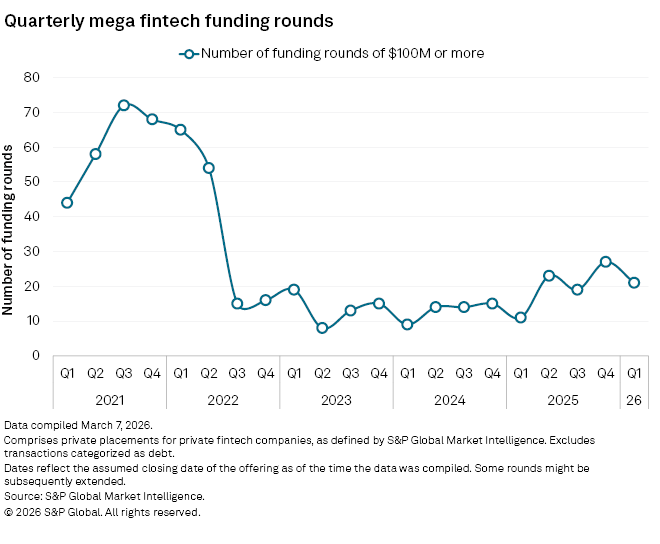
The sustained high supply of $100 million-plus rounds suggests investors are increasingly comfortable underwriting late-stage outcomes again. However, this is by no means a broad-based re-rating. We are observing capital crowding into companies that seem exit-ready or strategically essential (risk, rails and revenue durability).
Geographical trends
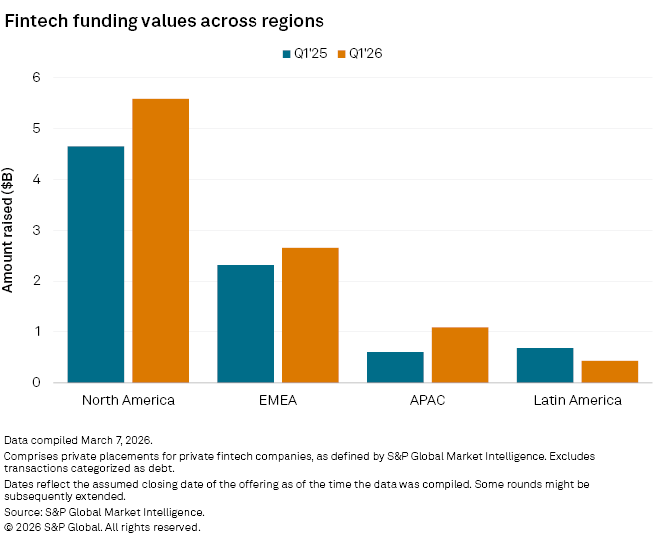
The rebound remains North America-led, but the first quarter shows a more interesting second story. Asia-Pacific is participating again, while Latin America cools a bit.
– North America grew year over year to $5.58 billion in the first quarter from $4.65 billion.
– Europe, the Middle East and Africa also rose to $2.66 billion from $2.31 billion.
– Asia-Pacific nearly doubled to $1.09 billion, albeit from a low base.
– Latin America fell to $430 million from $680 million.
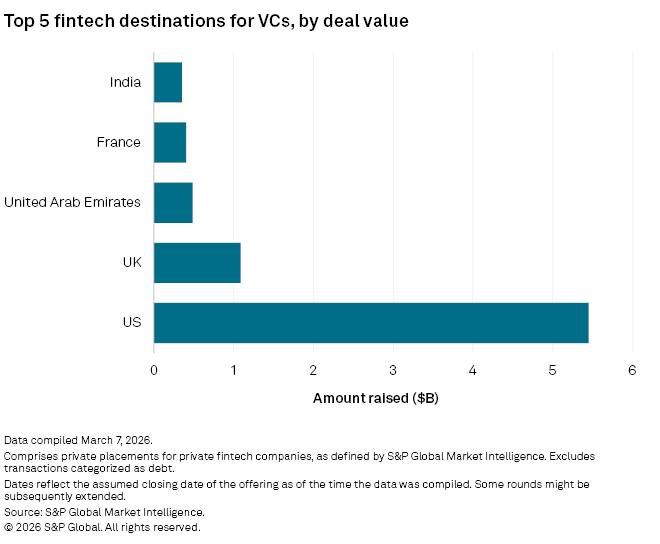
At the country level, capital remained concentrated among a handful of traditional fintech hubs. The US led with $5.46 billion, followed by the UK ($1.09 billion), the UAE ($486 million), France ($403 million) and India ($351 million).
Segmental trends
The sectoral mix in the quarter likely reflects a rotation toward risk and markets infrastructure, even as payments keeps its top spot.
– Insurance technology reached $1.45 billion, up approximately 127% year over year, the most dramatic increase this quarter.
– Investment and capital markets technology rose to $1.38 billion, up nearly 200% year over year.
– Payments totaled $2.10 billion, an increase of roughly 4% year over year.
– Financial media and data solutions came in at $2.06 billion, down around 14% from $2.39 billion.
– Banking technology remained flat at $1.66 billion, while digital lending fell to $910 million, a decrease of about 5% from the year-ago period.
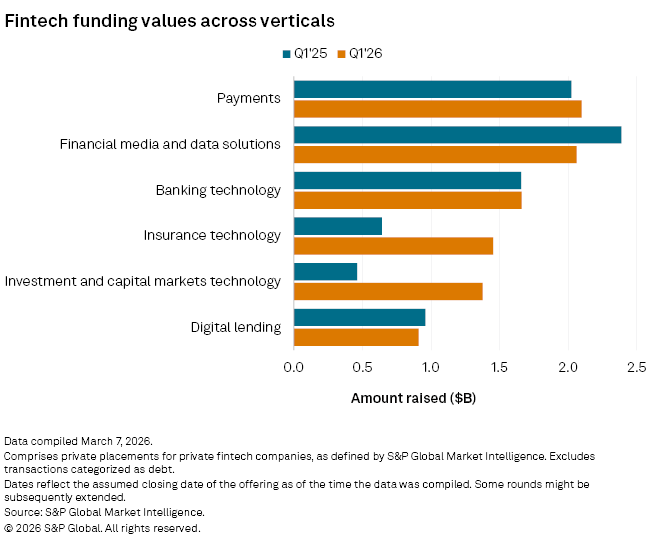
Payments remains the largest slice in this cut of the data, but investors are treating it as infrastructure. Investor attention is also gravitating toward firms with defensible distribution and multi-product economics. Meanwhile, underwriting and institutional markets tech offer something venture capital loves: complexity that compounds moats.
This article was published by S&P Global Market Intelligence and not by S&P Global Ratings, which is a separately managed division of S&P Global.