Research — March 24, 2026
Spectacular P&C statutory profitability may prove fleeting
By Jason Woleben and Tim Zawacki
A combination of cyclical tailwinds, relatively lighter catastrophe losses and the cumulative effect of profit improvement plans led US property and casualty insurers to deliver their strongest calendar-year underwriting results in 19 years in 2025, but the industry will be hard-pressed to replicate the same degree of success in 2026 and beyond.

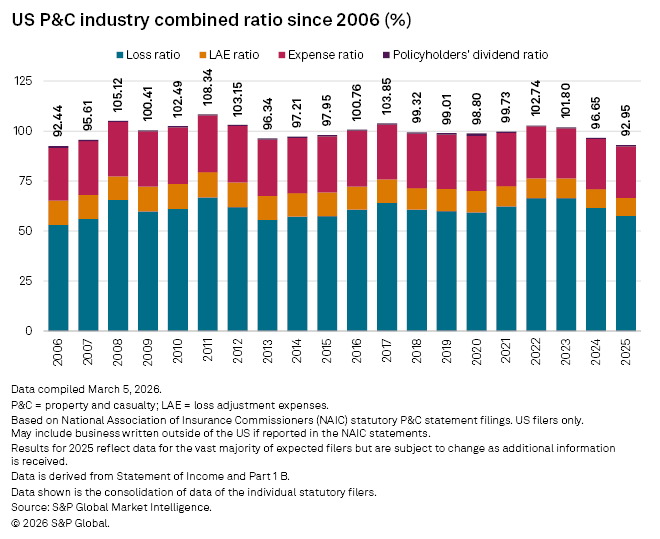
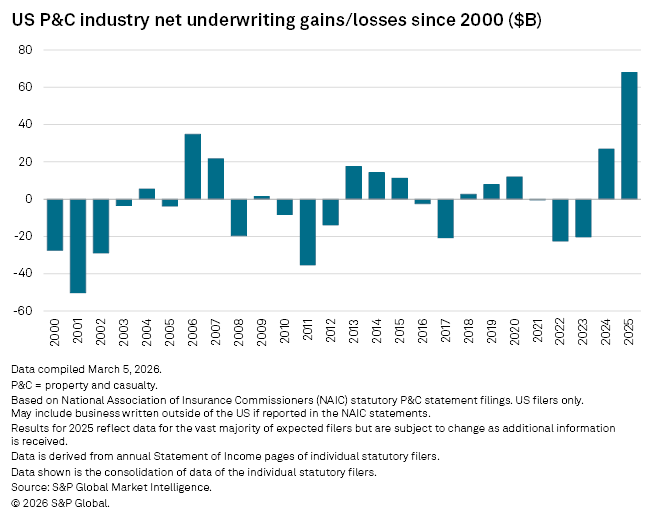
➤ The industry's aggregate net underwriting gain of $67.92 billion, according to an analysis of 2025 statutory results obtained as of March 7, represents what we believe to be a record high, surpassing the inflation-adjusted profit of $54.16 billion in 2006. The combined ratio of just under 93.0% represents a 19-year low, surpassed only by the 92.4% result in 2006. A 2016 presentation by then-Insurance Information Institute President Robert Hartwig labelled the 2006 result as the industry's lowest combined ratio since 1949.
➤ Dramatic improvements in the private auto and homeowners businesses drove the improvement from already strong 2024 results as carriers benefited from a variety of micro and macro dynamics, including generationally large rate increases continuing to earn into carriers' books and, aside from the January 2025 wildfires, a relatively benign year for natural catastrophes.
➤ We can say with conviction that the industry will not replicate these results in 2026 or, quite possibly, at any point in the foreseeable future. In addition to the unique confluence of circumstances that led to 2025's outsized profitability, written premium growth is significantly lagging earned premium growth at respective rates of 4.9% and 6.3% as heightened competition returns to the private auto market and the scourge of social inflation is not going away. To that end, even as underwriting results on a total-filed basis improved to levels we may only see once or twice in our lifetimes, several commercial casualty lines showed noteworthy deterioration.

That the homeowners line would help lead US P&C insurers to historic levels of underwriting profitability in 2025 seemed inconceivable as the year began. The Palisades and Eaton wildfires, according to data from Aon PLC, caused insured losses of $41 billion, sending the direct incurred loss ratio for the homeowners business skyrocketing in the first quarter of 2025. While severe convective storms continued to wreak havoc through the spring and summer, the absence of landfall-making US hurricanes led to sharply strong homeowners results during the second half of the year.
At 53.7%, the net loss ratio for the homeowners business stands as the industry's lowest such result since 2015. It marks an improvement of 11.1 percentage points from 2024. There have only been four calendar years (2006, 2013–2015) in the past three decades where the homeowners net loss ratio has been lower.
Similarly, the private auto business weathered concerns about the prospective impact of US tariffs on loss costs to deliver its strongest net loss ratio since 2020, or 2007 when excluding the COVID-19 pandemic year. At 61.1%, it marked a year-over-year improvement of 4.7 percentage points. Trends in the two major components of the private auto business improved at vastly different rates, however.
The private auto physical damage net loss ratio of 52.2% stands as the lowest result in at least 30 years, down 8.2 percentage points from 2024. The private auto liability business, meanwhile, posted a net loss ratio of 67.9%, a year-over-year decline of less than 2.1 percentage points. The private auto liability net loss ratio has been lower 20 times in the previous 30 years, and it may face upward pressure again in 2026 amid concerns about the impact of higher levels of attorney-represented claims on severity trends.
Not surprisingly in light of the strength in home and auto results, personal lines-focused groups posted the largest statutory net underwriting gains in 2025. The eight groups with the largest net underwriting gains for the year, The Progressive Corp., Geico Corp. parent Berkshire Hathaway Inc., The Allstate Corp., the group led by United Services Automobile Association, The Travelers Cos. Inc., Liberty Mutual Holding Co. Inc., Farmers Insurance Exchange and its affiliates and subsidiaries, and American Family Insurance Group., rank among the nine-largest US personal lines writers.
Rather than a story of personal versus commercial lines, however, the divide between property and casualty lines seemed most apparent in our review of 2025 results. After we subjectively labelled 18 lines of business as constituting property coverage and 14 as casualty coverage, we determined that the net loss ratio for the property lines fell by 8.1 percentage points year over year to just 50.1% in 2025. This was 20 full points below the result for the property lines just three years earlier in 2022, when a combination of supply chain-induced inflationary pressures and Hurricane Ian led to outsized losses. In the casualty lines, meanwhile, the net loss ratio increased slightly to 66.7% in 2025.
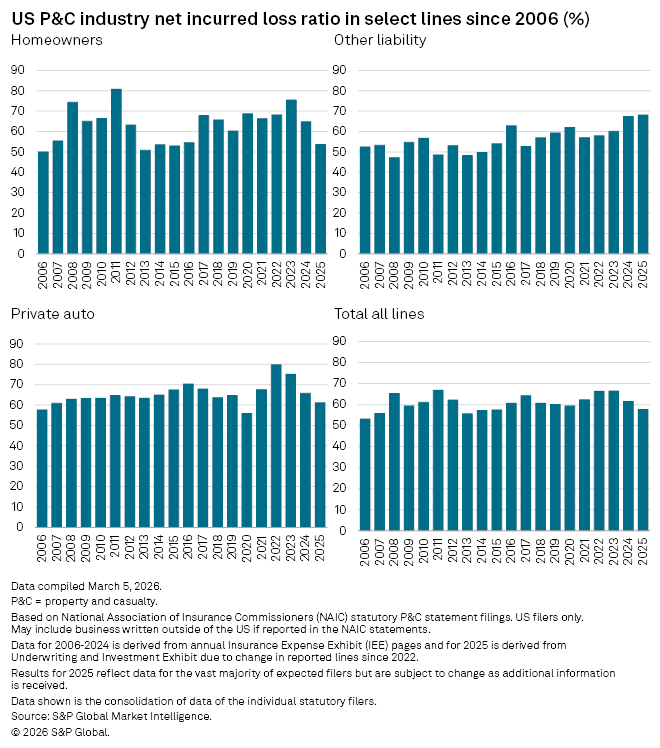
Lines such as other liability and medical professional liability showed historically poor results. The net loss ratio in the other liability coverages, which had been moving sharply higher in recent years, rose to a new 21-year high of 68.0% in 2025. Any comparisons to the early 2000s in the casualty lines are particularly alarming, given the magnitude of adverse prior-year reserve development the industry posted in that era, in many cases associated with latent liabilities such as asbestos and environmental pollution.
The medical professional liability net loss ratio of nearly 57.9% also marked a 21-year high. Although that loss ratio may not appear excessive, it puts the industry in line to have generated a calendar-year combined ratio in the vicinity of 108% given the high levels of loss adjustment expenses associated with the business line.
The industry continues to wrestle with fallout from the higher jury verdicts and settlement costs commonly known as social inflation. And while tort reform legislation in select states has generated meaningful improvements in results, especially to the extent the reforms make it more challenging for plaintiffs to recover large non-economic damage awards, the industry faces significant legal headwinds in a number of jurisdictions.
CNA Financial Corporation posted the industry's largest net underwriting loss at $815.2 million, inclusive of significant adverse reserve development primarily in the other liability lines. Primary subsidiary Continental Casualty Co. said that known asbestos and environmental accounts experienced higher-than-expected defense and indemnity costs, among other factors. The company is party to a Berkshire Hathaway adverse development cover on accident-year 1988 and prior asbestos and environmental bodily injury claims, but the benefits of that retroactive reinsurance are accounted for outside of the formula used to calculate underwriting gains.
In addition to the continuing challenges in the casualty lines, there are other factors that point to narrower US P&C industry underwriting margins in 2026. For example, the 2025 results notably exclude State Farm Mutual Automobile Insurance Co.'s $5 billion private auto policyholder dividend, which its board declared on Feb. 16, 2026. US P&C insurers paid only $5.50 billion in policyholder dividends in 2025, so that declaration alone would have nearly doubled the industry's tally, thereby adding more than 52 basis points to the industry's 0.58% dividend ratio had it been processed that year. Multiple East Coast winter storms in the first quarter of 2026 also increase the potential for an elevated loss ratio in the homeowners business on a sequential basis, though it will remain well below the result for the first three months of 2025.
Methodology
The industry-level results for 2025 referenced in this article represent an aggregation of individual company results filed with the National Association of Insurance Commissioners and obtained by S&P Global Market Intelligence as of March 7; prior-period results reflect our previously published aggregations of total-filed results. Any group-level results referenced in this article for 2025 reflect manual compilations of as-reported individual entity data.
Our calculations also may incorporate 2025 data for recently formed entities that may not immediately be available on S&P Capital IQ Pro. As such, it may not be immediately possible to replicate certain of the statistics contained in this article.
Data for 2025 will change to some extent as we obtain additional information in the coming weeks, including from Puerto Rico filers with an April 1 annual filing deadline. But we do not anticipate the movement will be material based on the number and relative magnitude of the expected filers for which we have not received results.
Important considerations for our combined ratio calculations include the following: the results include policyholder dividends unless otherwise noted, and we base expense ratios as the combination of other underwriting expenses and aggregate write-ins for underwriting deductions as a percentage of net premiums written.
Market Intelligence publishes statutory data for 1996 through the present. Any reference to data pre-dating 1996 is sourced from third parties.
This article was published by S&P Global Market Intelligence and not by S&P Global Ratings, which is a separately managed division of S&P Global.