Research — March 24, 2026
Prediction markets create insider trading loophole as enforcement lags

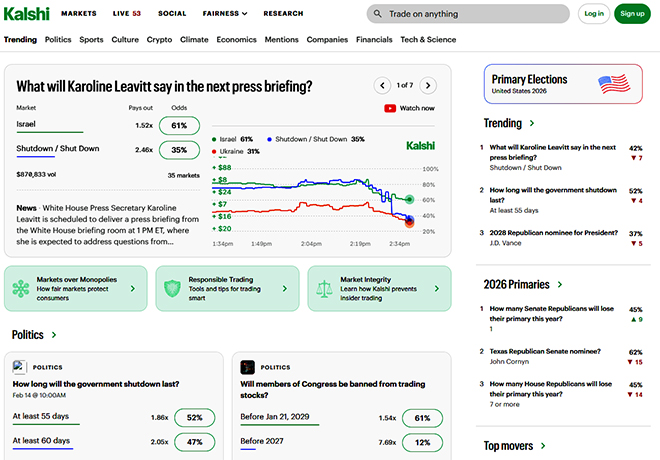
| Prediction market platforms such as Kalshi, pictured above, are attracting greater regulatory attention as users bet on a wide range of outcomes. Source: Kalshi |
Coinbase Global Inc. CEO Brian Armstrong ended a company earnings call in late 2025 by rattling off five cryptocurrency terms — Bitcoin, Ethereum, blockchain, staking and Web3 — after users on prediction markets wagered on whether he would mention them. The stunt moved more than $80,000 in wagers.
The October 2025 call highlighted growing concerns about regulating prediction markets, platforms where users bet real money on the outcomes of future events, from election results to corporate earnings and sports. While federal rules prohibit trading on nonpublic corporate information, legal experts say prediction markets face a growing enforcement crisis as regulators struggle to police insider trading in an industry where anyone can wager on an expanding range of events.
The enforcement challenge stems from prediction markets' pseudonymous nature and rapid growth, making it nearly impossible for regulators to cross-reference trades with lists of individuals with insider access, a standard practice in securities enforcement. Platforms such as Polymarket allow crypto betting under pseudonyms, while regulated exchanges such as Kalshi Inc. have enforced insider trading policies only twice, both involving traders who won every bet they placed. Staffing cuts at agencies tasked with regulating this space, including the Commodity Futures Trading Commission (CFTC), compound the problem.
"If somebody commits securities fraud, you know who the usual suspects are — the accountant, the law firm, the financial printer," said Peter Sanchez Guarda, a financial derivatives lawyer who left the CFTC in 2025 after 22 years as acting associate director. "When you can bet on anything, you don't know who the usual suspects are."
Surveillance gaps exposed
CFTC Rule 180.1 prohibits trading on material nonpublic information in derivatives markets using language nearly identical to securities fraud law. Under the misappropriation theory of insider trading, employees who trade on information acquired through their work violate the rule regardless of their role, Sanchez Guarda told S&P Global Market Intelligence.
While the CFTC has exclusive jurisdiction over commodity futures, Sanchez Guarda said it is unclear whether sports or political outcomes qualify as commodities under the statute. The CFTC has lost 20% of its staff since early 2025.
Chester Spatt, a Carnegie Mellon University finance professor who served as the SEC's chief economist from 2004 to 2007, said Armstrong's behavior could constitute market manipulation even if it does not qualify as classic insider trading under securities law.
Spatt said Coinbase's board should have addressed Armstrong's behavior, especially given Coinbase's subsequent entrance into the market. Coinbase launched its own prediction market in December 2025, powered by Kalshi, six weeks after Armstrong's comments. The company also acquired The Clearing Co., a prediction market infrastructure startup, to scale the business as part of its "Everything Exchange" strategy.
"It makes a mockery out of what prediction markets are supposed to be providing," Spatt said, noting that if participants believe insiders can trade freely, it undermines confidence in the markets' ability to aggregate information efficiently. "The board ought to be engaging with the CEO about this because it undercuts the CEO's responsibility to the company."
A Coinbase spokesperson told Market Intelligence that the company has "robust safeguards" in place covering employee participation in prediction markets, including an internal surveillance team and a strict internal policy. "Our internal policy prohibits all employees from trading, betting or participating in any prediction market involving information related to Coinbase, its affiliates, or any entity for which they have [material nonpublic information] or a confidential relationship," the spokesperson said.
The statement did not address Armstrong's earnings call remarks, but the company previously told DL News that Armstrong's comments were made "in a lighthearted, offhand way referencing online discussion around the earnings call." Armstrong said on social media that the moment "happened spontaneously when someone on our team dropped a link in the chat."
Companies respond to risks
Some companies are taking steps to minimize risk. When California Governor Gavin Newsom joked he could bet on himself running for president on Kalshi, CEO Tarek Mansour said the platform would immediately flag such trading as illegal.
The problem, though, extends beyond public stunts from politicians and CEOs. A communications director who reviews an earnings script days before delivery could bet on specific words the CEO will use, Sanchez Guarda said. Unless trading patterns are obviously suspicious, such as a perfect betting record, platforms lack the capacity to identify such activity.
OpenAI LLC fired an employee in February for using confidential information to trade on prediction markets, according to a report from Wired. The company updated its policies to explicitly ban employees from using insider information for personal gain on platforms such as Polymarket and Kalshi. OpenAI did not immediately respond to a request for comment.
Legal experts say more companies should follow suit. Morrison Foerster recommended in a February client alert that companies require employees to disclose prediction market accounts and implement annual certifications confirming they have not traded on confidential information. The CFTC issued an enforcement advisory Feb. 25 warning that exchanges are expected to police insider trading and that the agency "will investigate and prosecute violations," according to Gibson Dunn's analysis of the guidance.
"I'm pleased to see that our exchanges are adhering to their oversight responsibilities as self-regulated organizations and our Enforcement Advisory today reflects that," CFTC Chairman Mike Selig said in a post on X. "Let me be clear: if you attempt to engage in manipulation, fraud, or insider trading, we will find you and take action."
In February, Selig appointed Armstrong to the agency's Innovation Advisory Committee, which also includes Polymarket CEO Shayne Coplan and Kalshi's Mansour.
A CFTC spokesperson did not respond to emailed requests for comment from S&P Global Market Intelligence.
Polymarket disclosed March 10 that it is working with Palantir Technologies Inc. and TWG AI to build monitoring systems for its upcoming US-regulated platform. The tools will screen users against banned lists and detect suspicious trading activity.
Kalshi and Polymarket did not respond to requests for comment on their surveillance systems.
This article was updated at 5:22 p.m. ET on May 12, 2026, to add comments from a Coinbase spokesperson.
This article was published by S&P Global Market Intelligence and not by S&P Global Ratings, which is a separately managed division of S&P Global.
Content Type
Segment
Language