Research — March 24, 2026
Middle East war pressures copper prices, could impact nickel production
By Joenelle Donato and Ruilin Wang
Due to the broadening conflict in the Middle East, the closure of the Strait of Hormuz on Feb. 28 led to increased maritime risks for oil and energy markets. With over 25% of global seaborne oil and about 20% of global LNG trade passing through the strait, this stalled trade route furthers cost-push inflation given supply and logistical uncertainties. In this article, we highlight the closure's impacts to the copper and nickel markets, with the latter becoming increasingly susceptible to supply-side shocks.
Copper prices tempered by US dollar
The escalation of the US-Iran conflict is expected to have a limited effect on global copper supply. Although Iran is the Middle East's main copper producer, its output — about 360,000 metric tons of mined copper and 340,000 mt of refined copper in 2025 — represents just 1.5% and 1.2% of global production, respectively. In 2025, Iran exported just over 109,000 mt of refined copper, mainly to the United Arab Emirates and Turkey. Both countries can easily source copper from alternative suppliers, minimizing the risk of disruption.
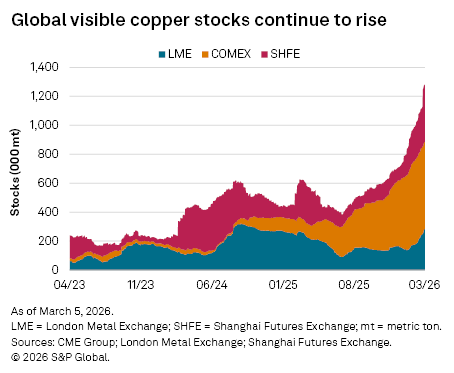
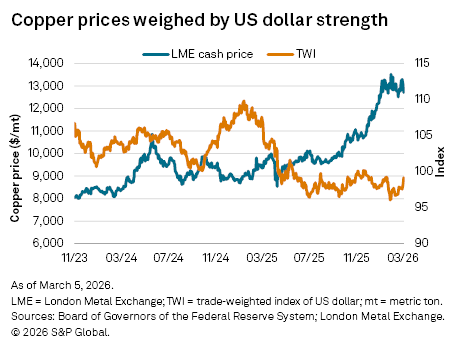
Global refined copper stocks have increased significantly in major exchange warehouses since January, rising 50% by early March to 1.25 million mt. This inventory buildup provides a buffer against potential supply shocks from the region.
The London Metal Exchange three-month (LME 3M) copper price fell from $13,343.5/mt on Feb. 27 to $12,955/mt on March 3, suggesting the conflict's immediate impact on copper has been downward. The closure of the strait has triggered a rapid increase in energy prices, which is expected to weaken global growth and put pressure on copper demand. At the same time, higher energy prices have renewed concerns about inflation, potentially delaying any US Federal Reserve interest rate cuts. This has strengthened the US dollar recently, adding further downward pressure on copper prices.
High global refined copper stocks are also weighing on prices, but this could be a short-term phenomenon. With the Chinese market now back from the Lunar New Year holiday, copper-consuming sectors are resuming production and gradually entering their seasonal peak demand period. As a result, we anticipate stocks at the Shanghai Futures Exchange will begin to decline from current high levels. Most global copper stocks are now sitting in the US market and are unlikely to flow out easily, especially with the possibility of the US imposing tariffs on refined copper imports.
In summary, copper prices are currently under short-term pressure from a stronger dollar, high inventories and demand concerns should global GDP growth weaken. Looking ahead, potential dollar weakness and ongoing tightness in the concentrates market are expected to provide support for copper prices.
Nickel supply chain vulnerable given Hormuz closure
The closure of the Strait of Hormuz highlighted a critical vulnerability within the global nickel value chain: the availability and cost stability of sulfur-based inputs essential for high-pressure acid leach (HPAL) operations. HPAL technology is a vital processing stage in the production of battery-grade nickel sulfate (NiSO₄) used in electric vehicle batteries. It relies heavily on sulfuric acid to convert laterite ore into mixed hydroxide precipitate (MHP), which is subsequently turned into NiSO₄. Thus, disruptions in the sulfur supply chain can materially impact primary nickel supply and even exacerbate price volatility.
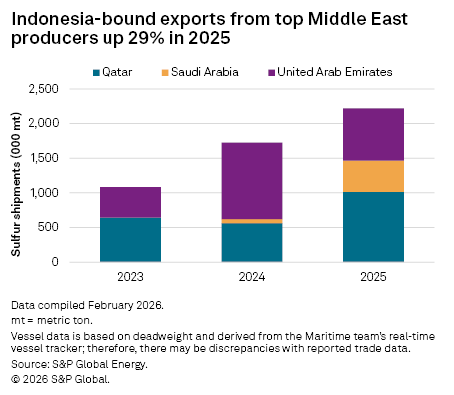
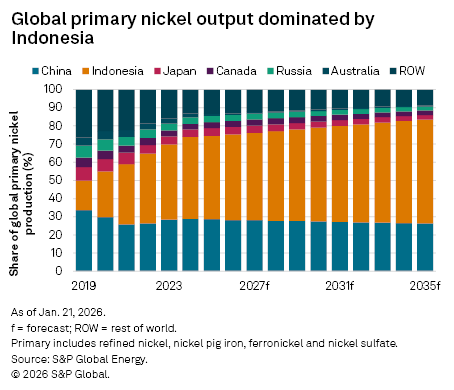
According to S&P Global Energy's preliminary assessment, Indonesia imported over 5.2 million mt of sulfur in 2025, up by 44% year over year, driven by the accelerated expansion of HPAL output. Exports to Indonesia from Qatar, Saudi Arabia and the UAE jumped 29%, led by outflows toward Bahodopi and Weda Bay, both of which house HPAL plants. Bahodopi, a joint venture between PT Vale Indonesia Tbk and GEM Hong Kong International Co. Ltd., is expected to commence operations within the year. On the other hand, PT Weda Bay Nickel received a lower production quota of 12 million wet metric tons for 2026, from 42 million wmt in 2025. Eramet SA, one of the venturers alongside Tsingshan Holding Group Co. Ltd. and PT Aneka Tambang Tbk, stated that the company will apply for a quota increase.
Although the recent rally in LME 3M nickel prices within the $17,000/mt to $18,000/mt range — partly attributed to Indonesia's recent quota reduction announcements — has improved market sentiment, it does not fully offset the impact of rising sulfur costs. HPAL plants with higher all‑in sustaining costs (AISC) in regions such as Australia and New Caledonia are more vulnerable during a surge in sulfur prices. These plants often struggle with design limitations, slow ramp‑up performance and persistently high operating costs. By contrast, Indonesia's HPAL operations benefit from structural advantages that keep their AISC low. They operate with lower energy and labor costs and tend to achieve higher recoveries through newer-generation HPAL designs.
Should the disruptions in the Strait of Hormuz persist, the nickel market will likely begin to increase the price premium associated with battery-grade nickel chemicals. The next phase of nickel market volatility may be driven less by ore supply constraints and more by the resilience of the sulfur-to-acid supply chain that underpins HPAL operations.
S&P Global Energy produces content for distribution on S&P Capital IQ Pro.
This article was published by S&P Global Market Intelligence and not by S&P Global Ratings, which is a separately managed division of S&P Global.