Research — March 31, 2026
Mastercard's $1.8B bet on BVNK accelerates stablecoin push
Mastercard Inc. has agreed to acquire BVNK Services Ltd. for $1.5 billion, plus $300 million in earnout, becoming the first large publicly listed traditional payments firm to use M&A to enter the stablecoin infrastructure market. The deal signals a clear bet that stablecoins will move beyond crypto niches to become part of mainstream payment plumbing.
Mastercard is positioning itself as an orchestration layer across fiat, stablecoins and tokenized money. In an increasingly fragmented, multi-rail payments landscape, control over connectivity and interoperability may matter more than control over any single rail.
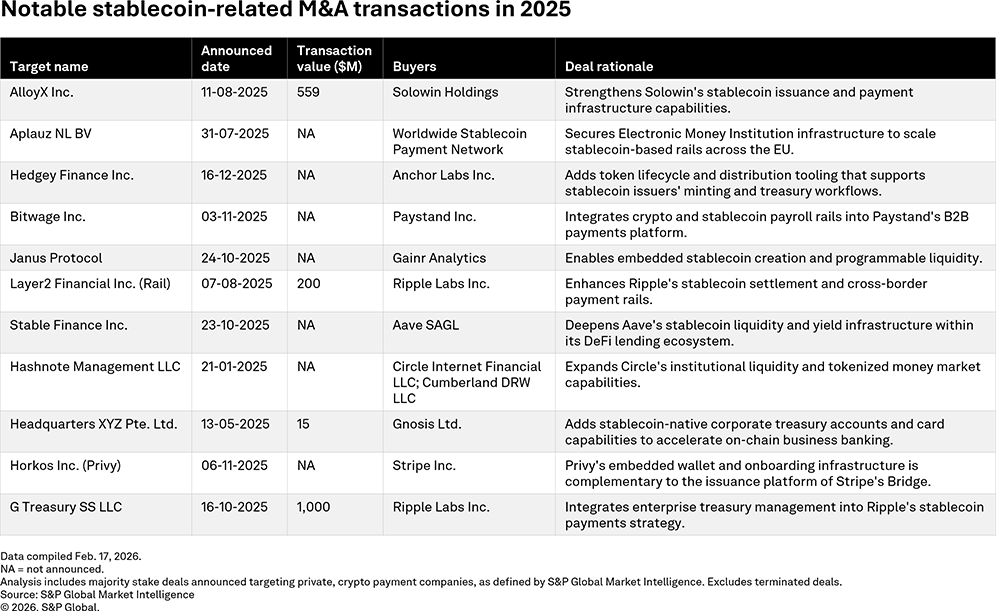
The timing is notable. Stablecoin-themed deal activity has been rising, with at least 14 transactions announced in 2025, according to S&P Global Market Intelligence. Mastercard's move may prompt other incumbents to follow.
Deal Snapshot Box
|

Mastercard's deal for BVNK validates our previous view that incumbents are more likely to buy than build as they expand into digital currency infrastructure. More deal activity is likely as other large payments firms, such as Visa Inc., seek to secure similar capabilities.
The card giant is careful in how it frames the deal. It does not present stablecoins as a substitute for existing payment rails. Instead, it treats them as an additional settlement and liquidity layer in cross-border payments, payouts and treasury flows. Its emphasis on compliance and support for both stablecoins and tokenized deposits is aimed at reassuring banks and preserving its role within the system.
The deal also highlights two strategic shifts. Stablecoin adoption emerges in high-friction segments rather than at the consumer checkout. At the same time, a more fragmented ecosystem enhances the role of orchestration and connectivity between fiat and on-chain systems.

Deal details
Mastercard is paying $1.5 billion, plus $300 million in contingent payments, to acquire UK-headquartered stablecoin payments infrastructure provider BVNK. The deal remains subject to regulatory approvals and customary closing conditions.
The card giant did not disclose further financial details, including revenue or profitability, during its announcement or investor call. BVNK’s team will join Mastercard following the close, which is expected in late 2026.
Deal rationale
Mastercard's rationale for acquiring BVNK instead of building internally comes down to time-to-market and ecosystem depth. The payments network is buying into a platform with licenses, global reach and ties across banks and liquidity providers. Recreating that footprint would take years.
The deal also broadens revenue prospects. BVNK's capabilities across sending, receiving, converting and storing digital currencies create multiple points of monetization. Mastercard intends to channel volumes through Mastercard Move, its push-to-card network turned global payout system spanning cards, bank accounts and wallets. It also sees scope to add foreign-exchange services, an area BVNK has yet to develop.
During the investor call, Mastercard framed the deal as bank-friendly, advertising support for both stablecoins and tokenized deposits. With its emphasis on compliance and risk controls, Mastercard is positioning itself as a reliable partner for banks as they aim to participate in digital currency ecosystems without taking on outsized risks. However, it added that the initial uptake of stablecoins will be led by fintechs and payment service providers. Banks may follow more cautiously as the contours of tokenized money become clearer.
Target profile
Founded in 2021, BVNK acts as a stablecoin payment infrastructure provider, offering crypto-native treasury, payment and on/off-ramp services. The company has raised over $90 million to date, including $50 million in a Series B round in December 2024 that fetched a valuation of $750 million. It raised an undisclosed investment from Citi Ventures Inc., a VC arm of Citigroup Inc., in October 2025.
In its deal announcement, it disclosed annualized payment volume of $30 billion, up from $20 billion in October 2025, signaling robust growth. Its customers include fintechs, payment service providers and large enterprises, with clients such as Worldpay LLC, Deel Inc., Rapyd Payments Ltd. and Flywire Corp.
Acquirer profile
Mastercard operates one of the largest global payment networks, connecting issuing banks, acquiring banks and merchants across more than 220 countries and territories. Long known for cards, it now casts itself as a multi-rail provider, spanning cards, account-to-account transfers and real-time payments, with growing interest in blockchain-based settlement. The scale of its card network remains its advantage. In 2025, Mastercard processed $10.6 trillion in volume and 175.5 billion switched transactions, with roughly 3.4 billion Mastercard-branded cards in circulation.
Its M&A strategy has centered on extending the company into adjacent payment rails, building out value-added services and broadening its reach in faster-growing flows. According to 451 Research's M&A KnowledgeBase, the BVNK transaction represents Mastercard's 11th acquisition since the start of the decade and ranks among its largest, trailing only the $3.19 billion acquisition of Nets' account-to-account business and the $2.65 billion purchase of Recorded Future. Prior acquisitions of VocaLink Ltd., Finicity, Nets' A2A business and Aiia illustrate a deliberate push into non-card payment flows, particularly real-time and bank-based transfers.
In this context, the BVNK acquisition continues that trajectory. It extends Mastercard's multi-rail model into stablecoins in an effort to deepen its role as an orchestrator of global money movement regardless of the underlying rail.
Competition
Stablecoin orchestration and fiat-crypto interoperability are emerging as key battlegrounds in payments, with incumbents, fintechs and crypto-native vendors all vying to become the control point. Mastercard's acquisition of BVNK strengthens its position, but it enters an increasingly crowded market with well-funded players.
Visa has been actively developing stablecoin capabilities through settlement pilots and cross-border initiatives. Like Mastercard, it treats stablecoins as a settlement layer rather than a replacement for cards. The result is a growing contest between the two networks over which will shape how digital currencies integrate with existing rails. Mastercard's move could prompt Visa to accelerate its push into stablecoin infrastructure, including potential M&A in the sector.
BVNK competes with infrastructure providers focused on stablecoin orchestration and on/off-ramp services. Zero Hash Holdings Ltd. has emerged as a key back-end provider for banks and fintechs and recently raised $104 million at a valuation of roughly $1 billion, highlighting strong investor interest in the category. Another notable competitor is Bridge, which Stripe LLC acquired for approximately $1.1 billion in 2024. Bridge's appeal lies in its ability to abstract stablecoin complexity into simple APIs, making it easier for developers to integrate blockchain-based payments without deep crypto expertise.
The winners in this emerging category will likely be those that can pair distribution and trust with deep technical orchestration, compressing complexity for customers across the payments ecosystem while maintaining regulatory compliance at scale.
This article was published by S&P Global Market Intelligence and not by S&P Global Ratings, which is a separately managed division of S&P Global.