Blog — Feb 8, 2026
US Broadband monthly churn hits 1.3%

Highlights
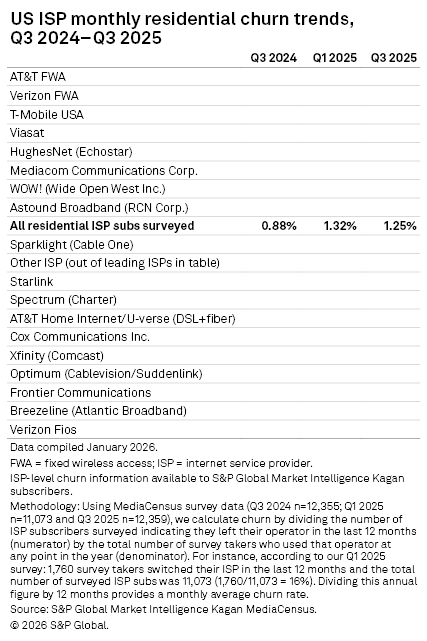
- Across all broadband types, including cable, fiber, satellite and fixed wireless, the US broadband industry averaged a monthly churn rate of 1.25% in the third quarter of 2025.
- For context fixed broadband’s low-1% churn rate is in line with the rate at which wireless operators lose their valuable postpaid customers monthly.
Internet service providers (ISPs) don’t generally share monthly churn rates.
But using responses from our biannual surveys of 10,000+ high-speed internet customers, Kagan has modeled monthly churn rates for the top 19 US ISPs, including Starlink and T-Mobile’s fixed wireless offering 5G Home Internet.
The three lowest monthly churn rates belong to fiber operators Verizon, Breezeline and Frontier. Because fiber is objectively the best technology for high-speed internet, it follows that these customers would be the least likely to hunt for a better option.
The highest churn rates belong to the three tier 1 fixed wireless operators. Prior surveys indicate fixed wireless and Starlink customers are among the most satisfied ISP customers. We think this is due to these technologies being the only broadband options available in many rural areas. So it is possible that those leaving FWA in 2025 are in more population-dense markets where more options exist, like in suburban and urban areas.
Across all broadband types, including cable, fiber, satellite and fixed wireless, the US broadband industry averaged a monthly churn rate of 1.25% in the third quarter of 2025.
For context, this low 1% churn rate is in line with the rate at which wireless operators lose their valuable postpaid customers monthly, according to their recent filings.
While postpaid phone monthly churn rates remain the envy of all subscription services at under 1%, at 1.25% per month in the third quarter of 2025 US broadband operators were just 9 basis points above wireless postpaid churn (which includes smartphones, tablets and any other connected device on a contract or equipment installation plan).

In terms of total broadband subscribers, fixed wireless and Starlink have been the growth stories in US broadband in recent years. Essentially if the volume of gross adds continues to grow faster than churn, which it has, the result is growing subscribers.
And as coverage expands and enticing deals continue, we expect fixed wireless will continue to grow its share of the broadband subscriber share in the US. Satellite broadband is also poised for more growth as Amazon’s Leo could launch commercially this year. Amazon expects its new broadband service will have over 3,000 low earth orbit satellites of its own in orbit by 2029.