Research — February 27, 2026
IM February 2026 – Drilling metrics log strongest start since 2023
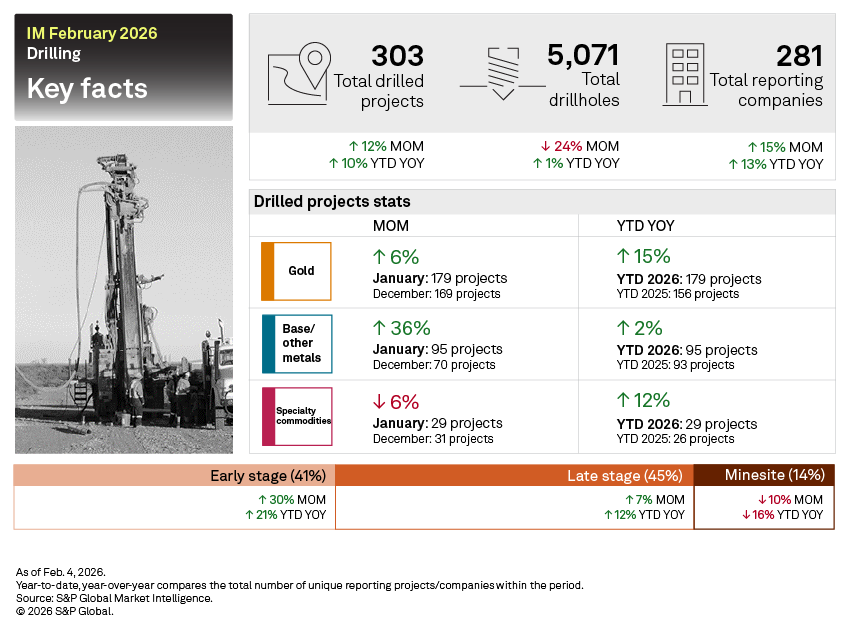
Drilling metrics had their strongest year-opening performance since 2023, with projects, drillholes and companies reporting all up compared to 2024 and 2025. Although drillholes dropped 24%, projects reporting rose 12% to 303 — an 11-month high — and companies reporting increased 15% to a high unseen since May 2023.
Late-stage projects continued to account for the greatest number of reported significant drill results in January, with 79 projects reporting. Early-stage projects came closer than ever to overtaking late stage, increasing by 26 to a 27-month high of 78 projects with significant results. Minesite projects reporting significant results fell by two, to 25.
Access the January 2026 drill results data.
The number of drilled projects rose 12% month over month in January. Gold and copper were the primary drivers of this increase, for almost half of the uptick.
Gold projects continued their upward trajectory, rising 6% month over month to 179 projects, a three-year high. Surprisingly, the number of gold drillholes reported dropped 30%, but it is still well above the total from January 2024 or 2025.
Base/other metals projects jumped 36% month over month, while dipping 6% in drillholes reported. Copper projects jumped 45% in January to 45 projects, an 11-month high, while drillholes increased 36% month over month. Silver projects increased 39% to 25 — a high last seen in May 2022 — yet saw a 54% drop in drillholes. Nickel and minor base metals had small increases in projects drilled in January, while lead-zinc was the only base metal group to decrease. All three saw increases in drillholes.
After December 2025's high, specialty commodities drilling slowed, with projects decreasing 6% and drillholes down 12%. Uranium projects continued trending upward, reporting from 11 projects, a 13-month high.
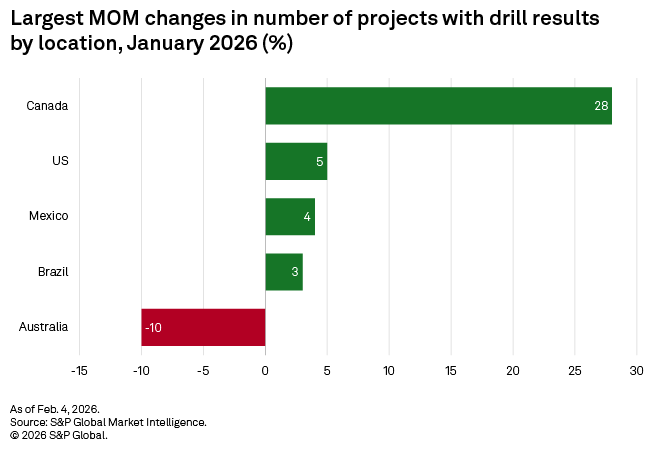
Although Australian projects declined 10% in January, the country continued to lead with 88 projects reporting. Canada fell short of overtaking Australia with a 49% increase month over month to 85 projects. The US increased 15% to 38 projects in January.
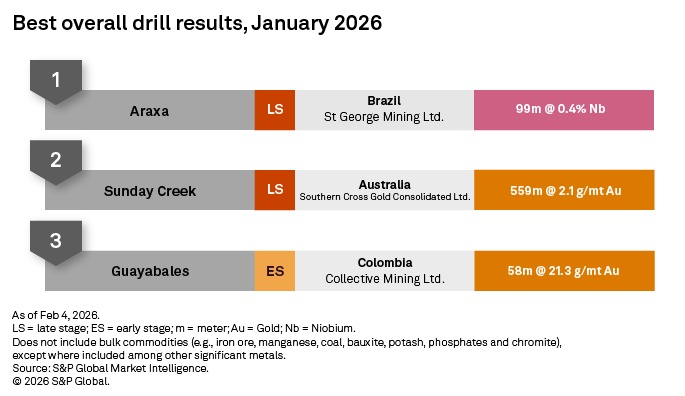
January's top result came from ASX-listed St George Mining Ltd.'s Araxa rare earth elements project in Brazil. The company reported an intersect of 99.1 meters grading 0.42% niobium and 5.62% total rare earth oxide (TREO). Current drilling highlights the expansion potential of Araxa, as the mineral system remains open.
The month's second-best result came from the Sunday Creek gold and antimony project in Victoria, Australia, owned by TSXV-listed Southern Cross Gold Consolidated Ltd., with an intersect of 559 meters grading 2.1 grams per metric ton of gold. The drilling intersected 16 vein sets and also recorded the highest antimony assay to date.
Rounding out the month's top three results is TSX-listed Collective Mining Ltd.'s Guayabales gold project in Colombia. The January drilling was the deepest to date, as well as the highest grade, with an intersect of 58.1 meters grading 21.3 g/mt Au. The maiden mineral resource estimate is scheduled for release in early 2027.
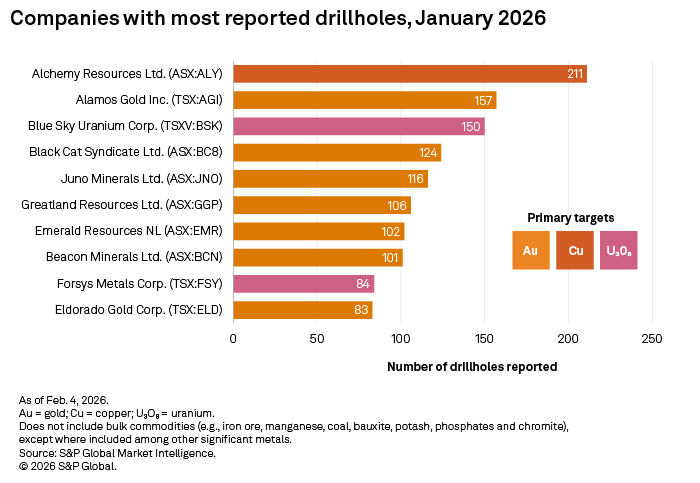
ASX-listed Alchemy Resources Ltd. topped the list of companies with the most reported drillholes, totaling 211 at its Karonie project in Western Australia. The next stage of the current drill program has started as part of the farm-in and joint venture with JOGMEC (Japan Organization for Metals and Energy Security).
This article was published by S&P Global Market Intelligence and not by S&P Global Ratings, which is a separately managed division of S&P Global.