Research — February 13, 2026
Consensus price forecasts – Gold, silver prices surge to new highs

By Anna Duquiatan
S&P Global Energy discusses consensus price forecasts for industrial and precious metals, including platinum group metals, amid broader market trends.
See S&P Global Energy's most recent market outlooks for aluminum, copper, gold, iron ore, lithium and cobalt, nickel and zinc.

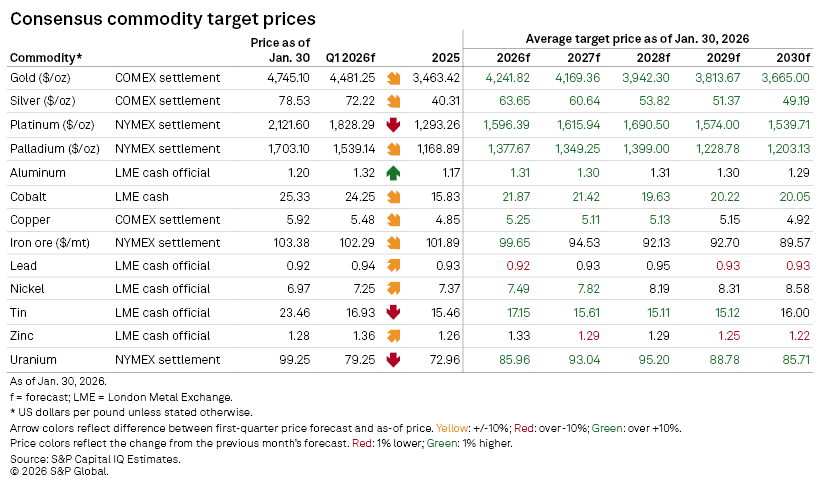
Gold, silver, platinum and copper prices reached new historic peaks in January, while most other industrial metals prices hit multiyear highs. Investors' flight to safety amid a fraught geopolitical and macroeconomic landscape — in conjunction with concerns over supply shortages — sustained upside momentum across metals markets for much of the month. Consensus price targets across 2026–30 were upgraded almost across the board, with a sharp boost for precious metals but limited gains for the nickel market as it continues to grapple with persistent structural oversupply.

The US Federal Reserve left interest rates unchanged at 3.50%-3.75% on Jan. 28, citing "solid" economic growth. While the Fed did not signal future policy adjustments, market participants anticipate one to two rate cuts in 2026.
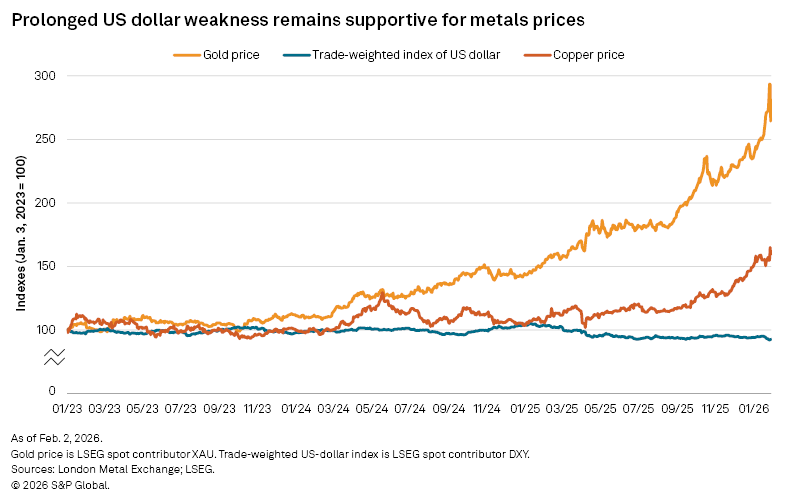
The latest Fed rate decision unfolded amid perceived challenges to its independence, following the Justice Department's criminal investigation into Fed chair Jerome Powell. Powell's term ends in May, with former Fed governor Kevin Warsh nominated to be successor, pending Senate confirmation. Concerns over the Fed's autonomy weighed on the US dollar, though steady interest rates and Warsh's nomination contained the downside.
Manufacturing remained subdued in the eurozone in January but improved across the US and Asia as production and demand firmed. Meanwhile, China's property and construction downturn continues, with sharper year‑over‑year declines in real estate investment and floor space under construction in December 2025. As China sets in motion its 15th Five‑Year Plan, new stimulus measures may bolster domestic demand, driving support for industrial metals prices.
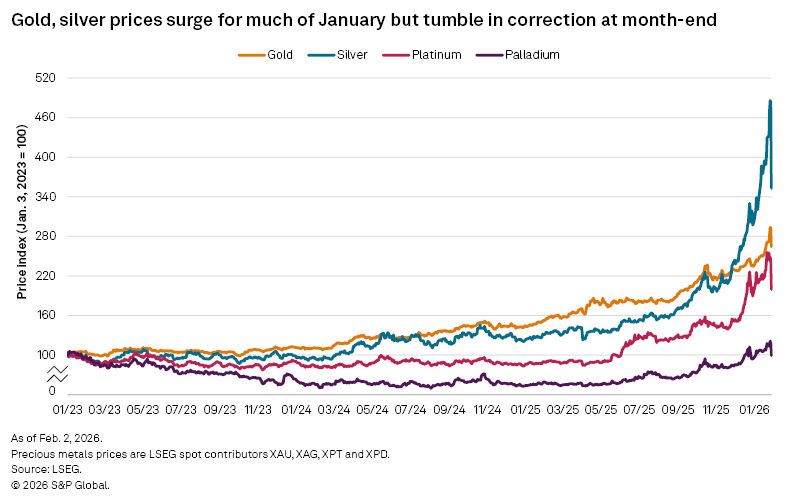
The London Bullion Market Association gold price extended its spectacular rally into 2026, setting 12 fresh records in January and peaking at $5,405 per ounce on Jan. 29 before dropping 7.8% the next day to $4,981.85/oz in profit-taking. Investors remain drawn to gold amid concerns about Fed independence, escalating geopolitical risks stemming from US' tensions with Venezuela, Greenland and Iran, and a delicate global macroeconomic outlook. A prolonged bout of US dollar depreciation spurred record inflows into gold exchange-traded funds, while ongoing de‑dollarization efforts keep central bank accumulation robust. Gold's bull run is expected to extend into a fifth consecutive year in 2026, although market correction and an improving global economic growth outlook pose downside risks. Gold consensus price forecasts were upgraded 6.1% on average across 2026–30.
Silver mirrored gold's dramatic rise and correction. The COMEX silver price hit a record $116.86/oz on Jan. 28 before plunging to $85.29/oz on Jan. 30. Yet, investors remain optimistic, with consensus price forecasts raised 30.8% on average across the next five years. Strong ETF inflows and surging retail demand in Asia and the Middle East continue to strain physical silver availability. Local shortages have reportedly pushed premiums above the London benchmark. Silver also faces a long‑standing structural deficit, with demand supported by its dual role as a safe‑haven metal and an industrial input in electronics, renewable energy technologies and electric vehicles.
At NYMEX, the platinum price surged to a record $2,821/oz on Jan. 26, and palladium hit $2,116/oz on Jan. 29 — the highest in more than three years — then both prices pulled back at month-end. Macroeconomic and geopolitical factors that support the gold price also drive upside momentum for platinum group metals, but ongoing supply-demand imbalances add fundamental support. The World Platinum Investment Council projects only a brief market equilibrium for platinum in 2026, followed by renewed deficits, while a palladium surplus is expected to emerge. Elevated prices may incentivize new supply but also erode some demand, especially in the jewelry sector. In the automotive sector — the largest demand driver for these two PGMs — platinum's premium over palladium may drive a palladium-for-platinum substitution. Consensus price forecasts across 2026–30 were lifted by an average of 11.7% for platinum and 12.6% for palladium.
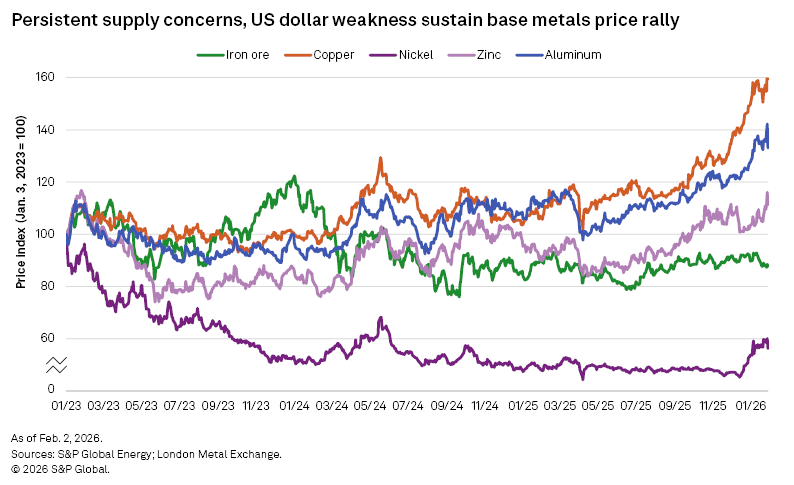
Copper also continued its ascent, driven partly by speculative interest linked to silver's rally. The London Metal Exchange three‑month (LME 3M) copper price reached an unprecedented high at $13,618 per metric ton on Jan. 29 before moderating. Spot concentrate treatment charges (TCs) remain low, straining smelter cash flow. Although China's construction and property slowdown is pressuring demand, tight concentrate supply, expectations of Fed rate cuts, and continued metal inflows into the US have kept prices firm. COMEX inventories remain high, even as US President Donald Trump's directive to negotiate critical mineral agreements temporarily eased tariff concerns. Copper is increasingly being priced relative to gold and silver, signaling further upside potential, although high prices may suppress consumption. Consensus price forecasts were raised 3.3% on average across 2026–29 and downgraded 0.7% for 2030.
Zinc joined the broader rally, with the LME 3M price reaching $3,412/mt on Jan. 29, the highest since January 2023. Global inventories remain historically low despite rising refined supply outside China. The concentrate market remains constrained, seen in falling TCs and China's strong raw material imports. While tariff delays improved macro sentiment, China's flagging property and steel sectors still cloud demand prospects. Zinc consensus price forecasts were upgraded 0.6% for 2026 but lowered 1.6% on average across 2027–30.
The LME 3M aluminum price reached a near four‑year high at $3,257/mt on Jan. 28 as expectations of slowing primary production and strong AI‑related consumption fueled concerns over supply shortages. China exceeded its annual 45-million-metric-ton capacity cap, while operational challenges at the Nordural smelter in Iceland and at Mozal in Mozambique risk further supply losses. The US Midwest premium set a new all-time high amid tariff uncertainties and tight domestic supplies. After the US imposed steep tariffs on aluminum imports in mid-2025, shipments of the metal from top supplier Canada in January to October fell more than 25% year over year. Canada diverted exports to the European Union, but future volumes could be limited by the latter's implementation of the Carbon Border Adjustment Mechanism (CBAM) this year, a quasi-tariff that prices in the embedded carbon emissions of imports. Consensus price targets were raised 1.4% on average across 2026–29 and lowered 0.3% for 2030.
The LME 3M nickel price averaged $17,966/mt in January, up 19.2% month over month. Top nickel producer Indonesia announced a sharp cut to its 2026 nickel production quota to 250-260 million mt, from 379 million mt in 2025, triggering rising concerns over potential supply shortfalls. However, the nickel market remains structurally oversupplied, with LME inventories jumping to over 275,000 metric tons in early January. Slowing stainless steel production growth and the implementation of Europe's CBAM weigh on demand expectations. Consensus price outlooks were lifted 0.5% on average across the next five years.
The Platts-assessed European cobalt metal price spiked to a more than three‑year high at $26.50 per pound on Jan. 27 due to continuing delays in exports from Democratic Republic of Congo. Platts is part of S&P Global Energy. DRC's cobalt exports to China plummeted 47.8% year over year in January–November 2025, while Glencore PLC's trial shipment under the new quota system has yet to reach China. Despite high cobalt prices, demand remains resilient, as applications in consumer electronics batteries and superalloys have shown strong tolerance for elevated costs. Slowing EV sales amid waning incentives and the diminishing popularity of cobalt-containing battery chemistries are dragging down demand expectations. Consensus price outlooks across 2026–30 were raised 6.3% on average.
The Platts IODEX 61% Fe iron ore price peaked at $109.25 per dry metric ton on Jan. 7 as pre-holiday restocking provided temporary demand support, then slipped below $105/dmt in Jan. 19–30. Platts updated its IODEX specification to reflect the pricing of 61% Fe iron ore fines shipped to China, from the previous 62% Fe benchmark, aligning with declining average ore quality. China's iron ore imports hit a record high in December 2025 but will likely be trimmed by sustained pressure across the domestic property and steel sectors. China's steel production dropped to a near-two-year low in November 2025, while the government reiterated that steel production curbs remain a priority. Rising exports from Brazil and steady shipments from Australia helped to loosen the global seaborne trade balance in 2025, while the imminent ramp-up of the Simandou mine in Guinea is expected to support the emergence of growing seaborne trade surpluses. Consensus price targets were raised an average of 0.6% across 2026–30.
S&P Global Energy produces content for distribution on S&P Capital IQ Pro.
This article was published by S&P Global Market Intelligence and not by S&P Global Ratings, which is a separately managed division of S&P Global.