Research — February 27, 2026
Banks meeting data center demand with billions in credit facilities, bonds

By Thomas Mason
Demand for data center financing remains red-hot, offering a wellspring for lenders that have the domain expertise and, in many cases, a big enough balance sheet to handle it.

Big banks are benefiting from the boom in data center construction, as they can accommodate the capital needs of hyperscalers and have investment banking arms that can run securitization offerings. But smaller banks can participate in the trend as well, via syndicated loans and by lending to companies that work on more modest projects.
Data center builders are using a variety of financing techniques: Credit facilities, asset-backed securities, commercial mortgage-backed securities and industrial revenue bonds.
The top 10 states for data center loans largely mirrored the states with the most data centers, with Virginia, California and Texas all making the list. But builders are also looking in new places, including a gigantic project in New Mexico. Tax advantages seem an important consideration, in addition to availability of energy and land.

We estimate that lenders committed to $121.91 billion in credit for data center properties in 2025, using machine learning to combine two datasets: One with the locations of data centers and another with commercial real estate loans made on US properties. This is explained in-depth in the Methodology section below; click here for a link to the Python code.
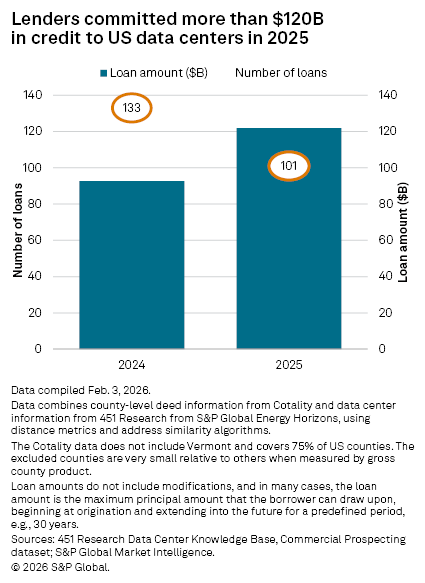
We use the term "committed" because some of these loans were credit facilities, with the reported value representing the maximum principal amount the borrower can draw upon. Several of the loan amounts were enormous, leading to a heavily skewed distribution. The average amount in 2025 was $1.2 billion, but the median was only $40 million. This suggests to us that the banks working on the biggest deals are benefiting disproportionately from the surge in demand for data center financing.
One bank is not typically on the hook, however, as the loans are often divvied up via syndication. A $6.92 billion loan to data center builder and operator QTS Realty Trust LLC in December 2025, for example, involved a consortium of 11 lenders, including Citigroup Inc., Goldman Sachs Group Inc., JPMorgan Chase & Co. and Wells Fargo & Co. Another builder and operator, Switch Inc., said in September 2024 that over 25 banks participated in two of its financings — a borrowing base facility and a revolving credit facility — together totaling $5 billion. Lenders upsized those credit facilities to $10 billion in July 2025.
Securitization is another option. Switch (via an LLC named after one of its data centers) filed a deed of trust in March 2024 that allowed for $15 billion in advances to issue asset-backed securities. As of October 2025, Switch had issued approximately $3.5 billion in ABS across four offerings, or about 23% of the capacity outlined in the deed. Switch and others have also used commercial mortgage-backed securities as a financing mechanism. Here, too, large banks, with investment banking arms that can run these deals, have reaped the spoils.
But smaller institutions are not completely shut out of the data center action. They might be participating in some of the syndicated loans, and they can lend to builders and operators of more modest projects. At the lower end of our loan dataset was a $25 million mortgage for a property in Elk Grove Village, Ill., owned by EdgeConneX Inc., whose data center solutions can range in size from 40 kW to 500 MW.
The top 10 states for data center loans largely mirrored the states with the most data centers, with three exceptions: Nevada, New Mexico and Tennessee.
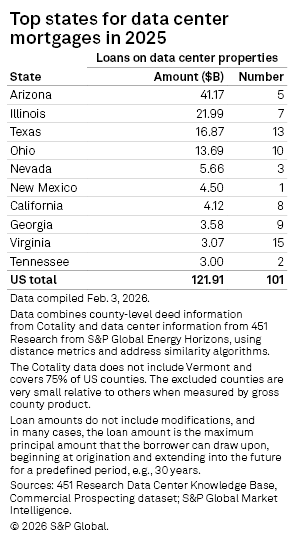
The New Mexico project illustrates yet another technique for financing data center construction: Industrial revenue bonds. The county, Doña Ana, is issuing the bonds to finance Project Jupiter, a hyperscale data center campus led by STACK Infrastructure Inc. in partnership with Borderplex Digital Assets. As part of the deal, the county owns the site and leases it back to Project Jupiter. A deed of trust filed in November 2025 shows a $4.5 billion line of credit for seven parcels of land in Doña Ana County. But the county's long-term plan calls for much more: The developers must commit to an initial capital investment of at least $50 billion within the first five years and a maximum aggregate investment of up to $165 billion over 30 years.
Methodology
The first step to match property records between the 451 Research from S&P Global Energy Horizons and Cotality datasets included analyzing latitudes and longitude coordinates; however, coordinates between the two databases may not be exact matches. Our solution uses a custom script that takes each 451 Research data center property record and calculates the Euclidean distance between the 451 Research property record and the Cotality property records, then returns the Cotality property record with the smallest distance. Due to the size of the Cotality property dataset, over 25 million property records in total, we limited the analysis to properties with mortgages originated in 2024 or 2025, which narrowed the list to approximately 950,000 and reduced computational complexity.
One of the downsides to this approach is that the algorithm will find the closest property record, even when it is not the same property, such as 580 Wald Ave. and 564 Wald Ave. To remedy this, we set a threshold for the Euclidean distance and used OpenAI o4-mini to vet the address pairs. Large language models are ideally suited to this task; they understand that common abbreviations in street names refer to the same property but also that different street numbers represent different properties. This system is still not perfect, however, due to the accuracy and availability of the street data. Sometimes the data center is still in the planning stages, so 451 Research will not have the exact street number yet, or the street name is missing from either the 451 Research data or the Cotality data. Conversely, the street number might be too specific, as some data center operators build campuses that span several blocks. This is where the Euclidean distance algorithm's weakness is also a strength, as it will find properties that are part of the same campus but have a different street number.
Given these limitations, we did some vetting to improve the accuracy of our combined dataset. We manually researched mortgages of more than $500 million, as this covered 80% of the total mortgage amount in our combined dataset. We further improved the combined dataset by using the attributes of the matches we knew for sure were right, or created a training dataset of ground truth. We identified common abbreviations in data center owner names (such as C1 for CyrusOne Inc.) and used the mailing addresses of companies that specialize in data centers to find additional properties that they own. This can uncover additional properties that data center owners have bought, where the plans are not widely publicized.
Click here for my GitHub repository, which has the Python code used to get the data from Snowflake and match the two datasets.
This article was published by S&P Global Market Intelligence and not by S&P Global Ratings, which is a separately managed division of S&P Global.