Research — Jan. 30, 2026
P&C next frontier for alternative managers' insurance AUM expansion

By Tim Zawacki
After alternative asset managers have helped reshape the US life and annuity sector in recent years, a new partnership between American International Group Inc. and CVC Capital Partners PLC underscores the prospective opportunities that may exist in the property and casualty sector to help fulfill their insurance assets under management (AUM) growth goals.

The intersection of alternative asset management and life insurance has taken on a number of forms, including vertically integrated structures, cross-ownership and long-term third-party investment management agreements. This has accelerated life insurers' investments in various kinds of alternatives, including limited partnership stakes, direct asset-based lending and various types of structured finance products, while helping them achieve record sales of certain types of products, particularly various types of annuities.
The strategic shift has been unfolding for more than a decade, but certain recent events have demonstrated the extent to which alternative investments have gone mainstream. High on that list from our perspective was the January 2025 announcement of a multifaceted $13 billion partnership between alternative asset manager Sixth Street Partners LLC and The Northwestern Mutual Life Insurance Co. The AIG-CVC pact involves a considerably smaller dollar amount — up to $3.5 billion in private equity and private credit investments — but we believe it may serve as a catalyst for similarly situated managers to broaden and accelerate their ongoing pursuit of insurance AUM.
The P&C sector is not as rich with opportunity as life and annuity given its liability profile, especially in shorter-tail business lines where liquidity is paramount. But we expect allocations among P&C insurers to alternatives to increase in 2026, in some cases perhaps significantly, amid an increasing convergence of interests between the sector and alternative asset managers. P&C insurers may face increasing pressure to generate additional incremental yield in 2026 at a time we expect that underwriting margins will compress and more dovish central bank interest rate policy could create headwinds for investment income.

Under the new partnership, AIG serve as a cornerstone investor for CVC's forthcoming private equity secondaries evergreen platform with an investment of up to $1.5 billion while it also allocates up to $2 billion in large-scale separately managed accounts (SMAs) and funds focused on certain strategies within CVC's private and liquid credit strategies.
The arrangement offers AIG what it described as a means to manage and transition its legacy private equity exposures while also moving the insurer closer to targeted allocations to private credit and private equity that it outlined during its March 2025 investor day. At that time, the company said that it was looking to increase allocations to private credit and private equity to between 12% and 15%, and between 6% and 8%, respectively, of its general insurance investment portfolio from 8% and 5%. It had already inked an agreement with Toronto-based Onex Corp. to acquire a minority equity interest and invest $2 billion over a three-year time frame across the alternative asset manager's platform, including in certain collateralized loan obligations (CLOs) and broadly syndicated loans. AIG CFO Keith Walsh said during a November 2025 conference call that the company planned to roll proceeds from divestitures of certain noncore legacy private assets, mostly in real estate, into Onex strategies.
"We have private credit mandates with a small group of strategic partners who follow strict investment guidelines," Walsh said. "We do a detailed review of every transaction we enter into and are very thoughtful about deployment and aggregation." The CFO expressed optimism about the prospects for the Onex arrangement to aid AIG in its pursuit of higher yields on invested assets. The new CVC partnership likely possesses a similar goal.
Definitions of what types of investments constitute private credit tend to vary from one company to another and related positions are scattered across various NAIC investment schedules. So for the purpose of this article, we limited our focus to investments in other long-term invested assets, including direct investments, co-investments and participations in private equity and hedge funds, reported on Schedule BA of statutory statement blanks by AIG and its US P&C peers. From a technical standpoint, this includes investments classified as joint venture or limited-liability-company stakes with characteristics of stock, bonds, real estate, mortgages, and miscellaneous other assets. Any references to P&C industry results exclude Berkshire Hathaway Inc.
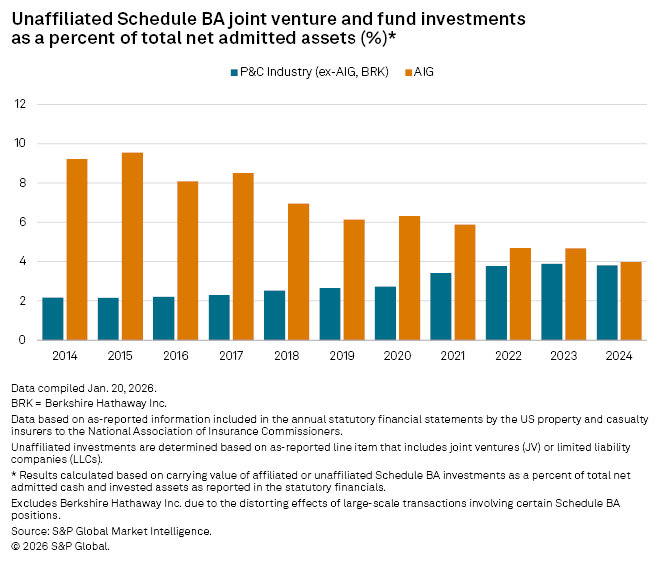
AIG's relative allocation to affiliated and unaffiliated funds and related vehicles on Schedule BA of its 2024 annual statutory filing of less than 7.8% was 1.9 percentage points higher than the rest of the US P&C industry's concentration, based on our review, but it was lower than it had been in the past, reflecting the company's efforts to reduce exposure to hedge funds. At year-end 2015, for example, investments of the kind by AIG's current US P&C subsidiaries amounted to 13.2% of net admitted cash and invested assets. The rest of the P&C industry's relative allocations have trended inversely, rising to 5.8% at year-end 2024 from 3.9% as recently as 2017. For additional context, US life industry relative allocations to those assets totaled 5.1% at the end of 2024.
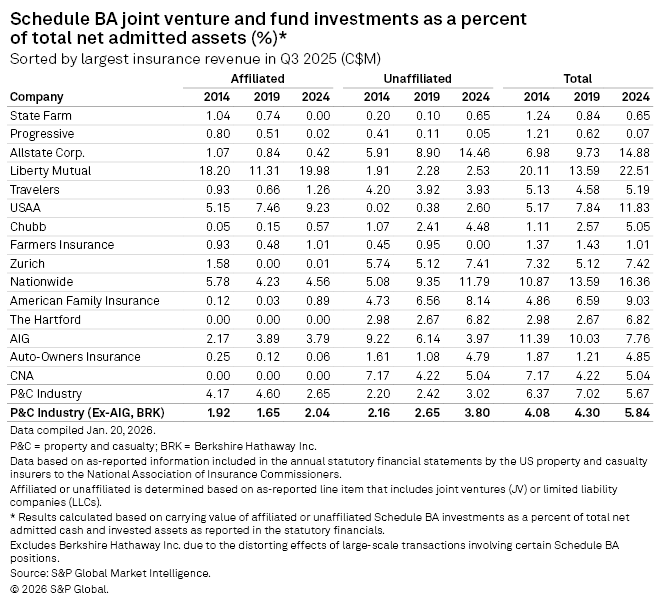
Among the 35 other US P&C groups with more than $10 billion in AUM, allocations ranged from 0% at Auto Club Exchange Group to well into the double digits at Liberty Mutual Holding Co. Inc. (22.5%), the group led by Nationwide Mutual Insurance Co. (16.4%), American Financial Group Inc. (15.1%), The Allstate Corp. (14.9%), and the group led by Erie Insurance Exchange (14.3%).
If we focus solely on unaffiliated joint venture and limited liability company stakes to exclude certain investments in downstream non-insurance holding companies, which serve to inflate the concentration level for Liberty Mutual in particular, AIG's 4.0% allocation compared favorably to the 2.9% result for the rest of the P&C industry.
A best-efforts linking of AIG's joint venture and LLC holdings with fund-level data compiled by With Intelligence, a part of S&P Global, finds diversification of by manager, asset class, primary strategy and geographic focus. At estimated Sept. 30, 2025 values, excluding commitments for additional investment, AIG held in excess of $100 million in funds managed by each of the following entities: Platinum Equity LLC, Solum Partners LP, The Carlyle Group Inc. and Viking Global Investors LP.
For CVC, meanwhile, the arrangement furthers its efforts to grow insurance AUM. The firm said in its 2024 annual report that it had raised more than €15 billion from insurance clients over a five-year span and saw a significant opportunity for additional growth. As of Sept. 30, 2025, CVC said that insurers across jurisdictions accounted for 25% of what With Intelligence reported to be a €10.4 billion final close of its CVC Credit Partners European Direct Lending Fund IV. Additionally, the company said that it raised a $1.1 billion insurance-focused US collateralized fund obligation.
Across the US P&C and life sectors, insurers held an estimated $355 million in funds with CVC in the name with notable investors including subsidiaries of MetLife, Inc., Arch Capital Group Ltd. and Brighthouse Financial Inc. That figure does not include commitments for future investment nor the hundreds of millions of dollars in additional US insurer investments reported on Schedule D of statutory statements in CVC Cordatus Loan Fund cash flow CLO notes.
This article was published by S&P Global Market Intelligence and not by S&P Global Ratings, which is a separately managed division of S&P Global.
Content Type
Theme
Location
Language