


RESEARCH — Dec 03, 2025
Surge in deposit-type contracts marks otherwise mixed Q3 for US life industry
By Tim Zawacki and Husain Rupawala
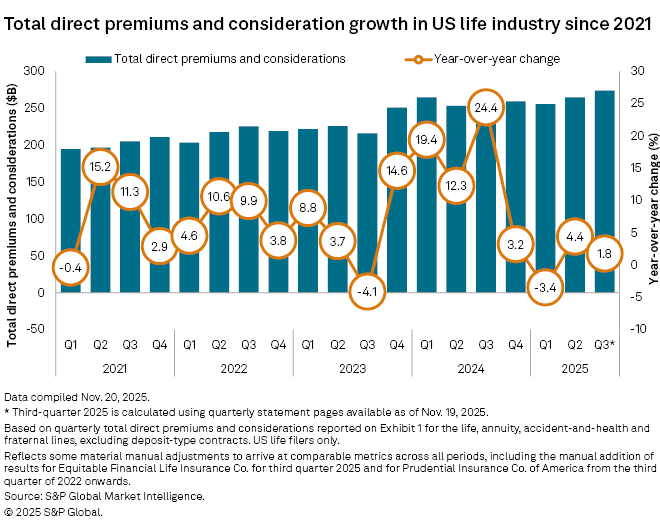
Mixed results in core businesses led the US life insurance industry to post only a modest third-quarter rise in direct premiums and considerations, but several leading carriers picked up any slack in the sector's fastest-growing line.

Total direct premiums and considerations increased by 1.8% in the third quarter to $273.68 billion, based on our analysis of newly released statutory financials for the third quarter, inclusive of life, annuity and accident-and-health business. That marked the second-slowest rate of change in the last two years, down from growth of 4.4% in the second quarter and ahead only of the 3.4% decline recorded in the first quarter of 2025.
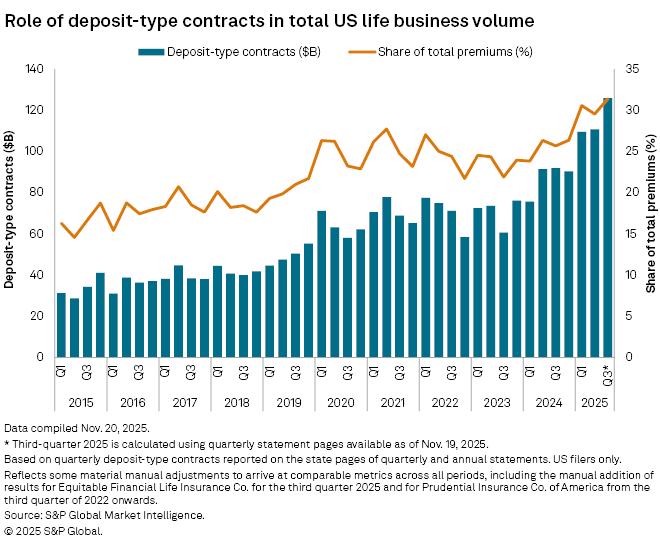
Deposit-type contracts, however, surged by 37.0% to a new quarterly high of $125.93 billion as life insurers continued to pivot to the issuance of funding agreements and funding agreement-backed notes. When added to the life, annuity and accident-and-health premiums and considerations, total industry direct business volumes increased by 10.8% in the third quarter, up from the 8.9% expansion booked on the same basis in the second quarter.
Premiums and considerations in the annuities business, the engine of the industry's outsized expansion from 2022 through most of 2024, slipped by 1.3% year over year, reflecting a challenging comparison in the individual portion of the business and persistent headwinds in the pension risk transfer group annuity market.
Macroeconomic uncertainties around the direction of the US economy and prospects for further easing in the Federal Reserve's interest rate policy could put a ceiling on the industry's near-term expansion, but continued favorable supply and demand dynamics for certain key life and annuity products also create a high floor for future business volumes.

Deposit-type contracts
The rate of growth in deposit-type contract funds accelerated in the third quarter to 37.0% from an already elevated level, marking a sixth straight quarter of double-digit year-over-year increases. They accounted for 31.5% of total direct business volume in the third quarter as compared with 25.5% in the year-earlier period. Under statutory accounting, however, amounts received as payments for those contracts are recorded directly as a liability and not included in revenue.
Deposit-type contracts include various types of products such as funding agreements, guaranteed investment contracts and certain annuities that lack insurance risk. Quarterly statutory filings do not provide a breakout by product, but funding agreements, which typically are used by life insurers as part of spread investing programs and for asset-liability matching purposes, likely played a significant role in the expansion. Volumes included the combination of issuance to facilitate the sale of funding agreement-backed notes to institutional investors and in connection with programs operated by the Federal Home Loan Banks (FHLBs). We calculate that life company general account funding agreements outstanding to the FHLBs to have totaled $126.82 billion as of Sept. 30, up from $125.45 billion three months earlier and $121.53 billion at year-end 2024 among available Sept. 30 quarterly statement filers.
Equitable Holdings Inc. led the industry with a volume of $21.07 billion, up 12.9% year over year. CFO Robin Raju, speaking during a Nov. 5 conference call, said that the company issued about $4.5 billion through its funding agreement-backed notes program through the first three quarters of 2025, with additional capacity for future expansion. It also ranked second in the life industry when limiting the analysis to general accounts with $7.07 billion in FHLB funding agreements outstanding. The overwhelming majority of Athene Annuity and Life Co.'s $20.73 billion in FHLB funding agreements are associated with its separate accounts.
"We can benefit (from) the strength of Equitable and having a strong rating, borrow at a low cost of funds and take that and invest it at attractive risk-adjusted yields at AllianceBernstein," Raju said of the company's asset management affiliate. Raju added that the program's growth is closely tied to rising sales of Equitable's registered index-linked annuities (RILAs) to the extent that "the returns are there."
Others that reported significant issuance of funding agreements in connection with funding agreement-backed notes programs included KKR & Co. Inc.'s Global Atlantic Financial Group Ltd., Lincoln National Corp., New York Life Insurance Co. and F&G Annuities & Life Inc.
Annuities
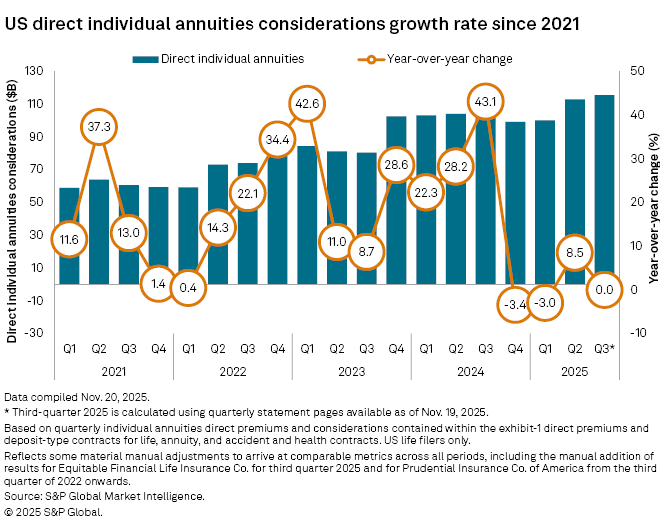
Individual annuity growth was essentially flat in the third quarter as the industry faced a daunting year-over-year comparison.
LIMRA's US Individual Annuity Sales Survey, which typically tends to be at least directionally consistent with results from direct premiums and considerations statistics from statutory filings, showed an estimated year-over-year increase of 4% in third-quarter 2025 sales volumes. Strength in RILAs and variable annuities offset weakness in fixed indexed annuities. Statutory results incorporate the impact of new and renewal business.
Individual annuity direct premiums and considerations comparisons varied widely among the leading market participants. The US subsidiaries of Athene Holding Ltd., which led the industry in individual annuity volumes from a statutory perspective in the third quarters of each of the past two years, posted an increase of 14.4%. But the group led by Massachusetts Mutual Life Insurance Co., which ranked second in the third quarter of 2024, posted a 43.4% year-over-year decline. The company had cited lower fixed and income annuity sales for an unfavorable comparison in the first half of 2025. Taking its place as the No. 2 individual annuity writer were the life subsidiaries of Nationwide Mutual Insurance Co., which produced a 73.0% year-over-year increase in direct premiums and considerations.
Executives at Athene parent Apollo Global Management Inc. attributed the company's third-quarter success during a Nov. 4 conference call to "particular strength" in fixed indexed annuities and multiyear guaranteed annuities. Athene has also launched a RILA product that Apollo said has produced inflows of more than $1 billion through the first nine months of 2025.
Comparisons from a statutory statement perspective become demonstrably easier in the fourth quarter of 2025 and the first quarter of 2026, though with the Federal Reserve's successive 25 basis points cuts to the federal funds rate in September and October, it is possible that the market will have experienced a pull-forward effect in sales comparable to the one that helped push volumes down in the year-earlier periods.
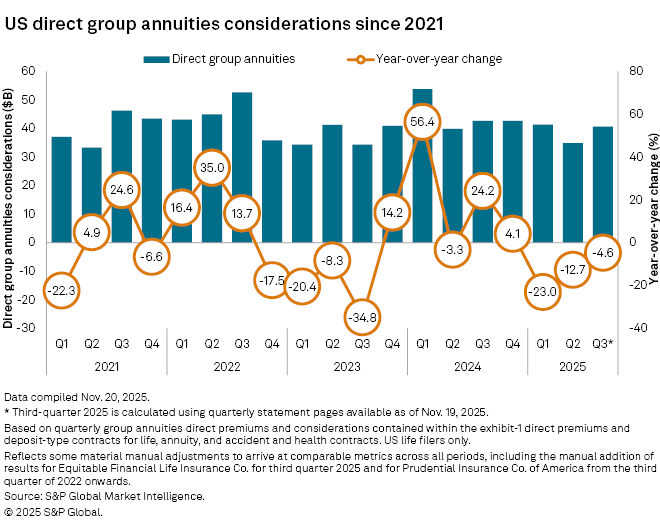
Group annuities continued to serve as a headwind to overall life industry expansion with a year-over-year decline of more than 4.6% in the third quarter and 13.6% for the year to date. The pension risk transfer group annuity business remains subject to litigation and related headline risk, though trends varied by market segment. Prudential Financial Inc., a leader in the jumbo portion of the market, showed declines in group annuity direct premiums and considerations of 40.6% in the quarter, but management spoke optimistically about the near-term pipeline and long-term opportunities in the business during a third-quarter earnings call.
Life insurance
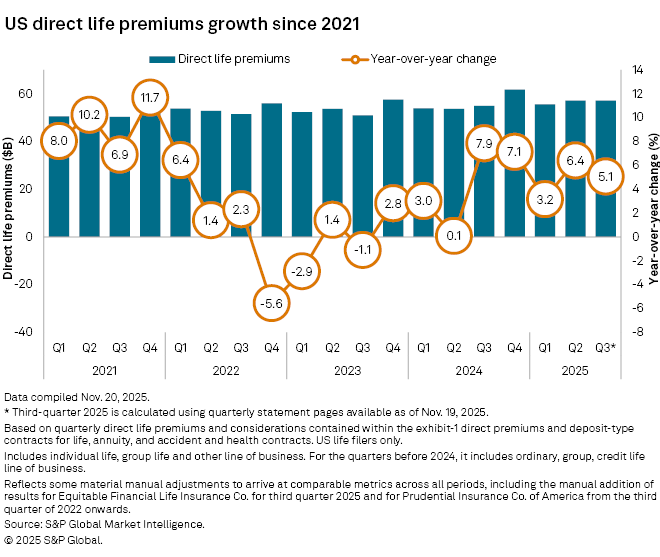
A strong year for individual life insurance continued with direct premiums rising by 6.1% in the third quarter.
LIMRA's preliminary US Retail Individual Life Insurance Sales Summary Report showed outsized expansion in annualized premiums for variable and indexed universal life products and strong growth in whole life annualized premiums.
Pacific Life Insurance Co., which ranked as the fourth-largest variable universal life writer in 2024, reported a 118% spike in direct premiums in that business during the first three quarters of 2025. While product-level detail on premium volumes is limited to annual statutory filings, Pacific Life's individual life business rose by 90.6% in the third quarter. Only Lincoln among the largest writers in the individual life space posted a growth rate anywhere near that level as it showed an increase of 61.8%.
Group life direct premiums, meanwhile, increased at a sluggish 1.2% pace, but that largely reflects the drag on results from the No. 1 writer in the business line. Excluding MetLife Inc.'s 10.3% decline in group life volume, the industry's expansion would have approached 6.1% year over year, which would have been more consistent with the growth it showed during the second quarter.
Accident and health
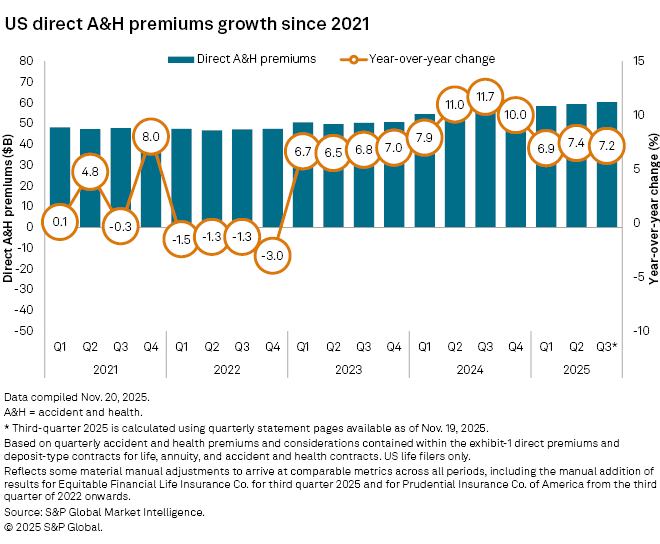
Growth rates in accident and health among life statement filers were much more consistent on a quarter-over-quarter basis, rising by 7.2% in the three months ended Sept. 30. The two largest accident and health writers among life filers, UnitedHealth Group Inc.'s UnitedHealthcare Insurance Co. and CVS Health Corp.'s Aetna Life Insurance Co., posted above-market rates of expansion at 12.2% and 8.5%, respectively.
The UnitedHealth company writes a mix of group comprehensive major medical, Medicare supplement and individual comprehensive major medical business, among various other coverages. Aetna Life largely focuses on group major medical and individual Medicare business.
With UnitedHealth guiding to a sharp expected decline in enrollment in its individual Affordable Care Act Marketplace business in 2026, however, headwinds in the life industry's portion of the accident and health business could face headwinds. The insurer says on its website that the life entity writes individual and family ACA insurance plans in 10 states, but this accounted for only 4.5% of its 2024 premium volume in the accident and health lines.
Methodology
Results from statutory filings reflect data on Exhibit 1 of quarterly statements obtained by S&P Global Market Intelligence as of Nov. 19, supplemented by various adjustments. The most significant adjustments are as follows:
1) We manually added data for Prudential Insurance Co. of America. Quarterly statutory filings and related data for New Jersey-domiciled companies such as the Prudential subsidiary are not disseminated by regulators for public review by state statute. Prudential posts select statutory results on its investor relations website, which we incorporated where available; and
2) The third-quarter 2025 statutory statement of Equitable Financial Life Insurance Co. missed the cut-off time for inclusion in our first data posting, so we manually incorporated the company's results into our analysis.
3) Our year-over-year comparisons are presented on an apples-to-apples basis using data reported in the prior-year column of Exhibit 1.
While the data is subject to change upon the receipt of additional information, we do not expect material changes to the industry totals given the size of the remaining entities for which second-quarter 2025 financials are not available.
Please note that due to the adjustments and estimates described above, values and year-over-year percentage changes calculated using S&P Global Market Intelligence industry aggregates for all periods referenced in this article may differ materially in both direction and magnitude.
This article was published by S&P Global Market Intelligence and not by S&P Global Ratings, which is a separately managed division of S&P Global.
Content Type
Theme
Location
Segment
Language