14 Jul, 2026
What upholding NY gas bans means for the US building electrification movement

Policies that restrict natural gas use in buildings are on firmer legal footing following a US appeals court opinion that upheld New York City and state gas bans for new construction, according to attorneys and legal experts.
The policies have been at heightened legal risk since 2023, when the US Court of Appeals for the 9th Circuit held that the federal Energy Policy and Conservation Act (EPCA) preempted Berkeley, California's first-in-the-nation gas ban. The decision upended a West Coast building electrification movement and had a broader chilling effect across the US.
But a June 30 decision by a three-judge panel for the US Court of Appeals for the 2nd Circuit for the first time established a conflicting precedent at the federal appellate level, easing the legal risk for policymakers seeking to address building sector emissions, some attorneys said.
"I think that state and local governments now should feel much more confident in addressing the impacts of fossil fuel combustion," Public Health Law Center senior staff attorney Daniel Carpenter-Gold told Platts, part of S&P Global Energy. "I think this does a lot to dispel the dark clouds that have been over every regulation discussion since" the 9th Circuit opinion.
The 2nd Circuit decision built on a trend: US district courts have roundly rejected the 9th Circuit's interpretation, instead upholding policies that restrict fossil fuel use in buildings.
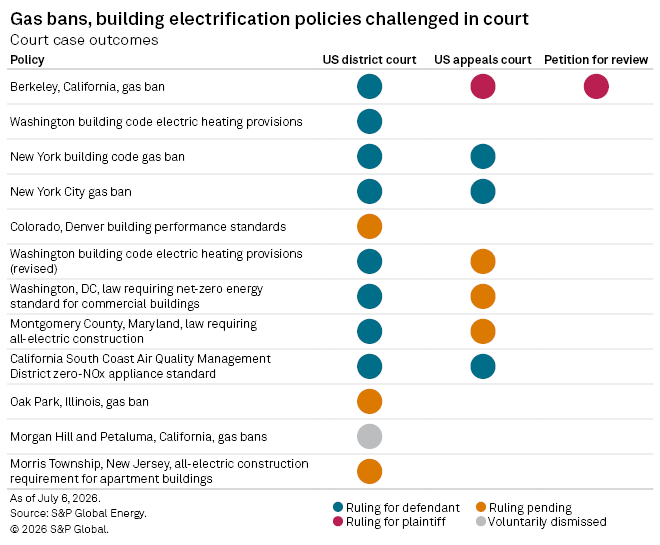
Attention is now turning to other US circuits, where some of the district court decisions are under appeal. Additionally, the New York cases are not yet settled, and shifting political winds could affect politicians' support for building electrification.
Looming over all the proceedings is the question of whether the US Supreme Court could get involved in addressing the circuit split created by the 2nd Circuit's break with the 9th Circuit.
"We are still discussing the options for moving forward with our clients, but at the end of the day, EPCA preemption of effective gas bans is a legal question the Supreme Court may ultimately need to resolve," said Sarah Jorgensen, a managing partner at Reichman Jorgensen Lehman & Feldberg LLP who represented the appellants in the New York cases.
Affirmation of influential dissent
Jorgensen's legal team also secured the 9th Circuit opinion in California Restaurant Association v. City of Berkeley. In that case, a three-judge panel held that Berkeley's gas ban effectively set maximum energy use of EPCA-covered appliances at zero and thereby conflicted with federal energy efficiency standards established by the US Department of Energy.
The 2nd Circuit panel read EPCA preemption more narrowly, largely hewing to Circuit Judge Michelle Friedland's interpretation, outlined in a dissent from the 9th Circuit's denial of Berkeley's petition for rehearing in 2024. Friedland opined — and the 2nd Circuit agreed — that the 9th Circuit made critical mistakes by applying colloquial meanings to technical terms to arrive at a broad reading of EPCA preemption.
Friedland said the 9th Circuit fundamentally misinterpreted EPCA's definition of energy use, which is "the quantity of energy directly consumed by a consumer product at point of use, determined in accordance with test procedures." By the statutory definition, energy use is a fixed number determined in test settings, and restricting gas use in new construction does not impact that figure, the judge said.
Courts have roundly followed Friedland's interpretation. The 2nd Circuit holding will add weight to Friedland's points because the panel's decision followed a more fulsome process, including briefing and oral argument, Carpenter-Gold said.
"The courts like that, and they treat it as important," he said.
A 'very comprehensive opinion'
The 2nd Circuit opinion also expounded on the points that Judge Friedland originated in her roughly 15-page dissent, attorneys said.
"It's a very comprehensive opinion itself, and they go to great lengths to check their own work and not just rely totally on Judge Friedland's dissent," Vincent Nolette, a fellow at Columbia Law School's Sabin Center for Climate Change Law, told Platts.
The 2nd Circuit cited additional examples from EPCA's legislative history to indicate Congress' intent, building on evidence compiled by Friedland, Carpenter-Gold said. He also noted that the 2nd Circuit delved further into the purpose of 1987 amendments to EPCA, stressing that Congress strengthened the preemption provision to specifically prevent a patchwork of energy conservation standards — not to block any regulations that could create challenges for appliance manufacturers.
The panel said, "The binary choice between electric and fossil-fuel-powered appliances does not represent the same risk of complication of the market as the potential for fifty different energy conservation standards."
The 2nd Circuit opinion could be instructive for policymakers and other courts because it essentially summed up when EPCA does in fact preempt local and state regulations, according to Nolette. He said these boiled down to three instances: when local and state energy conservation standards interfere with Congress' objectives in EPCA; when regulations reference or rely upon those federal standards; and when regulations otherwise impermissibly affect energy use.
Path to Supreme Court
The New York City gas ban remains in force, but it was unclear when the state policy would take effect. In 2025, New York agreed to delay the policy's implementation until the 2nd Circuit resolves any petition for review of the panel decision. The appellants have not yet filed a petition for rehearing.
New York Secretary of State Walter Mosley reached the agreement as Gov. Kathy Hochul (D) faced pressure within her party to delay the policy — and amid a broader moderation of New York's climate commitments. The Department of State said it was "very pleased" with the 2nd Circuit's decision but declined to comment on the administration's intentions to implement the all-electric construction policy.
Under the settlement, the state's gas ban would also remain in effect throughout the course of a petition for US Supreme Court review. Gas ban observers have long speculated that the issue could reach the nation's highest court following a circuit split.
The Supreme Court could deny a petition for review for the simple fact that there are many circuit splits, and the justices choose not to resolve most of them, according to Deborah Beim, a political scientist and University of Michigan professor who has studied when the high court wades into circuit splits. The Supreme Court is also more likely to grant review when the split occurs among more than two circuits, she said.
However, the Supreme Court may be more likely to review lower court decisions when circuit splits develop rapidly, Beim said. The fact that EPCA-based challenges to building electrification mandates in Washington, DC, and Montgomery County, Maryland, have reached two additional US appeals court circuits could attract the justices' attention, she said.
Berkeley ruling revisited?
These appeals court decisions bear watching because the Supreme Court may be less likely to grant a petition for review if a consensus emerges among several circuits, Beim said. In that case, the Supreme Court could allow the split to persist — or the circuit in the minority could revisit its holding.
That means the 9th Circuit could still decide to review the 2023 panel decision that roiled West Coast policymaking.
Seven circuit judges joined Friedland's dissent in 2024. On July 2, a separate 9th Circuit panel concluded that EPCA does not preempt a southern California air regulator's zero-NOx appliance standard, which would bar the sale of some gas equipment.
Of the dozens of California cities that adopted gas bans or electrification codes through 2023, some suspended — but did not officially revoke — their building electrification policies. Earlier this year, facing a lawsuit from the Trump administration over a 2019 gas ban, Morgan Hill, California, City Attorney Donald Larkin said the city chose the path of suspension due to the unsettled nature of EPCA preemption across US circuits.
"The reason we keep those ordinances on the books is things change," Larkin said at a city council meeting in January.