15 Jul, 2026
US power sector's fossil fuel planning stalled in Q2
By Karin Rives and Susan Dlin
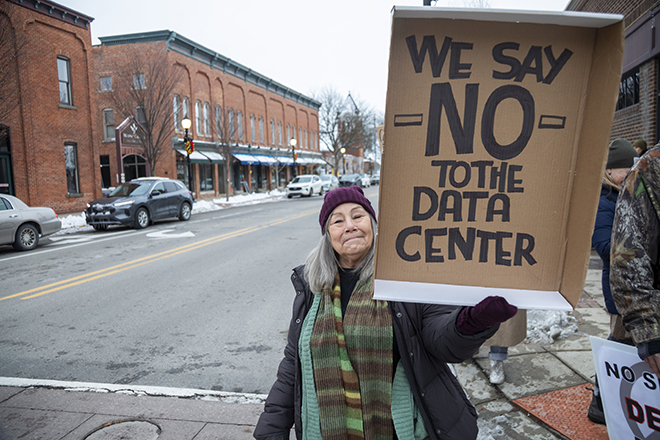
| Rural Michigan residents rallied against a multibillion-dollar Stargate AI campus planned on southeast Michigan farmland. The pushback against data centers amid rising power costs has contributed to recent market uncertainty, analysts said. Source: Jim West/UCG/Universal Images Group via Getty Images. |
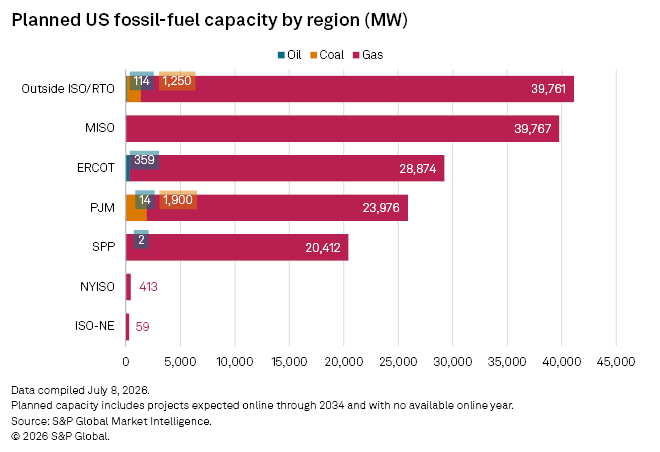
The US power sector's plans for new fossil fuel-fired electricity plants lost momentum during the second quarter of 2026, data from S&P Global Market Intelligence showed.
Every quarter since May 2024, power companies and other developers have announced projected double-digit growth rates in new gigawatt capacity to be built or in early-stage development. The expansion has been driven primarily by anticipated power demand from data centers.
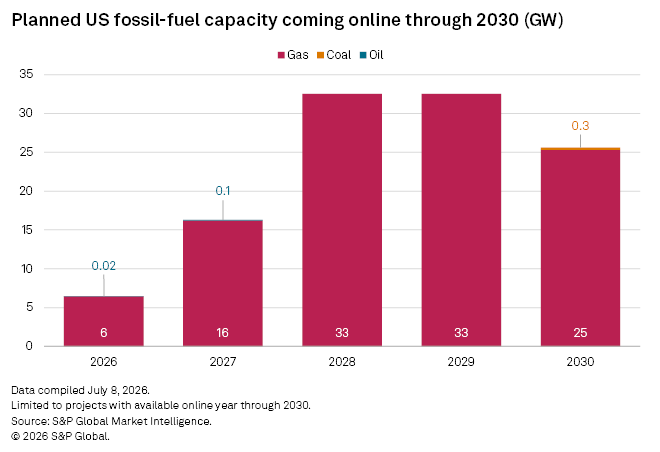
The planned building boom slowed down in the spring and early summer this year, with 156.9 GW of capacity now in the planned or early construction phases, just a 1% increase from the first quarter of 2026, the data showed. Natural gas generation still made up about 98% of the planned new fossil fuel-fired capacity.
Industry analysts cautioned that a single quarter does not offer reliable insights into power market changes, as growth is rarely linear. They also suggested that the rush to announce new power projects may be slowing as electric utilities and other developers shift their focus to permitting, contracting and financing projects announced months ago.
Companies may be holding back on new projects that would come online five or six years in the future, said Gregory Gangelhoff, a director at the utility consultancy Energy and Environmental Economics Inc., known as E3.
"For the next three years, we know that more power is better," Gangelhoff said in an interview. "Post-2030, there is a lot of uncertainty with demand and supply. I think there's another reason why ... I would expect to see a slowdown. The cone of uncertainty gets greater, and people are going to be more hesitant."
Industry uncertainty may also be growing as data centers in the US face sudden headwinds, calling into question some projections for electricity growth, according to Stephen Arbogast, a finance professor at the University of North Carolina's Kenan-Flagler Business School.
"You're now seeing data center moratoriums, and you're beginning to see the first expressions of doubt and skepticism on Wall Street as far as what these players are doing," Arbogast said in an interview. "I call them the green sheets of boom-bust skepticism."
As of now, the US power sector plans to build 237 new power plants, 222 of which would be fueled by natural gas.
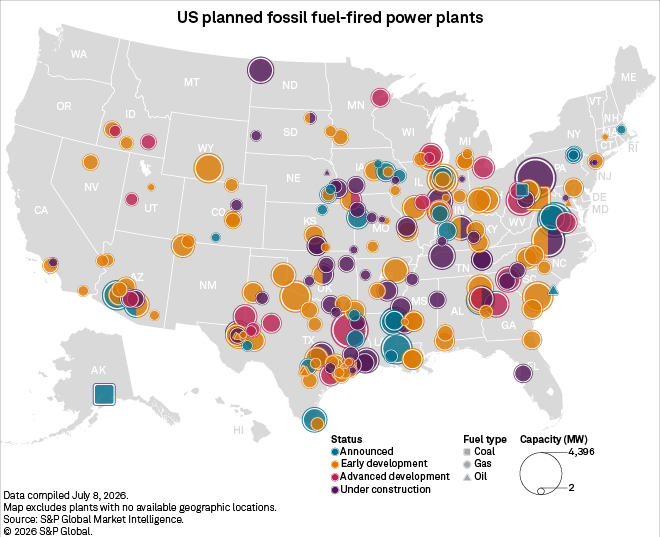
How many announced projects will ultimately be built and begin operating is unknown.
More than 750 GW of plant capacity that made it all the way to grid interconnection queues were withdrawn in 2025, while 600 GW in new requests were added, recent data from the Lawrence Berkeley National Laboratory showed.
"These are not projects that can be stood up overnight," Gangelhoff said. "There's always enough time for things to change. No single project is always guaranteed."
Supply and transmission constraints are prompting data centers to turn to behind-the-meter power resources in the near term, and about 80% of those resources are powered by natural gas, according to data compiled by Ben Levitt, S&P Global Energy associate director for North America power and renewables research. About 55 GW of such colocated new capacity in North America is now in the initial stages of construction, Levitt said.
"A lot of the discussions that we're having around our data center hubs are starting behind the meter," John Ketchum, President and CEO of NextEra Energy Inc., the largest US electric utility by market cap, told analysts during an April 23 earnings call. "Islanded solutions, I think more and more of the market is going to go there, particularly in areas of the country where the load interconnect process is taking five to seven years to clear."
The US power sector must also determine how much demand will actually grow. The Lawrence Berkeley National Lab reported in a separate June study that data center electricity needs could vary by as much as 322 TWh by 2030 and get more uncertain thereafter.
Longer time horizons will also favor clean energy, Levitt said in an interview.
"Many data center operators still have clean energy targets," Levitt said. "Longer time horizons give these operators more time to develop plans that rely on cleaner alternatives or consider emerging solutions like advanced nuclear or geothermal, especially if evidence of commercial viability builds."
Data center backlash
Local protests and legal challenges in early July 2026 upended a yearslong plan for a 2,100-acre data center near Manassas National Battlefield Park in Virginia, with Quality Technology Services LLC deciding to abandon the project.
Nationwide, counties are considering or adopting moratoriums on hyperscale data center developments to shield ratepayers from rising electricity costs and noise and pollution associated with such projects. New York on July 14 became the first state to halt construction of large data centers for up to one year.
As of July, lawmakers in 14 other states considered bills to ban or delay construction of new data centers, of which six failed, and one was vetoed by the governor, according to the National Conference of State Legislatures.
The second-quarter slowdown in announced natural gas and other fossil fuel-fired power projects is likely due to a combination of factors that could include optics, said Sam Silverman of the Silverman Strategy Group, a consultancy focused on helping AI companies and other industries communicate on technology and policy issues.
"It's not good PR to announce such projects right now," Silverman said. "It's an invitation to get in the middle of a moratorium fight or paints you as an easy target in an election year."