13 Jul, 2026
US pet insurance direct premiums written hit record high in Q1'26
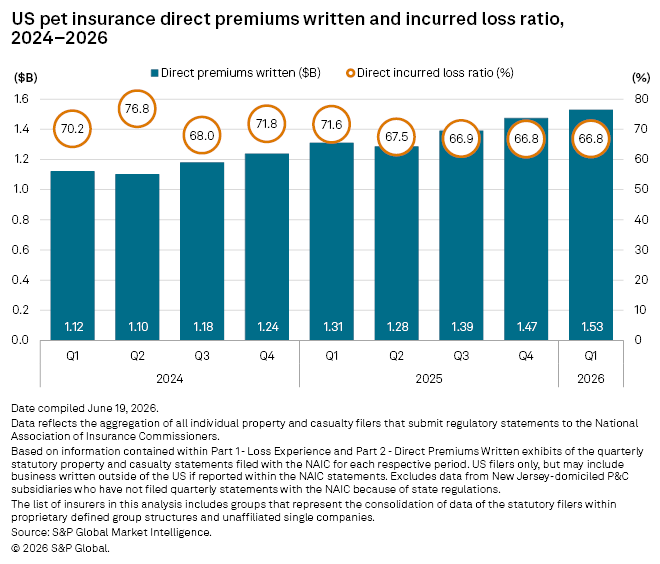
Business is booming for US pet insurers, with direct premiums written in the first quarter hitting an all-time quarterly high for the industry.
Insurers wrote $1.53 billion in direct pet insurance premiums in the period, reflecting an increase from $1.31 billion in the same quarter last year and from $1.47 billion in the last three months of 2025.
Laura Bainbridge, senior vice president for executive operations at Trupanion Inc., said in an email that one of the main drivers behind the increase in pet insurance premiums is that consumers are seeking "peace of mind" so they can prioritize the health of their pet and not have to fret over the costs of treatment.
"More and more pet parents are recognizing the value of high-quality pet insurance because the care available to pets today is better than it has ever been," Bainbridge said. "Veterinary medicine has advanced tremendously, with specialists, advanced diagnostics, complex surgeries, oncology treatments, and other sophisticated care...Naturally, people want access to those options for the pets they love."
Data reporting specific to pet insurance has only recently been made available as regulators made an effort to provide increased visibility after the sector saw rapid growth. Pet insurance was broken out as its own business line for the first time in the 2024 first-quarter statement and was also given a distinct breakout on Schedule P, which began with the 2024 annual statement.
Top players
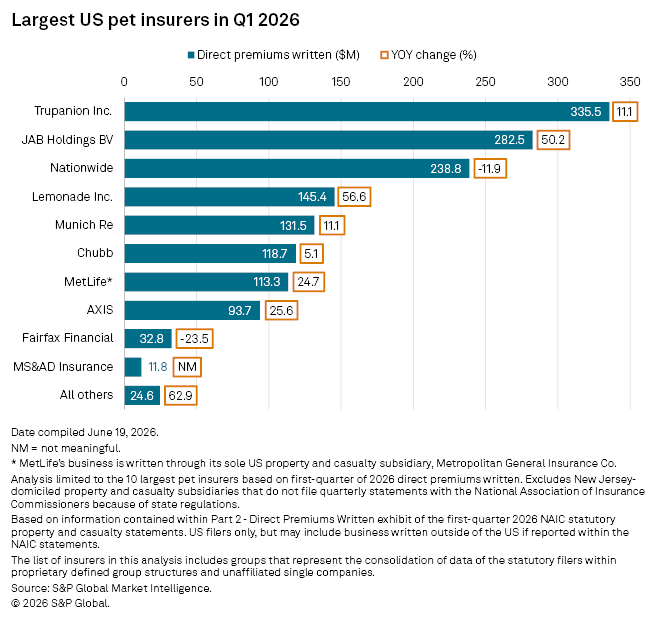
Trupanion was the largest underwriter of pet insurance in the first quarter, with $335.5 million in direct premiums written. That figure reflected an increase of about 11.1% from $302 million in direct premiums the insurer wrote in the first quarter of 2025.
JAB Holdings BV's first-quarter direct pet insurance premiums grew 50.2% to $282.5 million year over year, making the company the second-largest underwriter of pet insurance for the period.
Nationwide Insurance Co. ranked third with $238.8 million in first-quarter direct premiums. However, unlike many of its peers, Nationwide saw a year-over-year decrease in premiums written as they fell 11.9%. Among the top group of pet insurers, ninth-place Fairfax Financial Holdings Ltd. was the only other company to log a year-on-year decline in direct premiums written. Fairfax Financial wrote $32.8 million in first-quarter premiums, down 23.5% from $42.8 million in the year-ago period.
Meanwhile, Lemonade Inc. reported first-quarter direct premium growth of 56.6%, which was the largest year-over-year increase among the group.
In terms of the future prospects of growth for the pet insurance industry, Trupanion's Bainbridge said she feels the sector has a "long runway for growth because the underlying need continues to grow." Bainbridge also pointed out that the "vast majority" of pets in the US do not have insurance.
"Every month, well over a million puppies and kittens visit a veterinarian for the very first time, yet only a small fraction, less than 5%, leave with medical insurance," Bainbridge said. "That tells me we're still in the very early stages of adoption."
Loss ratios
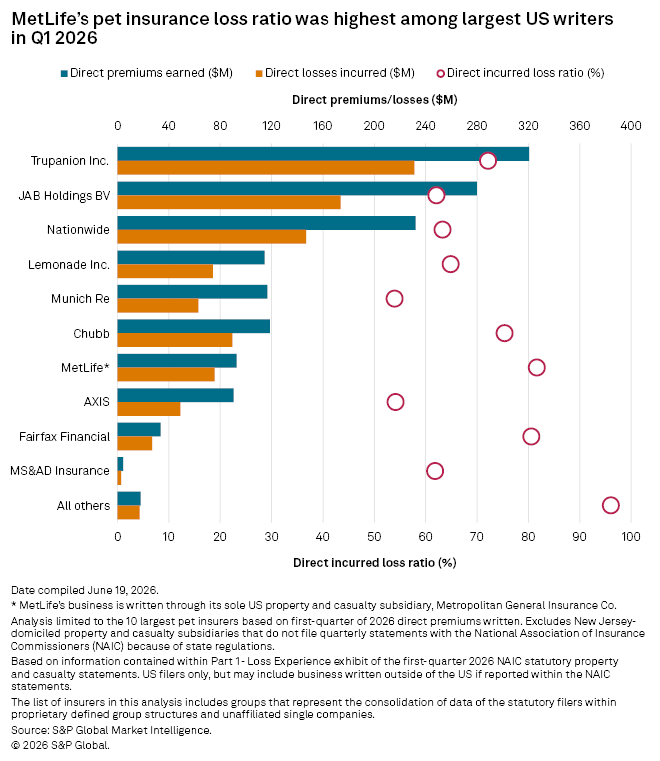
The pet insurance industry's average direct loss ratio for the first quarter came in at 66.8%, which was the same as the prior quarter and a decrease from a loss ratio of 71.6% in the first quarter of 2025.
Of the top individual pet insurers, four companies — JAB Holdings, MS&AD Insurance Group Holdings Inc., Lemonade and Nationwide — reported a first-quarter direct incurred loss ratio that fell between 61% and 65%.
MetLife Inc. was an outlier in the group with the highest direct incurred loss ratio of 81.6% for the period. MetLife reported first-quarter direct losses of $75.6 million while bringing in $92.6 million in premiums.
Fairfax Financial, Chubb Ltd. and Trupanion also had direct incurred loss ratios for the first quarter that were higher than the industry average at 80.5%, 75.3% and 72.1%, respectively.