15 Jul, 2026
US jobs market showing cracks with Fed focused on inflation

By Brian Scheid
Ongoing relative strength in the US jobs market has allowed the US Federal Reserve to prioritize combating inflation, potentially through higher interest rates later this year. But economists see signs of the labor picture widening soon.
The US unemployment rate is at its lowest point in a year, employment growth is continuing with 552,000 new jobs added in the first half of the year and layoffs remain below pre-pandemic levels.
"America's labor market appears broadly stable," Fed Chairman Kevin Warsh said before the House Committee on Financial Services on July 14.
Still, a recent slowdown in hiring, concentrated job growth, limited job mobility for many workers and wages that continue to lag overall inflation are flashing warning signals about the health of the labor market.
"There are fewer points of weakness than there were last fall," said Guy Berger, a senior fellow at the Burning Glass Institute. "But it's fragile — it wouldn't take much softening from where we are to return back to slow cooling mode."
Hiring stalls
An average of 92,000 jobs were added per month through the first half of the year, well above the 27,000 jobs monthly average from the first half of 2025, but it is still well below the 140,000 average from the first half of 2024 or the 256,000 average during the first half of 2023.
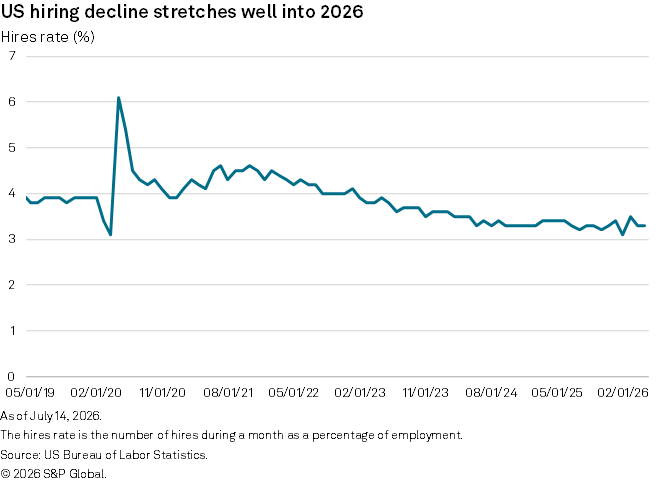
The US hires rate, the number of hires made each month as a percent of employment, was just 3.3% in May, about 60 basis points below its pre-pandemic high.
While unemployment in June fell to 4.2%, its lowest point since June 2025, the low hires rate shows that a healthy churn in the job market is "extremely low," said Daniel Zhao, chief economist at Glassdoor.
Prior to the pandemic, a hires rate of 3.3% typically corresponded to an unemployment rate of 8.2%, illustrating just how sluggish hiring has been this year, Zhao said.
"Sluggish hiring means that workers out of a job are frozen out of the job market, affecting new grads, laid-off workers and parents returning from childcare," Zhao said. "But this also means currently employed workers have fewer options to climb the career ladder by finding a better job on the open market, which also means less leverage to negotiate internally for a raise or promotion."
Postings for jobs at Indeed, a jobs listings website, are down close to 37% from its 2022 height. And while Indeed job postings are still near pre-pandemic levels, the civilian labor force has grown by nearly 6.2 million since.
"The same volume of postings now has to stretch across a much bigger pool of job seekers, so the market is considerably less tight than the raw number suggests," said Sneha Puri, an economist at the Indeed Hiring Lab.
Concentrated growth
While jobs growth has persisted, it has not benefited workers in all industries equally.
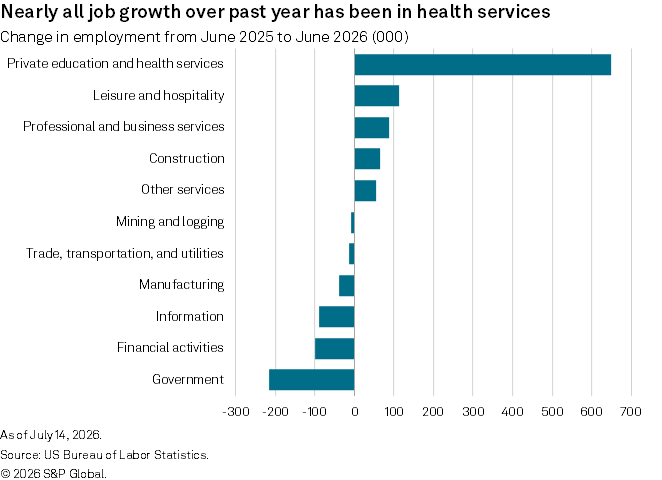
The US added 506,000 jobs from June 2025 to June 2026, with six of the 11 sectors losing a cumulative 464,000 jobs. But these losses were offset by gains, particularly in private education and healthcare, where employment grew by 648,000 over the past year.
Without the growth in healthcare employment, underway as the US population ages, US job growth would be negative.
"Healthcare is doing a disproportionate share of heavy lifting in job growth right now, which masks weakness elsewhere," said Puri with Indeed.
Low mobility
As hiring slows, new opportunities for American workers diminish, limiting workforce mobility.
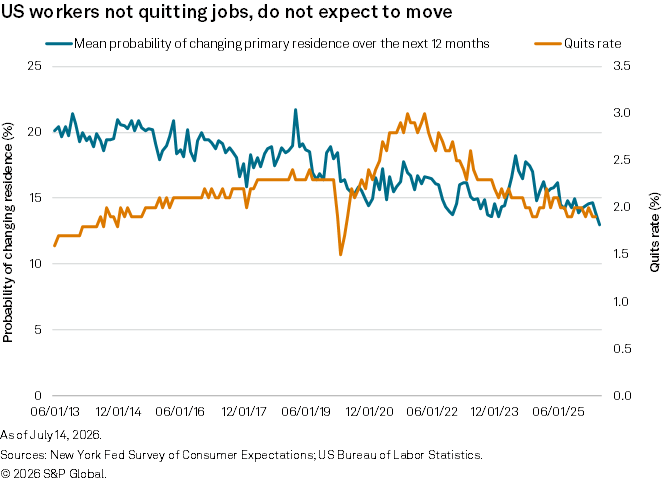
The quits rate, the percentage of the total workforce that voluntarily leaves their jobs in a given month, averaged just 1.9% through the first five months of 2026, compared to 2.1% in the first five months of both 2024 and 2025, and 2.5% during that stretch of 2023.
Without new opportunities, fewer Americans are moving for new jobs. The mean probability of Americans changing their primary residence over the next year fell to 13% in June, the lowest level on record, according to the New York Fed's survey of consumer expectations.
This results in a larger share of Americans are simply leaving the workforce entirely.
The labor force participation rate, the percentage of the working-age population either employed or seeking employment, dropped to 61.5% in June, the lowest point since early 2021.
The participation rate for prime-age workers, those between the ages of 25 and 54, dropped to 83.3% in June, a 60-bps drop from May, and the lowest level for this group since March 2025.
"That could be a bad sign," said Aaron Sojourner, a senior economist at the W.E. Upjohn Institute for Employment Research.
Lagging inflation
While wages have continued to rise, a sign that labor demand remains, it has lagged inflation growth this year.
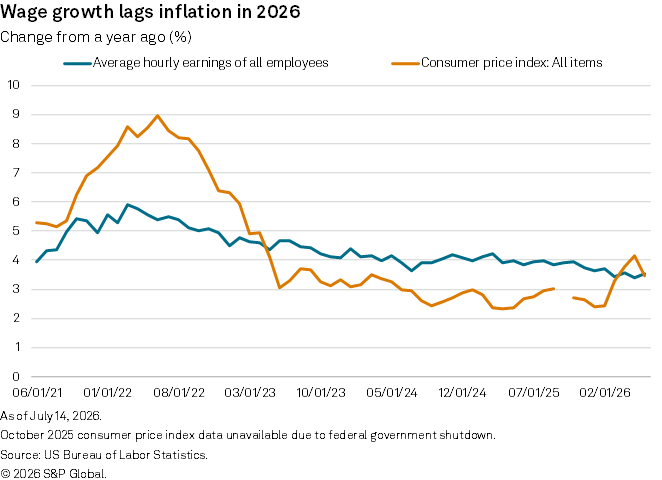
The consumer price index and average wages both increased 3.5% year over year in June 2026, but if inflation rises again, potentially due to the ongoing war in the Middle East, there are few signs that wage growth will keep pace.
"Put together, this isn't a labor market at full strength," said Indeed's Puri. "It's one where job seekers have fewer real options than the topline numbers suggest, and where many workers are staying in place not out of confidence, but because the alternatives simply aren't there."