10 Jul, 2026
Private equity dealmakers face reckoning in Washington

|
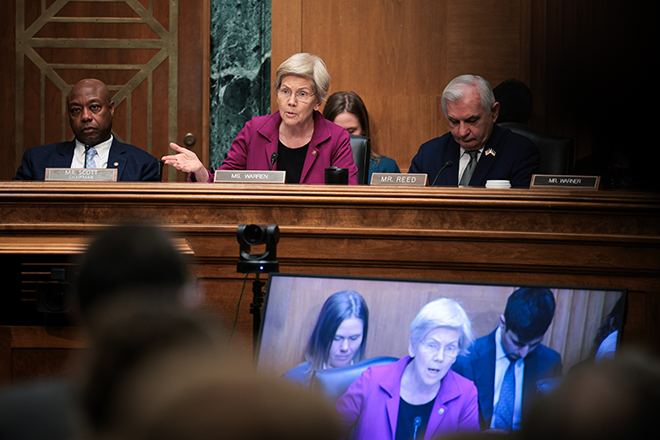
US Sen. Elizabeth Warren (D-Mass.) speaks at a hearing of the Senate Banking Committee on Feb. 27, 2025, at the Dirksen Senate Building in Washington, DC. Warren has been one of the private equity industry's most vocal critics in Congress. |
A new law set to take effect Friday, July 10, that limits — for the first time — private equity purchases of single-family homes takes aim at a practice blamed for reducing the availability of affordable housing. It's the latest example of how political adversaries in Washington are unifying over concerns that buyout shops increasingly make investments that critics say can gut businesses, raise prices and harm consumers. The Biden administration treated many sponsors as pariahs, accusing them of chasing short-term profits and exploiting a loophole that allows smaller assets to be consolidated without antitrust review. Private equity acquisitions were subject to intense scrutiny, with some unwound.
Under Trump, federal enforcers relaxed oversight of PE firms, declining to single them out for special treatment as state attorneys general sought to restrict their investments, especially in healthcare.
Now, as bipartisan critics raise alarms about private equity's reach into everything from defense technology startups to HVAC repair shops, the industry could face a reset if Democrats retake Congress.
"I think private equity firms see the writing on the wall right now as far as the future of their industry," Matt Parr, spokesman for the Private Equity Stakeholder Project, a nonprofit watchdog, told S&P Global's The Deal.
"No matter the party in power, there's going to be more disclosure required" about what they own and more "guardrails" to constrain their investment practices, he said. "Business as usual for the private equity industry is going to be coming to a close."
 |
– Get more insight on M&A and antitrust matters from The Deal's David Hatch and others here. – Listen to their podcast, Drinks With The Deal, on Capital IQ Pro. - Read profiles of founder and family-owned companies featuring actionable insights here. |
Lawmakers concerns
"We welcome the opportunity to talk to lawmakers about concerns they're channeling from their constituents," Will Dunham, CEO of the American Investment Council, the leading trade association for PE firms, said in an interview. "We're decidedly bipartisan in our conversations with policymakers."
Emphasizing that members invest in many sectors, Dunham said: "It's inaccurate to say that private equity is driving any of these particular markets in terms of the fundamentals." Rather, "private equity has become a stand-in for broader issues and concerns that people have" about the economy.
If the Democrats win big in November, expect legislation that seeks to curb PE investment in healthcare, artificial intelligence, utilities and data centers — and for CEOs and fund executives to be hauled before Congress, Parr said.
He also predicted a fresh push to enact the Stop Private Equity Looting Act, which holds investment firms liable for the debt, legal judgments and pension payouts of their portfolio companies.
"It was basically trying to get private equity firms to have skin in the game," Parr said of the legislation co-sponsored in 2024 by Rep. Alexandria Ocasio-Cortez (D-NY), a frontrunner for the 2028 Democratic presidential nomination.
PE's Playbook
Buyout shops inject much-needed capital into the economy, fueling innovation, business expansion, access to goods and services, pensions and other benefits, according to the investment council.
Nationwide, there are more than 13.3 million workers at 21,000 private equity-backed businesses, 85% with fewer than 500 employees, says the trade group, whose members include heavyweights Blackstone Inc. (BX) and Apollo Global Management Inc. (APO).
From the council's perspective, it's the occasional misstep that draws public attention. "A lot of the upsides of private investment are being lost" in the "political conversation we're having right now," said Dunham, who served as a top policy aide to former Republican House Speaker Kevin McCarthy.
For example, as Democrats complain that PE investment in youth sports increases costs for kids, expenditures on safety improvements, equipment, venues and event management software are largely overlooked, he maintained.
Since Trump's return to Washington, these have been heady days for private investors. His inner circle includes Stephen Feinberg, co-founder of Cerberus Capital Management LP and now Deputy Secretary of War, making him second-in-command to War Secretary Pete Hegseth.
Bill Pulte, the newly appointed Acting Director of National Intelligence, a cabinet position, founded Pulte Capital Partners LLC, a strategic investment firm, and Blackstone CEO and co-founder Stephen Schwarzman is a close adviser.
Yet as more Republicans join Democrats to warn that debt-heavy leveraged buyouts can trigger layoffs, bankruptcies and quick exits, opponents are becoming bolder.
"We should ban private equity rollup strategies," Sen. Elizabeth Warren (D-Mass.), the industry's most vocal critic in Congress, declared at a June 24 event sponsored by the Open Markets Institute, an anti-monopoly nonprofit influential during Joe Biden's presidency. "Could I just get an amen on that?"
In her latest salvo, Warren joined with Sen. Bernie Sanders (I-Vt.) and two Democratic colleagues to raise concerns about private equity's tentacles into student loans.
Crossing party lines, she teamed with Senate Judiciary Committee Chair Charles Grassley (R-Iowa) to caution that the Pentagon's embrace of private investment to jumpstart defense innovation could pose national security risks.
The Deal reported in June that a Republican House panel floated draft legislation that would compel PE firms to annually disclose their healthcare acquisitions, including transactions below the $133.9 million threshold for notification to Washington.
Whether it's housing, healthcare or retail, "it is very hard to get any kind of transparency" into the expanse of assets owned by investment firms, said Chris Noble, policy director for the stakeholder project.
Political Realities
If Democrats win back Congress, PE-focused bills "might have more legs," yet passage isn't assured, the policy director cautioned. At the state level where oversight has been rigorous, he noted that Democratic governors occasionally veto bills that target PE firms.
"I do still think it will take a bit of coalition building," Noble said. "Working across the aisle is not a foregone conclusion."
In some cases, the mere introduction of legislation, especially bipartisan measures, might be enough to prompt voluntary changes. "There are some private equity firms that internally adopted their own workforce principles," Noble recalled, referring to goals that include fair compensation and workplace safety.
As private equity joins the ranks of Washington boogeymen, industry advocates point to sensational claims they say are inaccurate and unfair. The housing bill sparked headlines that private equity was banned from the sector even though the legislative text allows for ownership of up to 350 homes.
"The reality is, in terms of the marketplace, we are a tiny fraction of the overall homes," Dunham said. "We were glad to see the bill evolve to protect more investment."