08 Jul, 2026
Pharmacy benefit manager suit shows Trump admin's keenness for deals
|
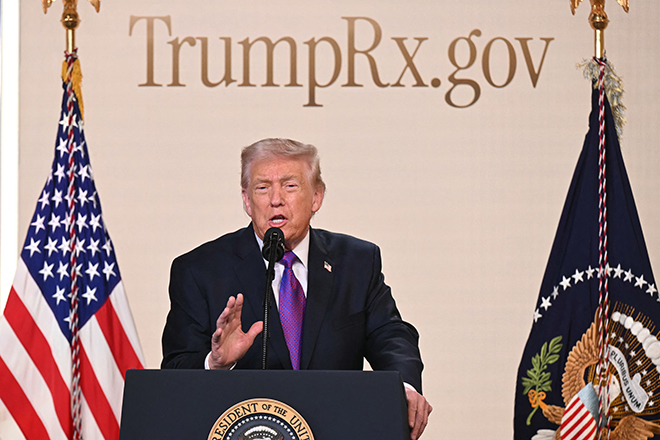
US President Donald Trump introduces the new TrumpRx website at the White House in Washington, DC, on Feb. 5. The TrumpRx.gov website will serve as a hub to find discounted prescription drugs by directing users to drugmakers' direct-to-consumer sites. |
The healthcare space has been a perennial target for US antitrust enforcers, but President Donald Trump's second administration has been much more willing than its predecessor to settle with insurers and other service providers.
Recent settlements in a Federal Trade Commission lawsuit targeting the "Big Three" pharmacy benefit managers (PBMs) — UnitedHealth Group Inc.'s Optum Inc., The Cigna Group's Express Scripts Inc. and CVS Health Corp.'s Caremark LLC — for allegedly abusing their "economic power by rigging pharmaceutical supply chain competition in their favor" is perhaps the highest profile example of this new regulatory approach.
All three PBMs have agreed to settlements or have indicated they are in negotiations to settle their cases. This represents a sharp departure from President Joe Biden's administration, according to industry experts.
"The largest, most significant and obvious change in posture is the willingness to settle. That is very clear," Nicholas Cheolas, a Washington, DC-based partner at the Wiley Rein law firm and former US Justice Department antitrust division attorney, told S&P Global Market Intelligence. "And we have seen many settlements in merger and nonmerger ... matters."
Regulatory scrutiny
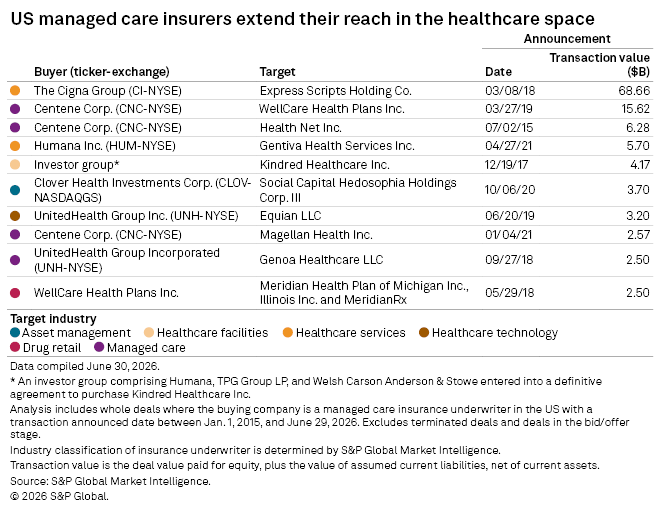
PBMs have been a target of bipartisan regulatory scrutiny due, at least in part, to their role in determining healthcare costs and the increasing amount of vertical integration in the industry. Health insurers have made wide-ranging acquisitions across the healthcare space over the last decade in areas including facilities, services, technology and drug retail.
PBMs administer prescription drug benefits on behalf of health plans and insurers, acting as middlemen that negotiate drug prices and manage formularies on behalf of drug manufacturers and pharmacies. Despite their intermediary role, most of the large PBMs are owned and operated by a handful of big managed care insurers.
The FTC's interest in PBMs has shifted significantly from Trump's first term to his second, with the agency applying more scrutiny now, according to Jonathan Swichar, a partner at Duane Morris and chair of its pharmacy litigation group.
The change was influenced by state and federal legislators and by Biden's appointment of Lina Khan to head up the regulator, Swichar said.
"Khan made it clear almost from day one that she felt that PBMs were an unchecked business," Swichar said.
During Khan's tenure, the FTC published two PBM-focused studies that were critical of how large PBMs owned by managed care insurers were treating independent pharmacies, highlighting how their tactics might be denying people needed medications, Swichar said. Although Khan left the FTC at the start of Trump's second term, concerns that the regulator would relax its attention on PBMs turned out to be misplaced.
"Whereas the FTC under Biden's tenure was heavily focused on investigation, almost immediately after Trump became president again the investigations shifted to enforcement," Swichar said.
The Big Three
The FTC in Trump's second term continued to support the lawsuit it filed late in the Biden administration's tenure targeting the Big Three PBMs. Court documents indicate that all three PBMs have since settled with the government, most recently Optum on June 12, but only the details of Express Scripts' settlement have been made public as of yet.
Conditions of the Express Scripts arrangement include provisions that stop the PBM from preferring its own "formularies high wholesale acquisition cost versions of a drug over identical low wholesale acquisition cost versions" and to provide a standard offering that ensures members' out-of-pocket expenses will be based on a drug's net cost rather than its "artificially inflated list price." This essentially eliminates Express Scripts' ability to engage in spread pricing, where it profits from the difference between what it pays for a drug to a pharmacy and what it charges, or receives, from the plan for that same drug.
The settlement, along with a version of the Consolidated Appropriations Act passed by Congress earlier this year, will have a dramatic impact on PBM business models, according to Renzo Luzzatti, president and CEO of US-Rx Care, a fiduciary PBM that operates under standards defined by the Employee Retirement Income Security Act of 1974.
The changes have sped up the conversation around pricing transparency and shaken up the ways buyers and employers will look at PBM services, Luzzatti said. However, they may not shift traditional PBM margins that much.
"If you're limiting spread pricing and other pockets of profit, it needs to show up somewhere, and in theory, the place that will show up is in the fees," Luzzatti said. "We're waiting to see how many fees are on that list."
A different approach
The settlements also point to another trend during Trump's second term: a willingness to cut deals rather than pursue litigation to the end.
"We're now far enough into this administration to know that the ... competition agencies here in the US are very willing to settle. The last administration by contrast was very willing to litigate matters," said Cheolas, who served in the DOJ's antitrust division until November 2025.
The Biden administration's DOJ brought several high-profile antitrust cases to court, including an unsuccessful effort to stop the merger of UnitedHealth and Change Healthcare Inc. Agencies under Biden were more skeptical about settling cases if they perceived a major deal to be anticompetitive, said Kevin Hahm, a partner at Hunton Andrews Kurth LLP.
"The FTC and DOJ position in those types of situations was that the agencies or consumers should not be the ones taking on the risk of a questionable settlement and that they should just block the deal outright," Hahm said.
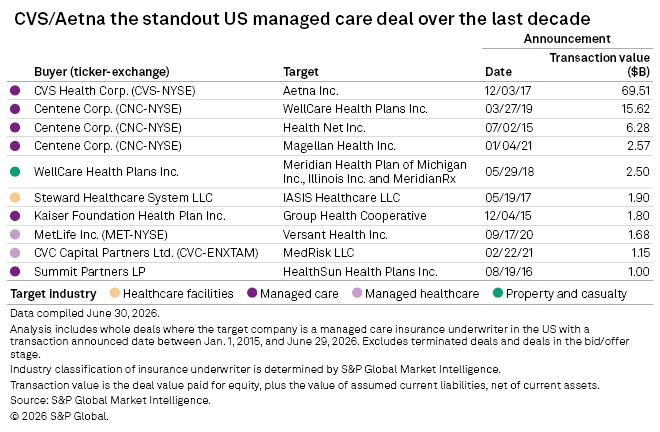
Mergers and acquisitions by health insurers during the second Trump administration have been relatively small in size compared to the blockbuster deals seen over the past decade.
Though the Trump administration has shown a willingness to settle competition-related cases, it will not necessarily be soft on antitrust enforcement when it comes to the healthcare space, according to Hahm.
The DOJ is "committed to antitrust enforcement" and is focusing on segments of the economy that impact American consumers the most, a spokesperson told Market Intelligence.
"We have employed every tool available to ensure we deliver tangible results in a timely manner, including settlements that guarantee immediate relief for consumers and maximizes the antitrust division's finite resources," the DOJ spokesperson said.
The spate of settlements are a mixed bag for consumers, according to Kathleen Bradish, director of legal advocacy for the American Antitrust Institute. Some can even contain provisions that do not seem related to the conduct at issue, Bradish said, such as requiring Express Scripts to cover access to TrumpRx as part of its standard offering.
"They seem to be more about administration agendas," Bradish said.
 |
– Read an article about US health insurers projected earnings in the first quarter. – Access data on insurance M&A on Capital IQ Pro. |