03 Jul, 2026
Giant 1-GW solar farm signals Eastern European renewables boom – Actis

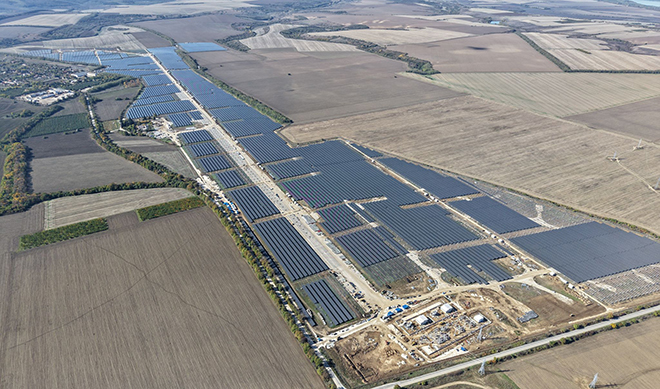
|
Rezolv Energy's 225-MW St. George solar plant in Bulgaria, built on the site of the former Silistra airport, entered operation in May. |
Central and Eastern Europe is emerging as an attractive destination for renewable energy investments, according to an executive at infrastructure investor Actis LLP, as portfolio company Rezolv Energy s.r.o. prepares to build what could be the EU's largest solar project in Romania.
The Dama solar plant, with more than 1 gigawatt of capacity, exemplifies the scale of opportunity in a region that was historically dependent on coal and Russian gas but is now racing to decarbonize, according to Jaroslava Korpanec, partner and head of central and Eastern Europe (CEE) at Actis.
Romania is one of the fastest-growing solar markets in the EU, adding 2.5 GW in 2025 — 45% more capacity than the previous year — to take it to 7.6 GW, according to industry association SolarPower Europe. Analysts at S&P Global Energy Horizons see the market growing beyond 19 GW by 2030.
Korpanec pointed to Romania's strong policy framework, expanding project pipeline and availability of financing as the key drivers behind the market's growth. Significant land availability and short permitting timelines also support development.
Among EU nations, the Witznitz project in Germany is Europe's current largest solar farm at 650 megawatts, according to S&P Global Market Intelligence data. In wider Europe, the Karapınar project in Turkey stands at about 1.3 GW in size, the data shows.
"It makes sense to build projects at scale. And that is what we have been able to take advantage of," Korpanec said in an interview with Platts, part of S&P Global Energy.
Dama, in western Romania near the Hungarian border, will be paired with a battery storage system and underpinned by corporate power purchase agreements and government-backed contracts for difference (CFDs), according to Korpanec.
The site is expected to reach financial close in the coming months and begin operations in 2027.
Energy security focus
Dama forms part of a more than 2-GW portfolio of wind, solar and batteries being built out in Romania and Bulgaria by Czechia-headquartered Rezolv, which was launched by Actis in 2022 with Abu Dhabi's Mubadala Investment Co. PJSC joining as an investor in 2025.
Rezolv recently commissioned the 225-MW St. George solar park in Bulgaria. Colocated with a 90-MW/240-megawatt-hour battery, the project is backed by a 12-year virtual PPA with glass packaging manufacturer Ardagh Group SA.
Like Romania, Bulgaria's solar market is growing rapidly. Some 1.7 GW of capacity was added in 2025, 39% more than in 2024, with Horizons analysts expecting the market to roughly double to about 12 GW by 2030.
Korpanec, who joined Actis shortly after Rezolv's launch, said the renewables investment case in the CEE region has been strengthened by the Russia-Ukraine conflict, which exposed the region's vulnerability to energy imports.
Prior to Russia's invasion of Ukraine in 2022, Russia accounted for roughly 40% of the EU's pipeline gas imports, with CEE countries particularly dependent. That share had fallen to around 6% in 2025, according to EU data, as member states moved away from Russian supplies.
"If you look today at the map and you look at the Baltics, you look at Poland, you look at Czechia, and then you look at southern Eastern Europe, you understand the significant need to decarbonize and to decouple from the dependency on Russian gas," Korpanec said.
But decarbonization and energy independence tell only part of the story. Korpanec emphasized that rising GDP growth and electrification in Rezolv's focus markets of Romania and Bulgaria will drive continued energy demand, particularly as the countries catch up economically with Western Europe.
"These are European countries where GDP growth is very much on the agenda, and electrification, as well as increased consumption of energy, is something that will need to be supported," Korpanec said.
That could include a push from the technology sector, with power demand from European data centers set to grow massively in the coming years.
"You can only imagine that Romania, with its vast land and space for solar, could also become attractive from a data center perspective," Korpanec said.
Portfolio expansion
In Romania, Rezolv is close to completing construction on its 450-MW Vifor wind farm, which is underpinned by PPAs with aluminum extrusion company Etem Gestamp Aluminium Extrusions SA, Belgian steel wire producer NV Bekaert SA and Italian utility A2A SpA.
The project also signed cross-border corporate PPAs in 2024 with Czech and Slovakian subsidiaries of Germany's Deutsche Telekom AG.
Korpanec said Rezolv typically aims to contract at least 60% to 70% of its projects' production via PPAs or CFDs. The company has secured over 1 GW of CFDs via government-backed auctions in Romania, covering portions of capacity at Dama, Vifor and its 300-MW Dunarea East wind farm.
"Romania ... has had three series already of [CFD auctions], which significantly support the offtake of the renewable energy and make it attractive for foreign investments, because those CFDs provide certain stability in terms of the offtake," Korpanec said.
That revenue visibility enables Rezolv to lower its cost of debt, Korpanec said.
For Dama, Rezolv is in negotiations with the European Investment Bank and the European Bank for Reconstruction and Development to secure funding, online filings show. Previous projects were financed by a mix of development banks and commercial lenders.
Korpanec said Actis intends to further expand its CEE renewables footprint, drawn by the region's economic fundamentals and policy support.
On July 2, Actis announced a deal to acquire a second CEE renewables platform, Klara Renewables, from CVC DIF. Klara has 171 MW of operating onshore wind capacity in Poland and about 275 MW of hybridization potential through solar or batteries, according to Actis, with an ambition to grow its portfolio to 1.5 GW.
"The intention and the ambition that we have is to continue to grow our investments in central and Eastern Europe," Korpanec said. "We're not opportunistic investors. We're long-term investors that invest in the economies and in the infrastructure in these countries."