01 Jun, 2026
US banks will sidestep SEC's semiannual reporting plan as risks outweigh rewards
By Lauren Seay and Ayesha Shahbaz
The vast majority of public US banks are unlikely to adopt semiannual earnings reporting as risks outweigh rewards, and opting out of quarterly filings would only create marginal benefits for smaller financial institutions looking to go public.
The US Securities and Exchange Commission on May 6 proposed a rule that would allow public companies to file semiannual earnings reports, following through on an idea floated by President Donald Trump last year. While the SEC sees it as a way to lessen the burden of being a public company, banking industry experts expect it to have very limited benefits for the banking industry.
A switch to semiannual reporting would not equate to meaningful time and cost saves for most banks and would instead invite risks such as increased scrutiny and reputation risk, reduced trading volume and a higher cost of capital, experts said.
"It's probably a hard no for the majority of banks," Hovde analyst Brendan Nosal said in an interview.
Stakeholders suffer
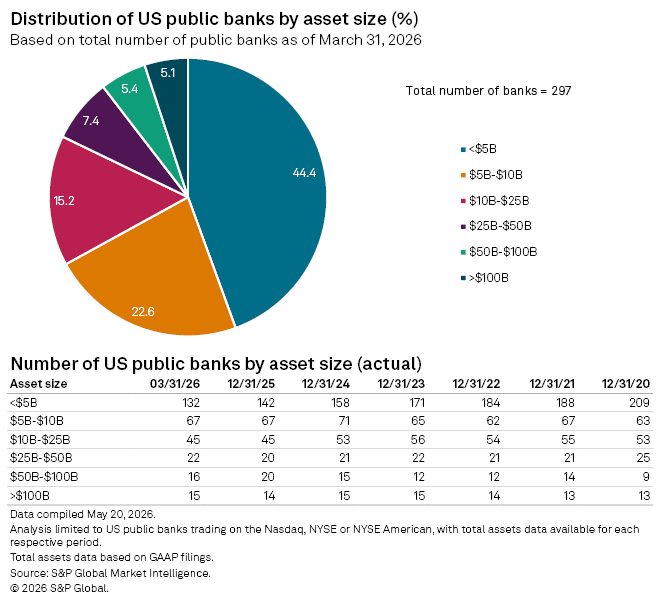
At March 31, there were 297 public US banks, according to S&P Global Market Intelligence data. Among those, the nation's largest banks, which trade at the highest multiple compared to other size buckets and the median for all public US banks, are the least likely to switch to semiannual reporting, experts agreed.
"Larger public companies ... are likely going to continue doing this voluntary quarterly or regular reporting because they want to continue to keep investors apprised. They've got very large volume and trading," said Mike Vanscoy, principal of technical accounting and advisory services at SolomonEdwards. "There's a reputation to maintain."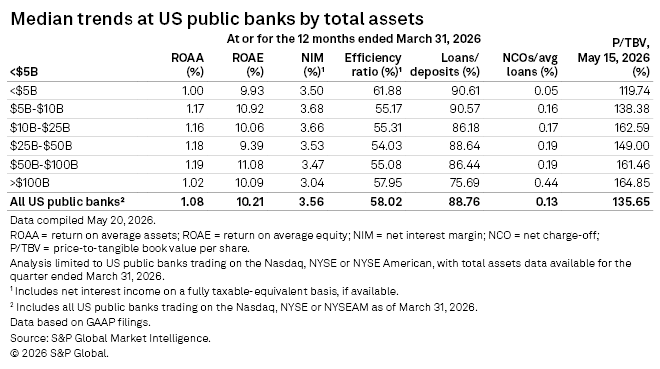
The biggest banks will not adopt semiannual reporting "because all the investors and equity analysts, bond analysts, everybody has been conditioned for decades and decades to be receiving this information on a quarterly basis," MRV Associates managing principal Mayra Rodríguez Valladares said.
There is "no chance" OceanFirst Financial Corp., which will have over $23 billion in assets after closing its acquisition of Flushing Financial Corp., will opt in semiannual reporting because of the number of stakeholders who depend on this information, Chairman and CEO Chris Maher told Market Intelligence.
"If I don't make GAAP reports available, I'm going to get all the GAAP questions the minute I file my call report," he said. "Our investors are going to require that they understand where we are each and every quarter."
Moreover, quarterly bank regulatory filings "are not going to be enough for Moody's to maintain their rating," Maher said.
If credit ratings analysts are not able to maintain their ratings on banks, it could hurt their cost of capital, according to Rodríguez Valladares. Banks are not required to obtain credit ratings, but they do so to lower their borrowing costs.
"It makes it harder to assess them to try to figure out what's the likelihood of those entities having any kinds of credit quality problems, including default," she said. "It may be more expensive for them to get a loan or to do a derivative or to do a repo."
Opting for decreased reporting frequency could also be seen as a red flag by the Street, even if a company's goal is cost saves, experts agreed.
"We've had the status quo for a very long time. It's the rules that we all play by. If a company chooses to do it, it could stand out as trying to not be as transparent as those other companies that maintain quarterly reporting frequency," Nosal said.
It could pose a reputational risk where stakeholders think, "Why did you quit reporting now? When we go six months without hearing something, are we going to be surprised?" Vanscoy said.
Trading risk
Less information flow would lead to decreased trading volume, which could hurt less liquid banks such as community banks, according to Hovde's Nosal.
Reducing earnings reports to twice yearly makes it so "those two times you do get it just takes on increased importance, right? So that means potentially larger price actions, potentially heavier trading volumes on those days, but lighter trading volumes the other times of the year and potentially increased volatility," Nosal said.
It could also lead to more severe stock market reactions when results are released, particularly to negative news.
"If the trouble comes with smaller bites, we have more time to absorb it. But if it's all of a sudden, I find out six months that there's been an issue for the last five or six months, there's a concern," Vanscoy said.
Nosal gave an example of the March 2023 failure of Silicon Valley Bank. "Imagine if in the aftermath..., we didn't hear from any bank publicly until July. We would have had a different outcome, and I don't think the outcome for the industry overall would have been better," he said.
Building up to quarterly reporting
Switching to semiannual reporting would not save banks much time or money because they would still be required to report quarterly financials to federal regulators like the Federal Reserve, Federal Deposit Insurance Corp. and Office of the Comptroller of the Currency, as well as state agencies if they are a state-chartered bank, sources said.
However, small banks that are "very cost sensitive" with less scale to spread the cost of quarterly reporting could see semiannual reporting as a way to save money, Rodríguez Valladares said.
"It is expensive to have all this army of accountants and internal auditors and compliance officers and a whole bunch of other professionals all involved," including graphic designers for investor presentations, she said.
The semiannual option could be attractive for banks with limited analyst coverage or low trading volumes, Maher said. The option could also be helpful for newly public banks as they get their "feet wet," Vanscoy said.
Even so, these banks will likely eventually move to quarterly reporting.
"What it will allow is banks that may not have the resources to do something on a quarterly basis, build those resources and build that expertise," Vanscoy said. "So they can build themselves to the point that says, 'Hey, we want to be just as visible as the larger players in this arena. So let's find a way to utilize our technology and build our resources out so that we can do that and not just meet the minimum SEC reporting requirements.'"
IPO impact
Reducing the burden of becoming or remaining a public company is one of the SEC's main goals with the proposal, according to Chairman Paul Atkins.
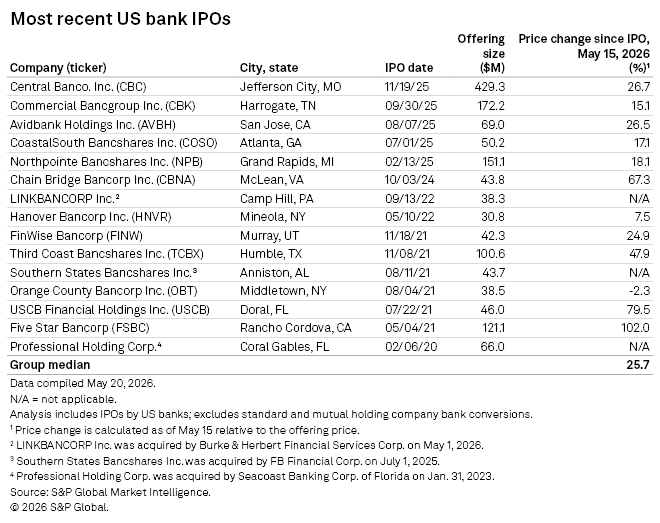
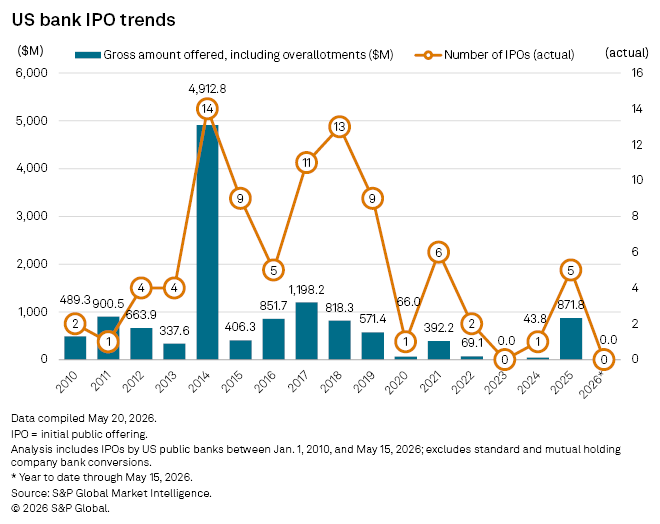
US bank IPO activity jumped last year with five IPOs, the most since 2021, when there were six. Last year also boasted the highest IPO transaction value since 2017. But activity has been muted so far in 2026, and experts do not think the semiannual reporting shift will give the banking industry a significant IPO boost.
The shift to semiannual reporting on IPOs will likely be marginal, but it could influence some smaller, closely held community banks that have been eyeing going public, Maher said.
"That would allow the company to slowly grow to the point where they could absorb the costs of quarterly filings," he said.