25 Jun, 2026
UK government reshuffle puts bank tax hikes back in play

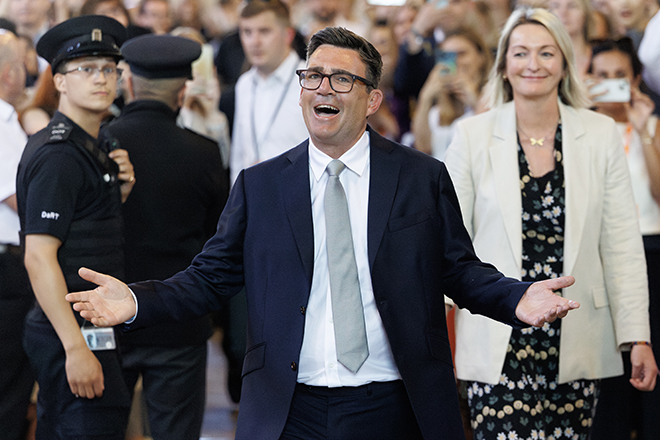
| Andy Burnham, former mayor of Manchester, could become the next UK prime minister after winning an MP seat in a local election on June 22. Source: Dan Kitwood/Getty Images News via Getty Images Europe. |
An upcoming UK government reshuffle after Prime Minister Keir Starmer's resignation has reopened the possibility of tax increases, which could also affect banks.
Tax hikes cannot be ruled out, as a new prime minister will face pressure to increase budget headroom without inflating the deficit, analysts said.
In May, long-term UK borrowing costs hit their highest level since 1998 amid Middle East-related concerns and domestic political uncertainty. Gilt markets will be sensitive to any increase in unfunded borrowing, raising the prospect of taxation as a means to shore up public finances, according to recent analyses.
Banks have been spared additional taxation by the Labor government in the past two years as they have argued a higher tax burden would limit their ability to lend to the UK economy and support the economy's and their own competitive power. Yet the situation could change under new leadership.
Reasons to hike
Former Manchester mayor Andy Burnham, currently the front-runner to replace Starmer, has already committed to the previous government's pledges not to increase income and value-added tax, Bill Diviney, head of macro research at ABN Amro, said in an emailed comment. In that case, a new bank levy could be an option, especially in light of banks' stronger profits in recent years, Diviney said.
Burnham, who is more left-leaning than Starmer, will seek to relieve cost-of-living pressures on low-income households, which is most likely to come from taxing the wealthy, ABN Amro said in a June 22 analysis.
Banks "are making thumping profits and returning a lot of cash to shareholders, so complaints that they cannot afford [higher taxes]...may fall on deaf ears," Russ Mould, investment director at AJ Bell, said in an emailed comment.
First-quarter profits at each of the UK's largest four banks — HSBC Holdings PLC, Lloyds Banking Group PLC, Barclays PLC and NatWest Group PLC — increased year over year and quarter over quarter, S&P Global Market Intelligence data shows.
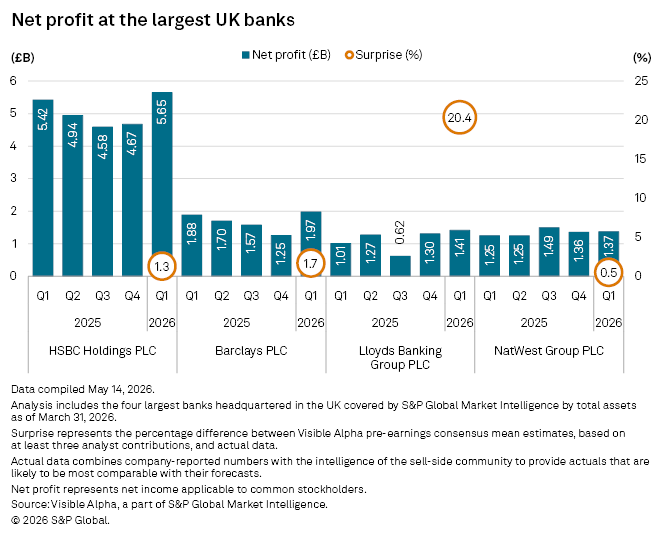
The aggregate pretax profit of the seven bank constituents of the FTSE 100 index — HSBC, Lloyds, Barclays, Standard Chartered PLC, NatWest, Lion Finance Group PLC and Investec Group — is set to hit an all-time high of £61 billion in 2026, according to the current consensus forecasts, Mould said. The seven banks are estimated to pay out an aggregate of £19 billion in dividends and another £5 billion worth of share buybacks this year, he said.
Banks oppose
Any tax hikes will face strong pushback from banks and their shareholders, and could also come to the detriment of consumers "through lower savings rates or higher interest rates on loans, should lenders choose to preserve profits by protecting their net interest margin," Mould noted.
UK Finance has not changed its stance on bank taxation, recently calling to cut levies and simplify tax rules to boost the UK's attractiveness as a global financial center, a spokesperson for the banking sector's trade association told S&P Global Market Intelligence.
Several international banks have previously vowed to "respond in kind to increases in taxation already perceived as unfair," and UK-based banks can argue the "record amounts" of additional lending they are providing to British industry could dry up if taxes are raised, Jefferies equity analyst Jonathan Pierce said in a June 19 note.
Burnham could provide some comfort to the sector sooner rather than later, the analyst said. A "simple comment" that banks already pay enough tax "would not rule out a small increase in the bank surcharge later this year, but would dramatically reduce the risk of a move back to 8%," Pierce said.
The UK bank surcharge was reduced from 8% to 3% in April 2023 to offset an increase in the headline corporation tax rate to 25% from 19%. At 46.4%, the total tax rate banks operating in the UK were subject to in 2025 is higher than that in other global financial centers, according to PwC estimates made on behalf of UK Finance. Banks operating in Amsterdam, Frankfurt, Dublin and New York were subject to total tax rates of 42.2%, 38.9%, 28.9% and 27.9%, respectively, according to the estimates.
JPMorgan Chase & Co. CEO Jamie Dimon warned that the US bank would abandon plans to invest billions in a UK headquarters if a Starmer successor raises bank taxes, Bloomberg reported May 12. Ana Botín, chair of Spanish group Banco Santander SA, which has a large UK business, said in a recent Financial Times interview that potential tax hikes for banks would make no economic sense.
'Sizable' near-term hike unlikely
Burnham has policy objectives that "may require a strong partnership with banks," which have also bought a net £60 billion in gilts in 2025, Pierce said. Given that, "we would be very surprised if his first move as [prime minister] were a sizable attack on the sector," Pierce noted.
Bond markets would also worry how a change in government spending would be funded, "and whether any decision to raise taxes would dampen already lackluster economic growth," Dan Coatsworth, head of markets at AJ Bell, wrote in a June 23 analysis. Markets would welcome it if Burnham keeps incumbent Rachel Reeves as Chancellor because "continuity implies consistency with current fiscal policies," yet Reeves may struggle to keep her job due to her strong links to Starmer, Coatsworth said.
"Reeves has successfully mitigated market concerns via a strong commitment to the fiscal rule — markets will search for similar reassurances from her successor," Francesco Pesole, FX strategist at ING, said.
Nominations for the next Labor Party leader, who would automatically become prime minister, will open on July 9 and end before the UK parliament's summer recess on July 16. Starmer, who stepped down on June 22, will remain as a caretaker prime minister until a successor is confirmed. This could stretch into September if a full leadership battle takes place.
Burnham's candidacy for the post looks strong, with UBS analysts suggesting he "could assume the premiership as soon as mid-July," especially after receiving the backing of key Labor rival Wes Streeting, who dropped out of the race. Burnham is also the most popular among any rivals to the leadership, ABN Amro analysts said.