29 Jun, 2026
Trade credit insurers show resilience as US-Iran ceasefire tested

|
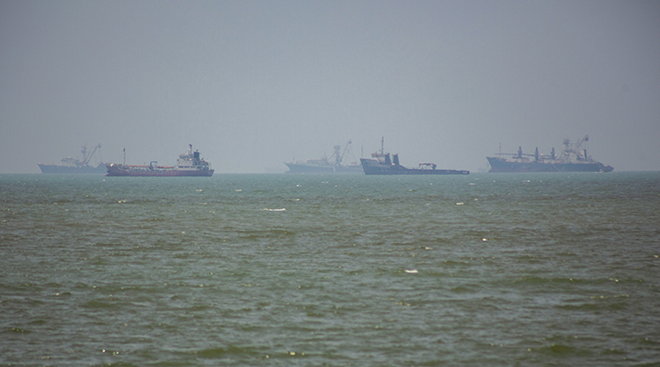
Large commercial vessels navigate the waters off the southern port city of Bandar Abbas, Iran, on June 21, 2026. |
The market for trade credit insurance has shown resilience in terms of claims, pricing and capacity despite the economic pressures created by the four-month Middle East war, industry experts told S&P Global Market Intelligence.
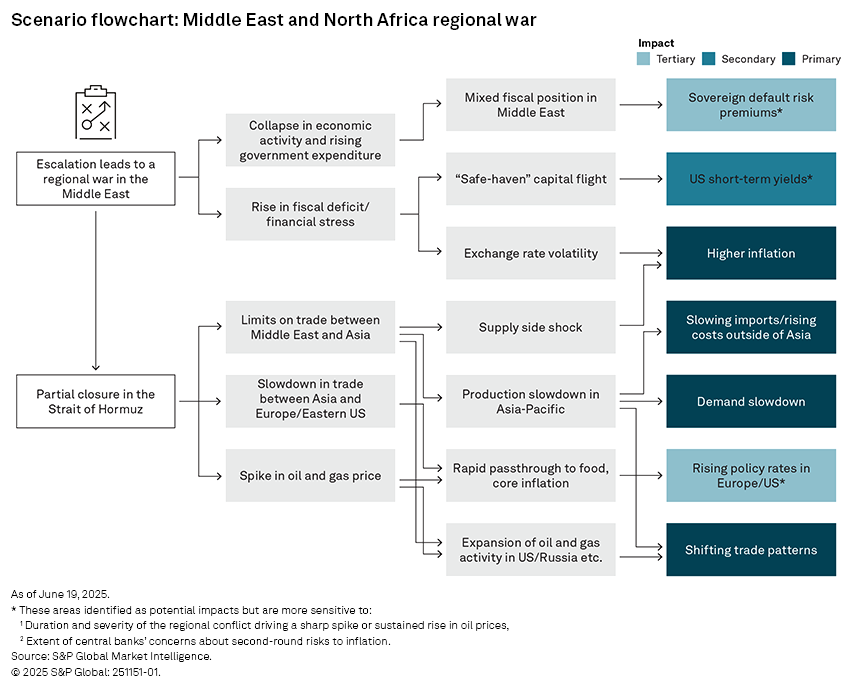
The conflict, which started Feb. 28, severely restricted the passage of oil tankers and merchant shipping through the Strait of Hormuz, creating supply chain disruptions and spiking energy costs, increasing insolvency risk across a variety of industries. Trade credit insurance provides companies with protection in the case of nonpayment in situations such as insolvency, default or the nondelivery of prepaid goods. In the US, corporate bankruptcy filings in May were the highest so far this year.
"On the trade credit side, we're not seeing any losses yet," Daniel Riordan, head of political risk, credit and surety at MSIG USA, said in an interview, adding that many trade credit insurance contracts have waiting periods or triggers of 180 days before claims can be made. "We're not seeing a lot of impact."
The US and Iran signed a memorandum of understanding (MOU) June 17 that led to an initial cessation of hostilities, but the sides have since exchanged limited fire. President Donald Trump in a June 28 social media post warned that the US might have to "militarily complete the job" if Iran did not stop launching attacks in the Gulf, while Iran threatened to bring long-term peace talks to a "complete halt" if the US continued its strikes.
Karoline Leavitt, the White House's press secretary, said June 29 that US envoys would engage in "high-level" discussions with Iran at a meeting in Doha, Qatar, the next day.
Relative stability
Premium prices in the trade credit space have also remained relatively stable, according to Riordan.
This idea that the Iran war has had a limited impact in terms of trade credit insurance was echoed by Pieter Van Ede, global head of trade credit at WTW.
"If you look at the combined ratios of those that have reported their Q1 numbers we don't see the impact from a pure claims perspective yet," Van Ede told Market Intelligence.
Leading trade credit insurer COFACE SA posted a 70% net combined ratio for the first quarter. Allianz Trade, meanwhile, noted its "outstanding profitability" despite "challenging market conditions" in its first-quarter results as its combined ratio improved to 80%. Though it has yet to publish quarterly results this year, the final member of the Big 3 trade credit insurers, Atradius NV, appears to be in good health from an underwriting perspective. It reported a gross combined ratio of 77.7% in its 2025 annual results.
In contrast, marine insurers are facing significant claims for container ships, oil tankers, bulk carriers and cargo hit by missiles and drones during the war, according to Allianz Commercial's latest Safety and Shipping Review.
According to Van Ede, there have been no "knee-jerk reactions" from insurers, such as looking to pull out of the region. In addition, pricing has remained steady as supply chain fixes have meant there has not been a massive impact on trade credit insurers in the short term.
"We don't see any uplift in pricing beyond the anecdotal — in specific sectors or corridors, such as exposures into Saudi Arabia or Egypt," Van Ede said.
That said, there may be some movement in terms of price toward the end of the year.
"We do expect some upward pressure on pricing towards the back end of 2026, though that is driven more by where we are in the broader market cycle than by Iran itself," Van Ede said.
Overall, the trade insurance market has shown a lot of resilience, and there have even been requests to uplift exposures in the region, he added.
The path forward
While the MOU between the US and Iran is expected to hold over the next few months, the risk of a return to hostilities remains.
"The MOU is an interim arrangement, and without a broader agreement covering Iran's nuclear program, sanctions relief and regional security guarantees, the likelihood of renewed escalation will remain high," said Jack Kennedy, head of the Middle East and North Africa desk of the S&P Global Market Intelligence country risk team.
"A reduction in war risks over the coming year would be dependent on the conclusion of a long-term US-Iran agreement ... and would need to include formal security/non-aggression guarantees, acceptance of the principle of a domestic Iranian uranium enrichment capacity, and meaningful sanctions relief. Such a long-term deal is unlikely," Kennedy added.
This sense of fluidity and uncertainty also applies to the trade insurance market.
"This is still an unresolved and fast-moving situation, so the fact that we have not seen a real claims impact is very much a short-term, Q1/Q2 assessment — and if anything, the risk is skewed towards the second half of the year," Van Ede said.
When it comes to shipping and the Strait of Hormuz, the situation is still far from returning to the status quo seen before the war.
"The MOU is likely to reduce shipping risks from extreme to severe in the near term, with conditions improving over the next three months but remaining volatile. Over a one-year horizon, a full return to prewar shipping conditions is unlikely without a durable agreement, with risks remaining severe in the absence of such an agreement," Kennedy added.
Future demand
The Iran war has driven more awareness and enquiries from companies, but any increase in demand for trade credit insurance is expected to be driven by other factors such as data centers and defense spending, according to MSIG USA's Riordan.
"AI data centers ... [are] the number one driver for credit insurance right now globally because hyperscalers are building data centers as fast as they can or encouraging contractors to build them as fast as they can,” he said.
Another factor set to drive the need for trade credit cover is security spending. European countries are increasing their defense budgets and there is demand for French ships, South Korean armored personnel carriers and drone technology, Riordan added.
In addition, Van Ede noted that the need for trade credit insurance is likely to remain high — even for large multinational companies that should be able to survive any economic shocks from the war — due to the credit risk insight that insurers have to their counterparties in the Middle East.