16 Jun, 2026
Protection gap means minimal insured losses after Philippines earthquake

By RJ Dumaual
|
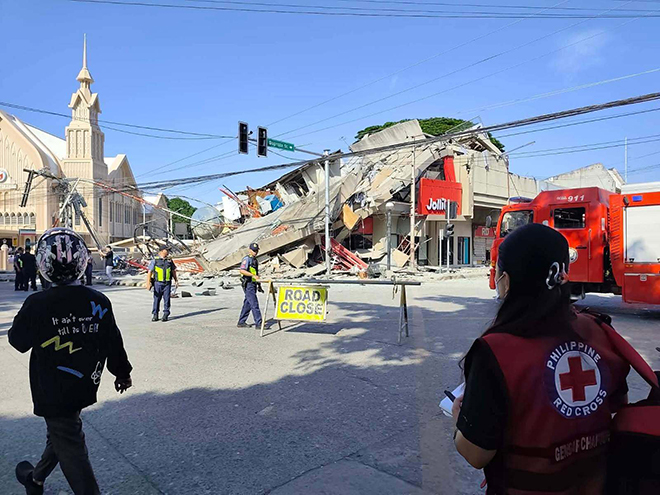
Buildings, including a Jollibee fast-food restaurant, collapsed after a 7.8-magnitude earthquake hit off Mindanao island in the Philippines on June 8, 2026. |
A 7.8-magnitude earthquake that struck off the southern coast of the Philippine island of Mindanao is expected to cause limited insured losses, with some exposure seen for international reinsurers.
Structural damage was widespread across the affected region. In General Santos City, several buildings collapsed or were severely damaged, including a popular fast-food restaurant, and the quake also triggered a landslide in Sarangani province that killed 13 villagers, according to Verisk Analytics.
"The Philippines' well-documented protection gap means insured losses will be a fraction of actual economic damage, [and] most residential and SME properties in Mindanao simply are not covered," said Mon Zandueta, CEO of KRM Reinsurance Brokers Philippines Inc. (KRM Re), in a statement to S&P Global Market Intelligence.
The Philippine Catastrophe Insurance Facility (PCIF) will absorb part of the primary layer, but international reinsurers will pick up the tail exposure from cedants who purchased catastrophe reinsurance programs, Zandueta added, agreeing with recent commentary from AM Best.
Major damage
Parts of St. Elizabeth Hospital in General Santos were severely damaged, forcing patients and medical personnel to evacuate and temporarily operate outside the main building. Buildings at Notre Dame of Dadiangas University also partially collapsed. In Sarangani, a bridge sustained cracks, and a shrine featuring a large cross collapsed. Police stations in the area also reported cracked walls, preventing officers from reentering.
A major part of the loss would be uninsured if the country's insurance penetration rate is used as a guide, Philippine Insurers and Reinsurers Association executive director Michael Rellosa said in a statement to Market Intelligence, cautioning that because claims figures have not yet started to come in, these estimates are all theoretical at this point in time.
The PCIF allows non-life insurers to cede their catastrophe risks to the pool. The PCIF, which will then share the pooled risks back to the non-life insurers, will enable these companies to more efficiently manage their catastrophe exposures and boost their capacity to take in more catastrophe risks.
Although the PCIF is already up and running, only nine of the more than 50 insurers have joined in the first year, said Rellosa, whose organization helped put the PCIF together. The PCIF and the companies that may have written natural catastrophe perils have their reinsurance treaties in place, and except for National Reinsurance Corp. of the Philippines (Nat Re), these reinsurers are international. It will be safe to say that international reinsurers may have some exposure, Rellosa added.
Nat Re did not respond to a request for comment.
H2 2026 impact
AM Best expects the Mindanao earthquake to have an impact on Philippine insurers' results in the second half of 2026 because local insurers have chosen to retain more risk.
Philippine non-life insurers have been increasing net retentions in recent years to manage high reinsurance costs, and that strategy gets tested in a loss event like this, KRM Re's Zandueta said, adding that for accounts that retained more risk, second-half results will "feel it."
"Events like the Sarangani quake reinforce the conversation we're already having with cedants about the right balance between retention and transfer, and the role parametric structures could play in closing that protection gap faster than traditional indemnity products," Zandueta said.
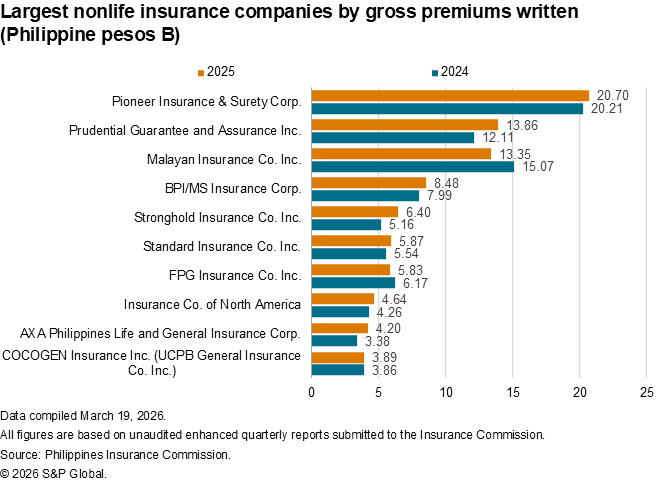
In 2025, Insurance Commission data showed that Pioneer Insurance & Surety Corp. was the largest non-life insurance provider in the Philippines on gross premiums written at 20.70 billion Philippine pesos, rising year over year from 20.21 billion pesos.
Prudential Guarantee and Assurance Inc. was second with gross premiums written of 13.86 billion pesos, increasing from 12.11 billion pesos in 2024. Malayan Insurance Co. Inc. rounded out the top three after posting gross premiums written of 13.35 billion pesos in 2025, decreasing from 15.07 billion pesos in 2024.