10 Jun, 2026
National Grid sees energy security driving UK-EU power trading deal

|
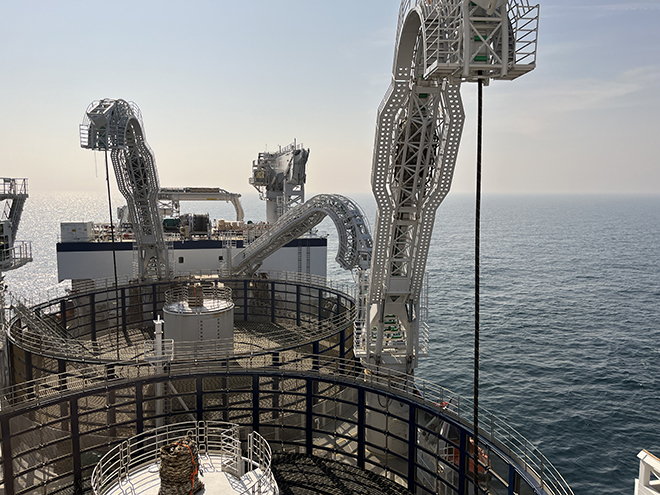
A subsea electricity cable being laid. National Grid said shifting power flows on interconnectors are underscoring the growing interdependence of the UK and European grids. |
National Grid PLC is "very positive" about the outcome of electricity trading negotiations between the UK and EU, with Rebecca Sedler, managing director of the British utility's interconnectors business, saying a focus on energy security should prevent the discussions from being derailed by unrelated policy disputes.
The UK is engaged in talks on rejoining the EU's internal electricity market, reversing its post-Brexit departure. The European Council formally authorized the negotiations in March following exploratory discussions that concluded in December 2025.
Sedler is hopeful of "some really good news this year" on the future power-trading relationship between the UK and EU, especially given the backdrop of a second gas crisis in four years and heightened geopolitical tensions from the war in Iran.
"Often, these negotiations can get deterred and delayed by other policy," Sedler said in a recent interview with Platts, part of S&P Global Energy. "I think what's different this time with these negotiations is just the priority of energy security, and the negotiation parties realizing that we have to drive forward solutions for the good of citizens on both sides."
Sedler emphasized the mutual benefits of closer integration for electricity interconnectors, pointing to the time difference between the UK and continental Europe and the variations in the two regions' energy mixes.
Britain has 10 two-way subsea interconnectors in operation, totaling more than 10 gigawatts, that connect it to France, Ireland, Norway, Denmark, the Netherlands and Belgium. A 1.4-GW cable is being built to Germany, and an additional 6.05 GW of planned cross-border capacity has regulatory approval.
"The European grid is stronger having connections to the UK," Sedler said. "There's so much reciprocity for our systems."
The European Council, in greenlighting the talks between the UK and European Commission, stated that any agreement would significantly contribute to energy security for both parties, especially amid the current geopolitical turmoil.
The electricity market talks are proceeding alongside parallel negotiations on linking the EU and UK emissions trading systems, which are expected to conclude by the next EU-UK summit. While the meeting was expected in July, its timing remains uncertain.
 |
Changing flow patterns
Despite more fragmented power trading arrangements since Brexit, the UK's operational collaboration with Europe through interconnectors remains robust, with flow patterns shifting in ways that underscore the systems' interdependence.
National Grid's 1.4-GW North Sea Link interconnector to Norway, which is not an EU member, is one asset that has challenged assumptions about directional flows.
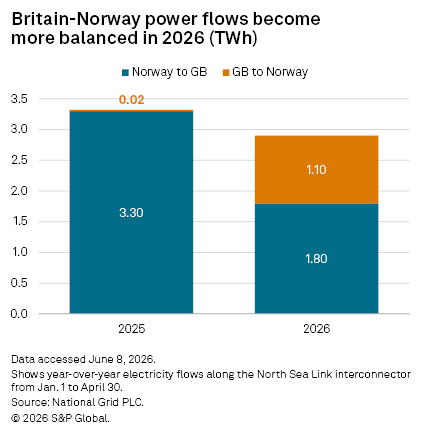
In the first four months of 2026, exports from Britain to Norway increased to 1.1 terawatt-hours, or 38% of the total flows, amid reduced snowfall and drier reservoirs in Norway, according to National Grid. In the same period of 2025, Britain exported just 0.02 TWh via the North Sea Link, or less than 1% of the total.
While the asset remains a net importer to Britain, the increase in exports runs contrary to initial projections of low-cost Norwegian hydro consistently coming to the UK, Sedler said.
"We're seeing patterns that would be ... outside of our traditional envelope of modeling," Sedler said, pointing to geopolitical uncertainties and "scarcity signals" that are difficult to forecast.
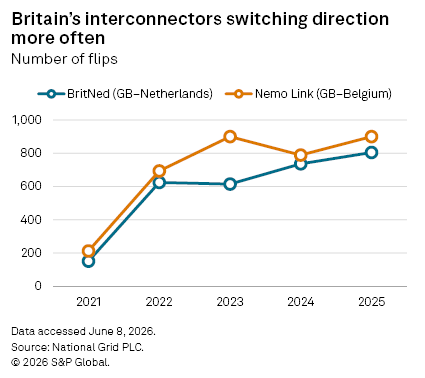
Those directional flips are also occurring more frequently on certain interconnectors as renewables output expands, especially on cables connected to markets where power prices are roughly at parity with the UK, Sedler said.
National Grid said its 1-GW BritNed cable to the Netherlands and 1-GW Nemo Link to Belgium each flipped direction more than 800 times in 2025, four times the level seen in 2021.
The cables typically export power from Britain in the morning, switch to importing in the afternoon as solar farms in continental Europe start generating, then flip back to exporting in the evening, the utility said.
Despite power prices similar to those in the UK, the Netherlands and Belgium still have "huge moments of crazy disparity," Sedler said, referring to afternoon hours when prices often go deeply negative due to the proliferation of solar.
"What we're seeing is the systems across Europe evolve in ways that they were never built for ... and they were never governed for and the markets were never set up for," Sedler said. "All we need to ensure is that the assets are healthy, they're available, they can respond to market signals, they flow in the right way, they're safe and that we support whichever end needs it."
Britain's National Energy System Operator Ltd. in May imposed temporary trading restrictions on interconnectors to France, Denmark, the Netherlands and Belgium, limiting its ability to reverse day-ahead power flows after complaints from European grid operators about "operability challenges" caused by within-day trades.
The curbs, which are in place until the end of 2026, affect National Grid's BritNed, Nemo, Viking, IFA and IFA2 interconnectors, as well as the privately owned ElecLink cable.
 |
Hybrid cables advance
Closer UK-EU electricity cooperation is becoming increasingly important as the industry moves beyond traditional point-to-point interconnectors toward hybrid offshore assets that integrate wind generation.
North Sea nations aim to build 300 GW of offshore wind by 2050, including 100 GW of hybrid assets combining generation and interconnection.
National Grid is developing several hybrid projects, including LionLink to the Netherlands, Nautilus to Belgium and GriffinLink to Germany.
The 2-GW LionLink, the most advanced of the three and a "really important proof-of-concept," is expected to submit a development consent order application in the UK in 2027, before construction begins the following year, Sedler said.
The Netherlands recently announced a first offshore bidding zone in Europe, allowing wind connected to LionLink's offshore platform to bid into whichever market offers the best price rather than being tied to a home market.
Sedler described this as a "huge first" that could serve as a blueprint for achieving North Sea ambitions.
The executive stressed that the UK must now follow suit in announcing a similar regulatory framework — a multipurpose interconnector window — for the next generation of hybrid power cables. But progress so far has been slow.
"When the UK is delivering all of this offshore wind, why are we not moving quicker with this in the UK?" Sedler said. "We need it this year ... It's absolute madness that we're not coordinating all this infrastructure in the UK."