30 Jun, 2026
Labor share of economic growth hits new low; AI adoption could further the trend

By Brian Scheid
American workers are receiving the smallest share of corporate growth in decades as inflation soars and productivity rises, thanks at least in part to increased adoption of AI.
Labor share, the fraction of total economic output that goes to workers in the form of compensation, has declined to 54.1%, down from 55.3% a year ago. That is the lowest level since the US government began tracking it following World War II. For every dollar increase in economic output, workers received about 54 cents in wages, salaries and benefits. The remainder went to business owners in the form of profits, interest or rent.
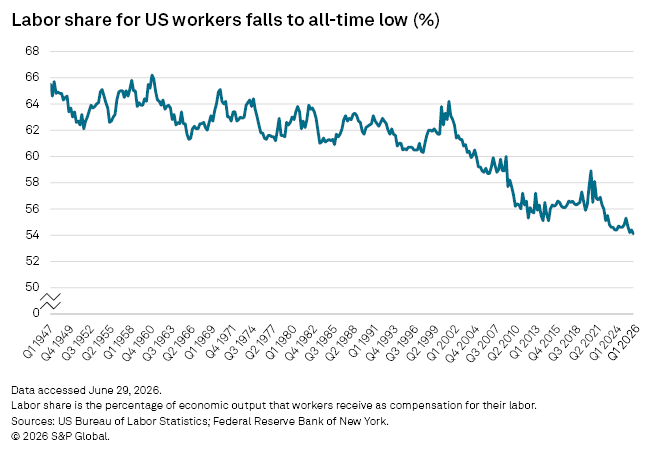
Since the start of 2020, US workers have seen their labor share average 55.5%, well below the averages of 62.4% and 61.7% in the 1980s and 1990s, respectively. Even as US economic growth persists and stock markets continue to rise, workers are seeing fewer benefits, said James Knightley, ING's chief international economist.
"Structurally, workers have been receiving less of the rewards from growth over the past 25 years," Knightley said. "Rewards are increasingly going to corporate profits and those high-income households that own stocks."
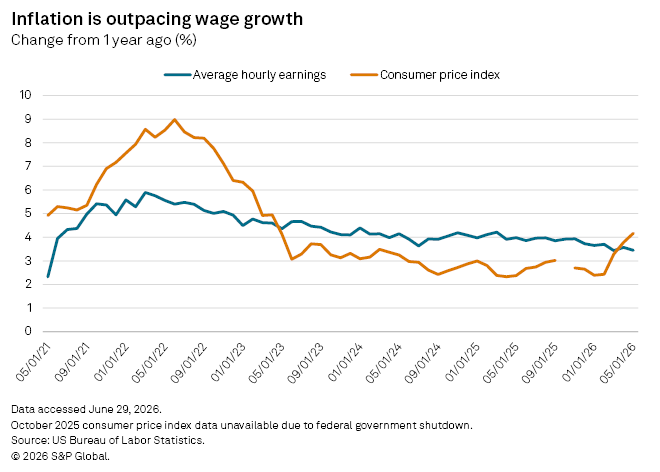
The labor share is falling as productivity and prices are growing faster than wages, and is expected to decline further with inflation outpacing wage growth.
In a June 24 post, economists at the Federal Reserve Bank of New York looked at the persistent decline in the labor share since the COVID-19 pandemic, finding that it fell in ways similar to earlier recessions, driven by the same within-industry forces.
"It looks like across all industries the labor share is coming down," Richard Audoly, a research economist in the New York Fed's research and statistics group and one of the post's authors, said in an interview.
For the labor share to recover, there would need to be more wage growth, allowing wages to catch up with labor productivity and inflation, Audoly said.
If the labor share were to remain at its current level, US workers would likely see lower wage growth. If recent history is a guide, the labor share is less likely to fully recover.
"The one lingering question is whether this time is different," said Heather Long, chief economist at Navy Federal Credit Union. "While the post-COVID period looks similar to history so far, it's not clear that there will be an improvement in labor share of income."
Tech shift
The path forward for labor share remains unclear; the causes of the decline are also uncertain and likely multiple. Increased globalization and the rising market power and efficiency of mega corporations such as Amazon.com Inc. are often cited by economists as the key causes. But technological change, particularly the pervasive growth of AI, has been a leading contributor since the pandemic.
"Companies are investing significant amounts of money in capital to build out AI and data storage capacity," Long with Navy Federal said. "There's a greater tilt toward capital over labor with the returns going largely to shareholders, not workers."
As corporate AI adoption continues, the labor share of income could hit new all-time lows, Long said.
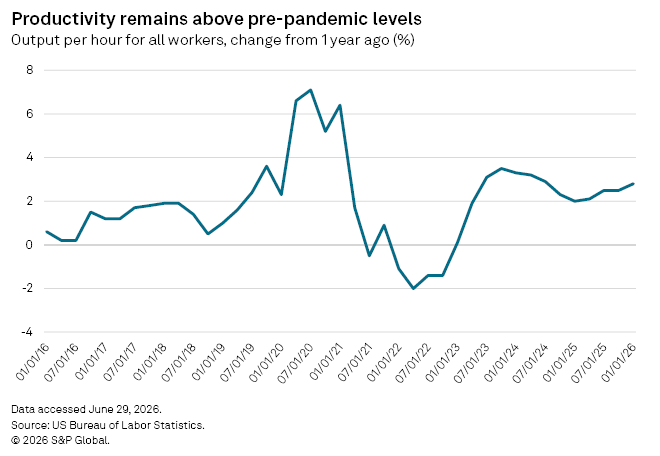
The decline in labor share comes as AI has driven productivity improvements, allowing many firms to delay or reduce hiring, Knightley with ING said.
A June 24 report from Glassdoor LLC found that AI-related keywords in employee reviews of companies increased 240% from May 2025 to May 2026, and were mentioned in reviews more than inflation or burnout. The discussion of AI among US workers is "turning negative," the report states, as employers demand greater use of AI while also citing it as a reason for layoffs and reduced hiring.
"AI has been top of mind for every leader for the last few years, and as leaders stress about AI and harp on it, that is trickling down to workers," Daniel Zhao, chief economist at Glassdoor, said in an interview. "With AI, employees are worried about a range of issues from their own job security to being able to meet their leaders' AI targets to dealing with their leaders' reliance on low-quality AI output."