30 Jun, 2026
'Huge momentum' for US solar, wind power as key subsidies lapse
By Garrett Hering and Kirsten Errick
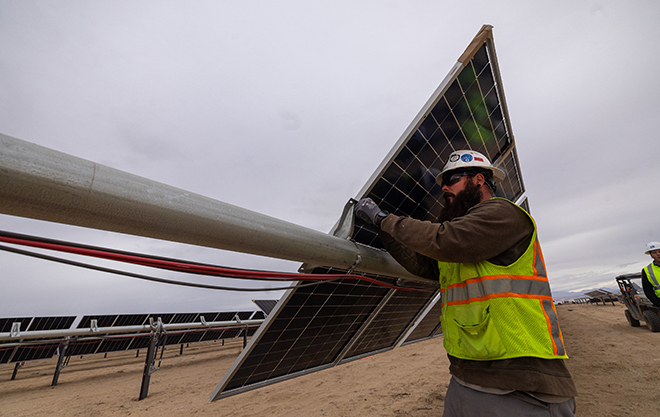
| A worker helps install photovoltaic panels at a solar farm in Kern County, California. |
One year ago, US President Donald Trump enacted sweeping budget legislation that significantly accelerated the federal government's phaseout of key Biden-era renewable energy incentives.
The law, dubbed the One Big Beautiful Bill Act, gave wind and solar power developers just 12 months to lock in valuable tax credits by starting construction. Developers that meet the July 4 deadline have four years to bring their facilities to fruition, while those that miss it must place their projects into service by the end of 2027.
The compressed tax credit timeline, coupled with rising data center-driven demand for electricity, added urgency to a historic clean power building boom sparked by the 2022 Inflation Reduction Act, according to developers and analysts. Yet it also unleashed uncertainties about the pace and price of future capacity additions.
"Ironically, what the Beautiful Bill did [was] it's actually created huge momentum for solar and wind," Sabah Bayatli, president and CEO of Texas-based developer OCI Energy LLC, told Platts, part of S&P Global Energy. "Why? Because of this: You are telling people the credits are running away and everybody's trying to utilize [them]."
The subsidiary of South Korea's OCI Holdings Co. Ltd. was able to "safe harbor," or secure expiring tax credits, by starting construction on nine projects in the first five months of 2026 and six in 2025.
"We had to commence construction for the sake of the tax credits," Bayatli said. "If you are a developer with safe harbor, you are really in a strong position."
Projects that started construction in 2025 were able to avoid onerous new foreign entity of concern (FEOC) restrictions on supply chains that took effect this year. Prior to Sept. 2, 2025, developers were able to safe-harbor projects either by proving they had spent at least 5% of total costs or by starting significant physical work, per the US Treasury Department's August 2025 guidance.
Although a US district court struck down the Trump administration's safe-harbor guidance June 6, developers had less than a month to take advantage of the reexpanded rules before the July 4 deadline.
"We don't see any huge impact or benefit from that," Maheep Mandloi, director of clean energy equity research at Mizuho Americas, told Platts about the court decision.
'Really strong runway'
Most major wind and solar developers prepared well in advance of the July 4 deadline, with many locking in legacy Section 48E investment tax credits and Section 45Y production tax credits last year.
"You may see some small developers weren't sophisticated enough scrambling, but anybody real in this business has had this bucked up for a long time," Joe Osha, senior managing director and equity research analyst at Guggenheim Securities, said in an interview.
The Solar Energy Industries Association and research firm Wood Mackenzie estimated in a June report that developers have safe-harbored more than 200 gigawatts of solar, indicating robust business through 2030.
Wind developers have had less success, safe-harboring 16 GW of onshore projects and 7 GW of offshore developments, Wood Mackenzie said in May.
Near-term developer ambitions extend beyond those estimates.
Between 2026 and 2030, solar developers plan to add roughly 288 GW of utility-scale capacity, while wind developers intend to build over 80 GW, according to S&P Global Market Intelligence data.
The US has never installed that much combined generating capacity over a five-year period, according to an analysis of US Energy Information Administration data.
Although developers frequently experience delays, power industry observers and participants widely expect solar to remain the leading source of new US generating capacity through 2030, largely augmented by wind, batteries and natural gas.
S&P Global Energy CERA, in its latest integrated house view released in May, forecast record generating capacity additions over the next several years, led by renewables, batteries and gas.
"We see a really strong runway to continue building these projects during the rest of this window over the next few years," Cary Kottler, chief development officer at Pattern Energy Group LP, said in a recent interview. "I'm confident in that."
Pattern in May started commercial operation of its roughly 3,650-megawatt SunZia wind power and transmission system in New Mexico and Arizona, one of the largest clean energy infrastructure projects in US history.
In addition to wind, Pattern is developing solar and battery storage, the latter of which maintained tax credits into the mid-2030s under the budget bill.
"We'll build a couple of dozen more projects over the next few years," Kottler said.
Solar developer Silicon Ranch Corp., for its part, "prioritized assets and markets that were the most viable to advance for customer needs," Matt Beasley, the company's chief commercial officer, said in an email.
"In the near term, there has been an immediate rush to pull forward and complete pipeline projects," Beasley said.
However, "there are parts of development — planning/design, permitting, grid interconnection upgrades, and construction, for example — that simply can't be rushed," Beasley said.
Guggenheim's Osha sees the Treasury Department's delayed FEOC guidance as another near-term challenge impacting development.
"That could end up creating some problems in terms of tax equity availability," Osha said.
OCI's Bayatli also has concerns about the lack of FEOC guidance.
"If the government is not giving the market specific guidance on how I should achieve this requirement, then basically the market will have a problem," the CEO said.
2030 and beyond
The biggest consequences of the July 4 deadline may not emerge for another four years, when the last of the wind and solar projects supported by federal tax credits have been built.
"The industry actually is okay without these credits," Osha said.
Some developers echoed that sentiment.
"We're excited about that environment," said Kottler, adding that Pattern is focused on developing a "strong mix of different options" with its equipment suppliers and construction partners to address rising demand.
"And I don't see any let-up in the opportunity to do that in the posttax credit window," Kottler said.
Without the tax credits, however, power purchase agreement pricing "has to go up by 20 to 30% roughly," Bayatli said.
But some costs could decline without tax credits.
"A lot of the cost structure is elevated," Mandloi said, pointing to prevailing wage labor and domestic product factors, which would no longer be required in the absence of tax incentives.
By using certain amounts of US-made equipment, developers can increase their investment tax credit to 40% of project cost from 30%.
The 10% domestic content adder does not offset the increased cost of US-made products, according to Bayatli. "But it still helps you ... avoid all these FEOC discussions."
Call for 'investment certainty'
US manufacturers fear that the end of the tax credits will hurt domestic factories.
"Domestic content creates the market support for the domestic manufacturer," Marta Stoepker, a spokesperson for Hanwha Corp. affiliate Q Cells, told Platts. "So, with it gone, I think there's concern about what will happen to the market. Will it go back to supporting largely imported products? Or will it continue to support the US market?"
"The factories in the near term are fine," said Yogin Kothari, chief strategy officer at the Solar Energy Manufacturers for America Coalition, pointing to safe-harbored projects. "We will want to look to reinstate some kind of policy certainty for driving demand."
"I'm really thinking here beyond 2030," Kothari added.
Bayatli is calling for Congress to act by providing "investment certainty," noting that the budget bill Trump signed into law one year ago "changed the entire thesis" for the private sector to invest in the US.
Under the Biden administration's Inflation Reduction Act, tax credits were to begin a four-year phasedown in 2032 or when the US power sector's greenhouse gas emissions dropped to 25% of 2022 levels, whichever came later.
"This is not good for any investment," the executive said. "I hope that my voice will arrive at Congress at some point."