30 Jun, 2026
Gulf banks expected to show robust performance amid regional instability
By Deza Mones and Cheska Lozano

| The wreckage of a drone in downtown Dubai in March. Source: AFP via Getty Images Europe. |
 |
The war has severely impacted the United Arab Emirates (UAE), Qatar, Saudi Arabia and the other GCC nations, most notably due to the effective closure of the Strait of Hormuz oil route.
The World Bank now projects a sharply lower 2026 GDP for the GCC and a
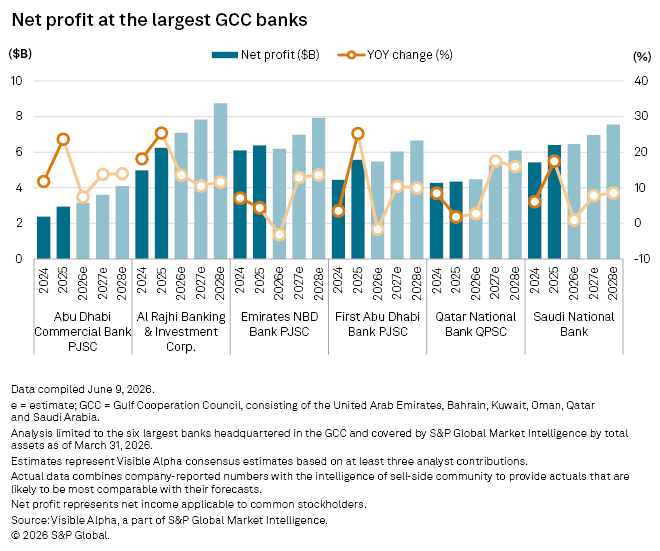
Still, the largest lenders in the region are projected to grow revenue and profits in the years ahead, backed by a combination of strong fundamentals and sovereign support.
Analysts expect Saudi-based Al Rajhi Banking & Investment Corp. to record a 13.6% year-over-year rise in profit for 2026, with further increases in 2027 and 2028, according to Visible Alpha consensus estimates.
Profits are also set to rise for the full year 2026 at Saudi National Bank (SNB), Qatar National Bank QPSC
For 2027, profit growth is projected to be in the 7% to 18% range for all six banks.
The central banks of the UAE, Kuwait, Qatar and Bahrain rolled out proactive support packages for banks to give them operational headroom to navigate the conflict. The packages combine measures that ensure access to liquidity and funding, provide temporary relief from capital requirements and allow flexibility in the classification of loans.
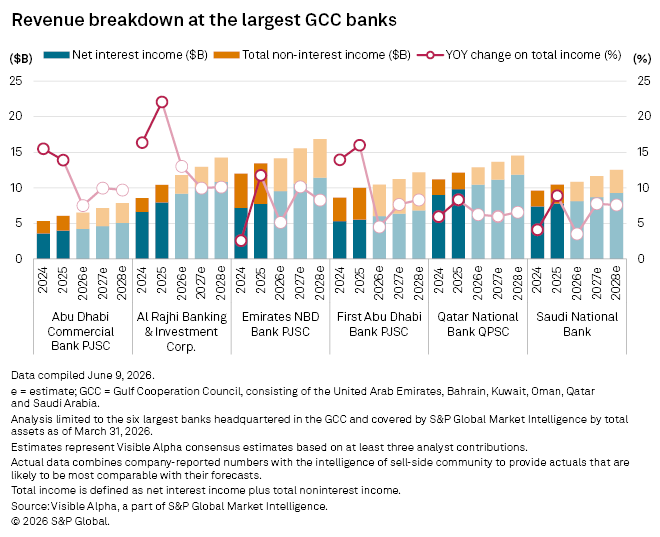
While aggregate revenue growth is expected to slow in 2026, net interest income (NII) — the banks' main revenue driver that is boosted by higher interest rates — should surpass 2025 levels, according to Visible Alpha estimates.
This comes on the back of renewed rate hawkishness by the US Federal Reserve amid expectations for high inflation and uncertainty around the interim US-Iran peace deal. Central banks in the Gulf typically move in lockstep with the US Federal Reserve's monetary policy rate decisions due to their currencies' peg to the US dollar.
The banks' aggregate NII is expected to reach $47.56 billion in 2026, $51.42 billion in 2027 and $55.35 billion in 2028, versus $42.82 billion recorded in 2025.
Fee income appears more impacted by instability in the region, as investment banking activity has slowed considerably. Aggregate noninterest income is projected to dip 3.4% in 2026 to $18.96 billion before returning to an upward trajectory in the next two years.
Still, the increase in public and private sector spending on infrastructure should drive long-term growth in revenue and profits for the GCC banking sector, Junaid Ansari, director of investment strategy and research at Kamco Invest, told Market Intelligence.
Challenging operating environment
The war with Iran has exposed a vulnerability in the Gulf region in the form of the Strait of Hormuz, a critical artery for global energy trade. The narrow passage's monthslong effective closure has severely dislocated oil market flows and put a strain on Gulf economies.
The World Bank currently projects real GDP growth of just 1.3% for the GCC in 2026, down 3.1 percentage points from its January forecast and far lower than the 4.5% expansion recorded in 2025.
Growth in the UAE is now estimated at 2.4%, down sharply from the previous 5.0% forecast in January. Qatar and Kuwait will both see sharp slowdowns, mainly due to declines in hydrocarbon revenue, while growth deceleration in Oman is expected to be moderate as it is less exposed to the conflict, given that its major ports are located outside the Strait of Hormuz.
Saudi Arabia's economy — the biggest in the region — is expected to show some resilience, mainly due to its ability to reroute oil exports through the East-West pipeline, with growth projected at 3.1%, down from 4.3%, according to the World Bank.
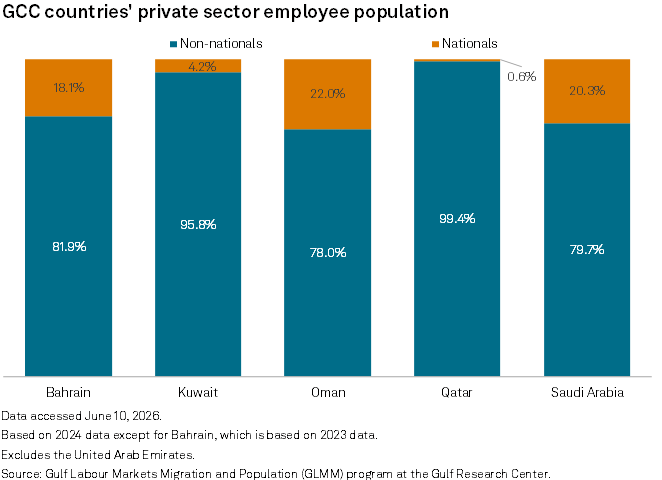
The region's reliance on a non-citizen workforce has also been tested. Expatriates account for more than 99% of the private sector employee population in Qatar, nearly 96% in Kuwait, and almost 80% in Saudi Arabia in 2024, according to data from the Gulf Labor Markets Migration and Population (GLMM) program at the Gulf Research Center.
Some expats left the region at the onset of the conflict, but most have come back to the GCC, David Morel, founder and CEO of global recruitment agency Tiger Recruitment, said in an interview.
When it comes to the region's ability to attract talent, the volume of applications continues to "far outstrip available roles," Megan Prosser, senior manager of banking and financial services for the UAE and GCC at headhunter Robert Walters, told Market Intelligence.
In the UAE, while expats comprise close to 90% of the population, the proportion of those economically able to leave is likely far lower, S&P Global Ratings said in a recent commentary.
Some GCC governments have implemented economic stimulus packages to support businesses, in addition to central bank measures designed to help banks.
– Set up alerts for the Middle East & Africa Monitor, a weekly roundup of financial news in the region.
– Compare banks using the Peer Analysis template on S&P Capital IQ Pro.

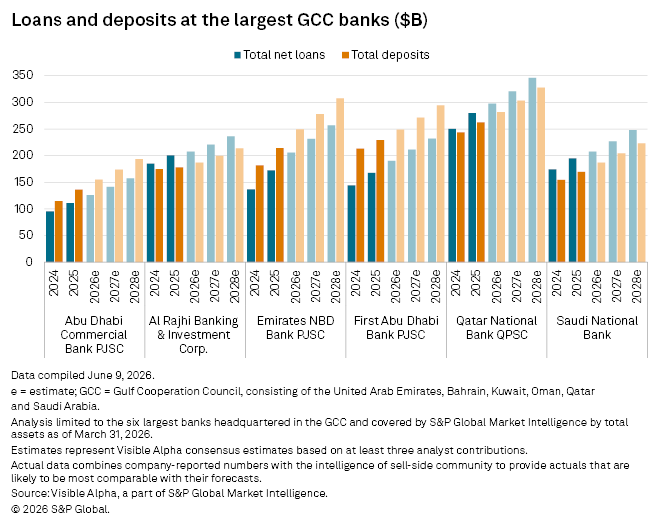
For 2026, analysts expect Saudi banks to moderate lending to rebalance their books. Total net loans at Al Rajhi and SNB are projected to surpass $207 billion in 2026 from $200.68 billion and $194.43 billion, respectively, in 2025.
Total deposits, meanwhile, are expected to reach roughly $207 billion at the two banks, from $177.90 billion at Al Rajhi and $169.58 billion at SNB in 2025.
Banks in Saudi Arabia and the UAE have been offering higher savings rates in recent months to attract fresh deposits.
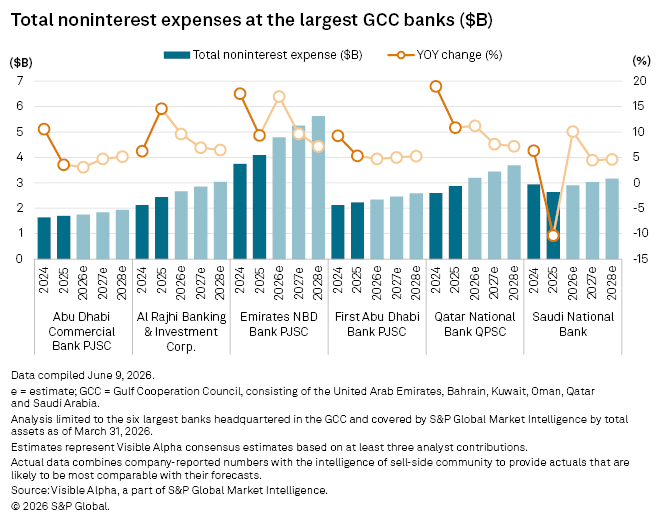
Costs, meanwhile, are expected to be contained.
Emirates NBD is seen logging the highest increase in total noninterest expenses for 2026 of 17%. For the first quarter, the bank's operating expenses grew 14%, which it said was driven by spending on strategic initiatives such as digital and international expansion. Despite this, its cost-to-income ratio — a measure of operational efficiency — remained low at 29.2% as of March-end.
Visible Alpha is a part of S&P Global Market Intelligence.