01 Jun, 2026
Erste Bank, ABN Amro record highest deposit growth among big European banks
By Adrian Jimenea and Cheska Lozano
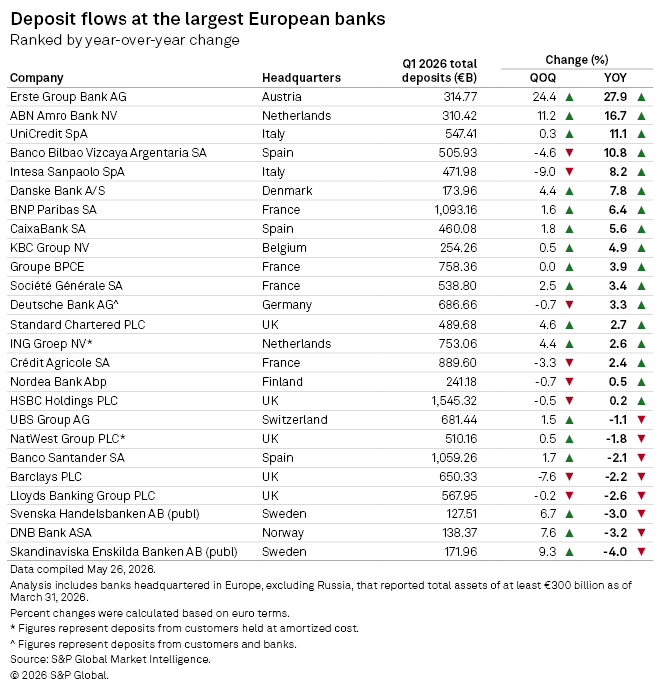
Erste Group Bank AG and ABN Amro Bank NV recorded the biggest deposit growth among the largest European banks during the first quarter, driven by the integration of acquired businesses.
Austria-based Erste Group's deposit base totaled €314.77 billion at the end of March, up 24.4% from three months prior and 27.9% from a year earlier, S&P Global Market Intelligence data showed. Erste Group acquired de facto control of Banco Santander SA's Polish arm in a €7 billion deal.
Dutch bank ABN Amro's deposits grew 11.2% quarter over quarter and 16.7% year over year as it took over its smaller domestic peer NIBC Bank. The group saw continued growth in demand deposits in the quarter, despite economic uncertainty and migration from maturing time deposits, according to an earnings presentation.
Deposits at European banks with total assets of €300 billion or more increased by an average of 2.3% in the first three months of 2026, the data showed. Deposit growth is seasonally stronger in the first quarter than at other times of the year, partly due to bonus payments made during the period.
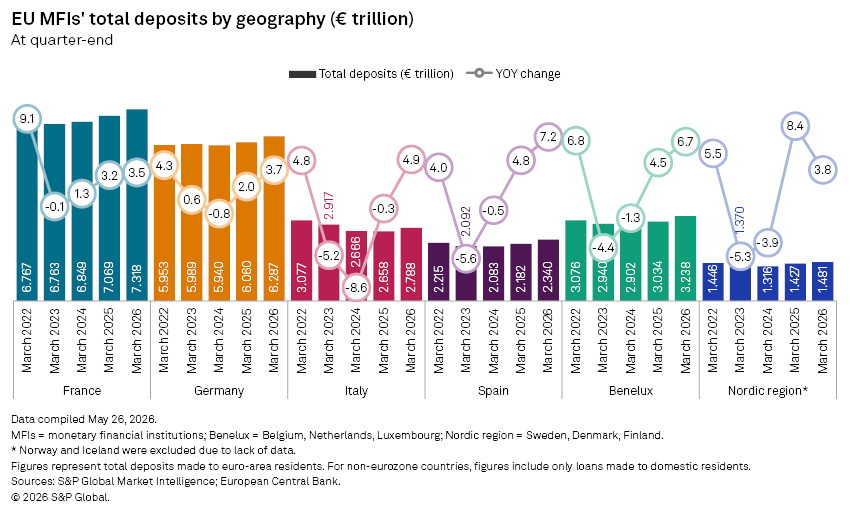
Spain-based monetary finance institutions (MFIs) recorded the best year-over-year deposit growth among European banks at 7.2%. "Deposits are growing because also the economy is growing," said Javier Pano Riera, the CFO of CaixaBank SA, the largest domestic bank in Spain. The bank is gaining payroll deposits, indicating that employment is growing, he said during an earnings call.
MFIs in the Benelux region, where ABN Amro is based, saw a 6.7% year-over-year increase in deposits, while Italian MFIs grew deposits by 4.9%. Germany, France and the Nordics saw more modest deposit growth of 3.7%, 3.5% and 3.8%, respectively.
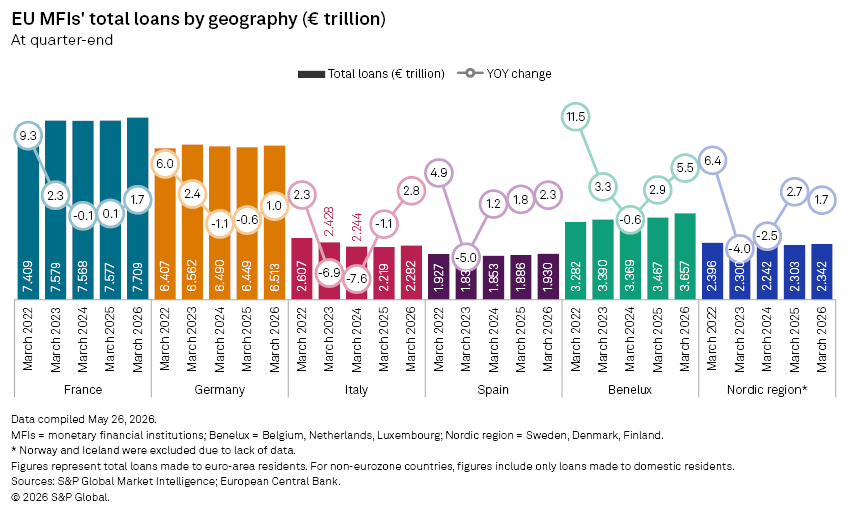
Loan growth was more subdued during the quarter. Euro area banks reported a larger-than-expected tightening of credit standards for loans or credit lines to businesses amid economic risks and geopolitical and energy developments, according to the European Central Bank's latest bank lending survey. Some banks reported additional tightening related to exposures to energy-intensive firms and to the Middle East.
The results of the survey and the ECB's other consumer expectations survey indicate that so-called stagflationary pressures have increased, Carsten Brzeski, ING Research's global head of macro, said in a note. A stagflation scenario is characterized by slow economic growth, elevated unemployment levels and rising prices.
Benelux MFIs experienced the best year-over-year loan growth in the quarter at 5.5%. Italian and Spanish MFIs reported loan growth of 2.8% and 2.3%, respectively. German MFIs had the lowest year-over-year loan growth at 1%.
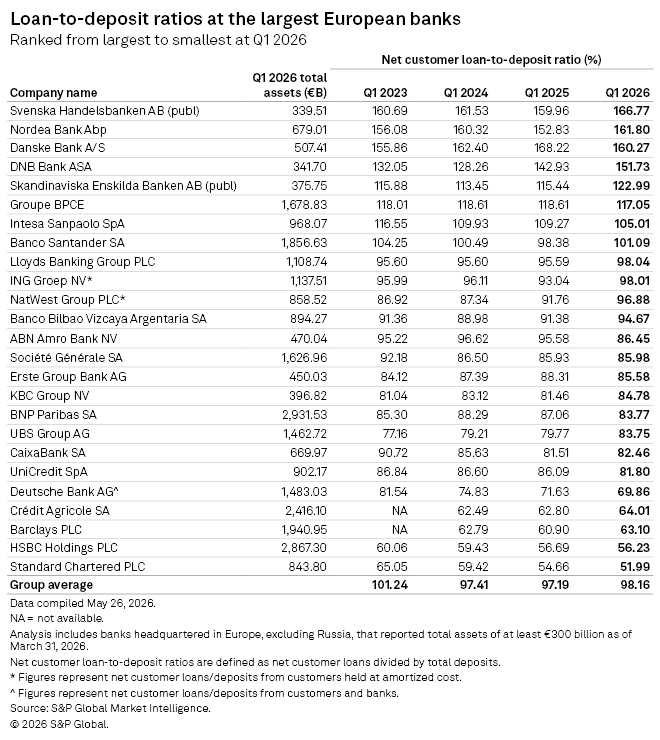
Nordic lenders continued to have the highest loan-to-deposit ratio among Europe's largest banks, with Sweden-based Svenska Handelsbanken AB (publ) topping the list with a ratio of 166.77%. Finland-based Nordea Bank Abp came in second with a ratio of 161.80%, followed by Danske Bank A/S with 160.27% and Norway's DNB Bank ASA with 151.73%.
A higher loan-to-deposit ratio means a bank's loan book is higher than its deposit book. However, Nordic banks having higher ratios does not necessarily mean trouble — mortgages make up a significant chunk of their loans, and these mortgages are mainly funded by covered bonds, which are considered stable.
Standard Chartered PLC had the lowest loan-to-deposit ratio at 51.99%, followed by HSBC Holdings PLC at 56.23%. Both lenders are based in the UK, but derive the bulk of their business and income from Asia-Pacific and other emerging markets.
On average, the sampled banks' loan-to-deposit ratio was 98.16% at the end of March, up from 97.19% a year earlier.