05 Jun, 2026
Energy industry sees few benefits in semiannual SEC reporting proposal

By Allison Good
|
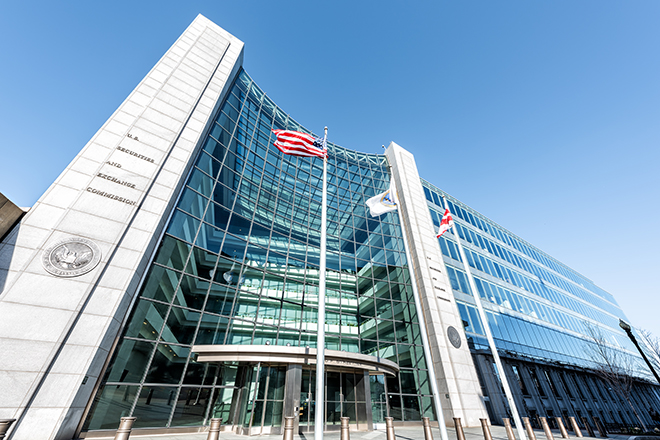
Energy investors and management teams are cautious of a proposed rule by the US Securities and Exchange Commission, above, to allow semiannual reporting of financial results. |
There is little reason for energy, utility and renewable power companies to switch to semiannual financial reporting from quarterly reporting should a proposed US Securities and Exchange Commission rule allowing the option become final, according to multiple sector attorneys and experts.
While less frequent reporting could enable more companies to go public by reducing administrative burdens and easing costs, energy investors will continue to demand the transparency provided by quarterly disclosures, said attorneys and analysts interviewed by Platts, part of S&P Global Energy. Management teams are also wary of the flexibility that could come with semiannual reporting because lenders, customers and other regulatory entities require financial and operational information on a quarterly basis.
The SEC released a proposal for public comment on May 5 that would allow public companies to file semiannual reports instead of traditional quarterly reports, saying the option provides flexibility "to choose the interim reporting frequency that would best serve the company and its investors."
"Several companies point to quarterly earnings updates as a reliable resource to clear material non-public information to provide updates to the investment community," Scotiabank analysts wrote in a May 14 report tallying the results of a survey of utility investor relations teams. "We agree that six months seems like a long time to wait between regular updates."
"[M]ost companies would likely continue with the status quo," Scotiabank concluded.
IPOs underway
The SEC proposal arrives as several oil and gas and renewable energy companies have recently launched initial public offerings, buoyed by data center developers' demand for power. Semiannual reporting could ease emerging companies' paths to becoming public by reducing costs and administrative tasks associated with quarterly disclosures.
Among companies that have debuted on the Nasdaq in recent months are geothermal company Fervo Energy Co., nuclear reactor and fuel developer X-Energy Inc., solar and storage power plant engineering and construction company SOLV Energy Inc., and oil and gas surface land and resource management company EagleRock Land LLC.
SoftBank Corp. has also reportedly tapped banks to prepare an IPO for renewable power producer subsidiary SB Energy Corp.
"I've always felt like the cost of reporting was something of a red herring," Peter Gardett, CEO of market data platform Noreva, said in an interview. "It's expensive but not determinative when it comes to an IPO. Market conditions are certainly much more of an obstacle for that."
"Smaller energy companies fresh off of an IPO who are developing infrastructure projects with long-term horizons" may be more inclined to release semiannual reports, according to Perkins Coie attorney Chris Wassman, who specializes in capital markets transactions and corporate compliance. However, they will have to "counterbalance the fact that less information might mean less analyst following."
Quarterly requirements
Energy companies would still be required to make quarterly disclosures to other parties and regulators, Foley & Lardner attorney Scott Ellis, who focuses on energy litigation, said in an interview.
"In terms of what they have to do on a day-to-day basis to satisfy contractual and lending requirements, I don't think they're looking at this as saving time," Ellis said. "Trying to manage two separate timetables if they decided to adopt semiannual SEC reporting just doesn't make a whole lot of sense for them."
The Federal Energy Regulatory Commission, for example, requires interstate natural gas pipeline companies and electric utilities to submit quarterly financial reports. Many state public utility commissions use those reports to track both state and federal compliance.
Power purchase agreements also "have very strict and detailed reporting requirements that often match a quarterly reporting cadence," Ellis said.
Additionally, quarterly disclosures facilitate access to capital.
"For companies that are frequently in the capital markets raising money for registered offerings, there's a concern that if you don't have more frequent financial results available ... investors may otherwise demand more information," Perkins Coie's Wassman said.
Responses from energy investors and management teams during the commenting period, which ends July 6, have been similarly negative.
The proposal is "really disliked" among oil and gas investors and would be "incrementally worse" for retail investors who do not have institutional access, The Schneider Capital Group CEO Timm Schneider said in an interview.
While semiannual reporting has been an option in Europe since 2013, large energy companies such as Shell PLC and BP PLC have continued to report their financials quarterly to maintain transparency, Schneider added.
Other downsides
A future federal administration could also reverse a final rule and revert to requiring quarterly reporting.
"If you're doing it by rulemaking, it's very easy to get a new rule with a new administration that doesn't see things the same way," Jay Dubow, who leads Troutman Pepper Locke's securities investigations and enforcement practice group, said in an interview.
For the renewables sector, semiannual reporting has the added disadvantage of blurring the line between public and private markets, according to Noreva's Gardett.
"If public firms move towards only talking to you twice a year, that puts them on a much more level playing field with private firms and funds, which themselves now have access to the same pool of retirement capital that would traditionally be going into public equities," Gardett said, referring to a US Labor Department proposed rule easing restrictions that prevent US retirement savers from investing 401(k) assets in private equity and credit funds.
"A lot of renewables and power development is increasingly happening in the private market, and it becomes harder and harder to tell the difference between public and private," Gardett added. "If you look at a company like a Brookfield or an Apollo today, these are publicly traded firms that are collections of private assets, and it's entirely possible that more companies will start to look like that."