17 Jun, 2026
Asian stocks set to extend outperformance of global peers

By Nick Lazzaro
|
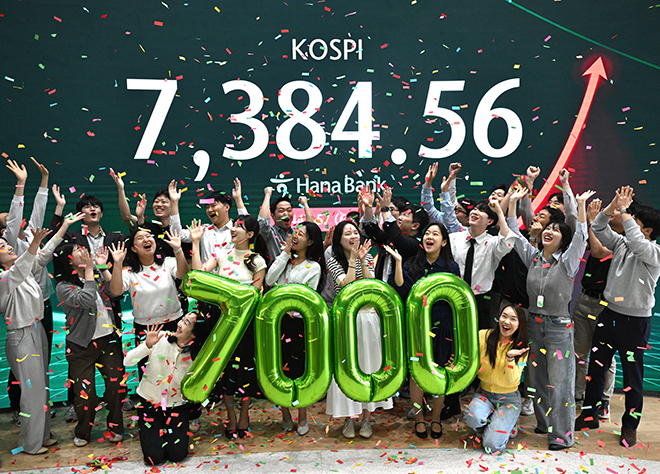
Currency dealers celebrate in front of a screen showing South Korea's benchmark stock index, the KOSPI, during a ceremony celebrating it breaking 7,000 points at the Hana Bank headquarters in Seoul on May 6. The KOSPI has been one of the world's best-performing stock indexes this year, driven by companies such as tech heavyweight Samsung Electronics Co. Ltd. |
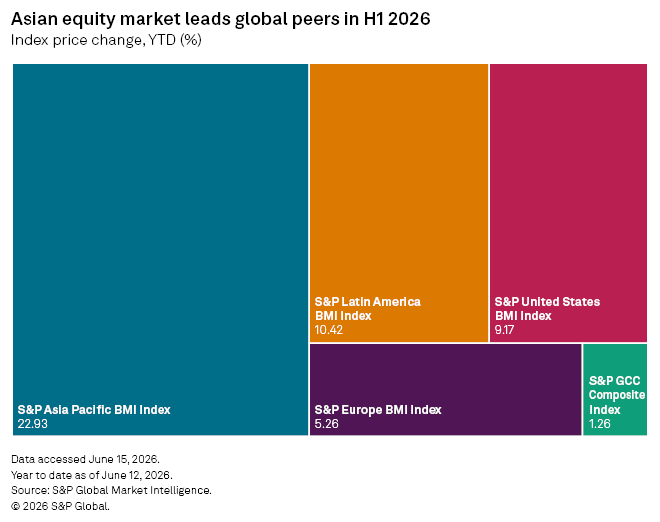
Asian stocks are poised to extend their outperformance of global peers in the second half of the year after leading in the first six months.
The S&P Asia Pacific BMI Index this year climbed nearly 23% through mid-June and more than 19% since the end of the first quarter, outperforming other major regional BMI stock indexes compiled by S&P Dow Jones Indices.
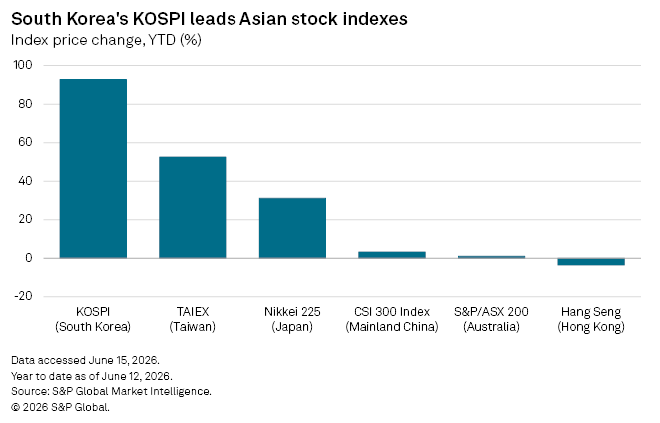
AI investment enthusiasm powered Asian equity markets in April and May, particularly for technology companies based in Japan, South Korea and Taiwan. The trend is expected to continue, though it faces pressure from elevated energy prices and AI-related market concentration concerns.
"I would caution investors with some of the countries that have soared yet are very concentrated, such as in South Korea, with two companies in the KOSPI index," Jimmy Lee, CEO of The Wealth Consulting Group, told S&P Global Market Intelligence. "Asian economies are affected the most from the current oil shock. This could be a factor in how those markets perform during the second half of this year."
China, India, South Korea and Japan recorded the world's largest net oil imports by value among individual countries in 2025, according to Market Intelligence data.
Despite their greater exposure to energy price volatility, growth tied to AI development and technology exports could buffer Asian companies from associated risks, according to Nick Niziolek, co-chief investment officer, head of global strategies and senior co-portfolio manager at Calamos Investments.
"The marginal opportunity remains overseas in markets like South Korea, where governance reform and leadership in AI memory has been a powerful combination; Taiwan, which is the center of the advanced semiconductor supply chain; and Japan, where corporate restructuring is a real and durable theme," Niziolek told Market Intelligence.
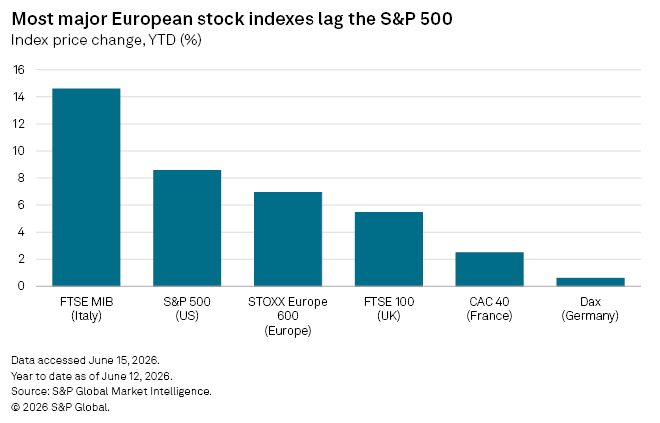
Meanwhile, major European equity markets have lagged through June. The S&P Europe BMI Index has risen more than 5% through mid-June, falling behind the S&P 500's nearly 9% gain. In 2025, the European index rose nearly 32%, doubling the S&P 500's 16% increase.
However, certain sectors in Europe provide ongoing upside for the region's equity market.
"We are more selective in Europe but continue to see an opportunity to participate in the defense and infrastructure spending programs that should provide a multi-year tailwind, in addition to their place in the energy and semiconductor supply chains," Niziolek said.
Emerging markets outlook
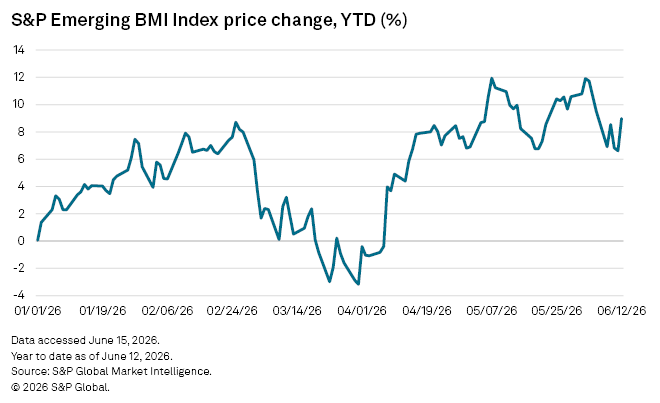
Broadly, emerging markets have performed similarly to the S&P 500 this year, with the S&P Emerging BMI Index up nearly 9%. However, regional- and country-specific index performance has varied, and movement in the second half of the year could depend on energy prices and the US dollar.
"A supply shock that strengthens the dollar and keeps US rates higher for longer pulls capital out of emerging markets quickly, and that channel usually does more damage to their equities than the oil price move that set it off," said Vazgen Gevorkyan, strategic adviser to Armenian wealth management company Wilco and supervisory board member of Evocabank. "For the second half, I expect emerging market equities to track the dollar and US rates more closely than their own local fundamentals."
Still, global manufacturing trends may point to stronger growth in emerging markets later this year. S&P Global Purchasing Managers' Index data for May showed the sharpest rise in global factory production since July 2021.
"When you have leading indicators that are rising broadly around the world, it tends to favor emerging markets because those indexes are heavily comprised of cyclical stocks," BMO Capital Markets Managing Director and Chief Investment Strategist Francois Trahan said in an interview.
A ceasefire in the Middle East could boost emerging market cyclical stocks and could offer an additional tailwind to markets focused on industrial production and natural resources.
"There will be a lot that needs to be rebuilt, so there is going to be a future source of demand for resources," Trahan said. "Some of that will filter through to American companies, but it will disproportionately benefit emerging market companies."
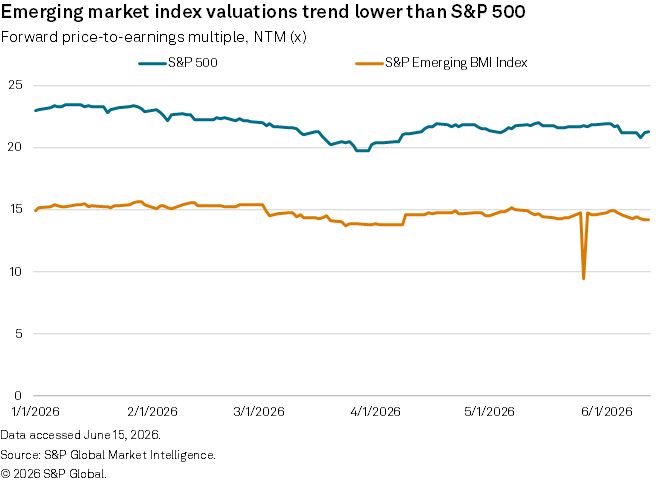
The discounted valuations of emerging market stocks relative to the S&P 500 provide an additional tailwind.
"We do continue to believe emerging markets offer a compelling long-term opportunity set, especially compared to overvalued US markets," Alissa Corcoran, co-chief investment officer, director of research and portfolio manager at Kopernik Global Investors, told Market Intelligence. "In our view, we are being overcompensated for the risks we are taking in emerging markets."