10 Jun, 2026
Analysts see Danske Bank beating its 2028 targets
|
Danske Bank aims to |
Analysts expect Danske Bank A/S to exceed its medium-term targets, aided by increasing activity with corporates and an AI-led efficiency push.
Denmark's largest bank by assets in April announced financial targets for 2028 including around 63 billion Danish kroner of revenue, a return on equity (ROE) of more than 14.5%, a cost-to-income ratio under 43% and ordinary dividends equivalent to 60% to 70% of net profit.
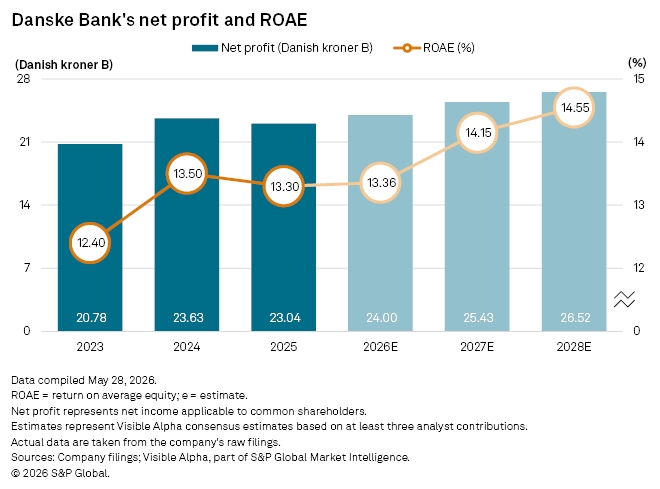
The bank is projected to report an ROE of 14.55% in 2028, according to the latest Visible Alpha consensus estimates. Danske Bank is also forecast to achieve better revenue and efficiency results than it has guided for, the data shows.
"The bank is doing the right thing and I think the management is going to deliver on the target," said Martin Schei Nilsen, analyst at SB1 Markets. "Relative to other banks, [Danske Bank] is still an attractive share to own over the next two or three years."
Danske Bank's shares are up 2.1% year to date, outpacing most of its biggest competitors in the Nordic region.
The ROE target "makes sense," Schei Nilsen said in an interview. Danske Bank can benefit from customers switching banks to grow its share in its smaller markets while maintaining its leading position in its home country, Schei Nilsen said.
Denmark is the bank's largest market, accounting for 58% of group loans at the end of March. There, the bank boasts a 27% market share in corporate lending and 23% in retail lending, according to a company presentation. Sweden is the second-largest market, accounting for 18% of group loans, followed by Finland and Norway, with 12% and 8%, respectively.
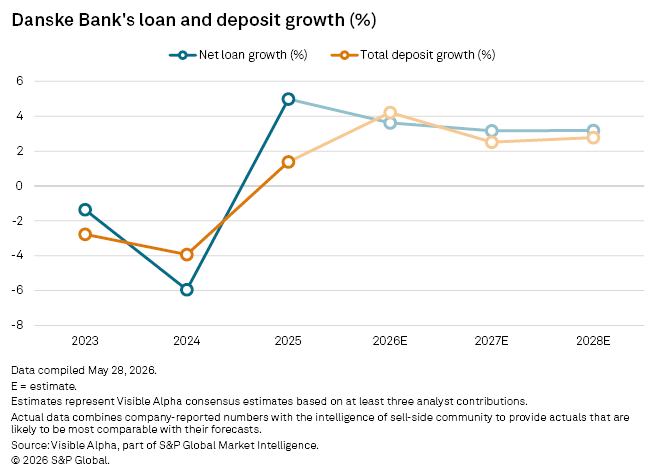
Danske Bank's targets assume annual lending growth of 3% to 4% and deposit growth of 1% to 2% through 2028. They also assume relatively flat three-month interest rates over the same period. Executives and analysts have said the assumptions are conservative.
Corporates
Danske Bank's loan growth ambitions are likely to be powered more by corporates than by households in the near term as the macroeconomic environment is "somewhat mixed," Goldman Sachs analysts said in a May 21 note. While cautious households and elevated savings rates are limiting retail loan growth, corporate activity is more constructive, underpinned by stable leverage, strong cash flows and increasing infrastructure and investment needs, they said.
In late March, the Danish central bank forecast GDP growth of 1.8% in both 2026 and 2027 and 2% in 2028. It expects Denmark to spend more on defense, climate and demographic development.
Danske Bank is boosting its financing of the defense sector by including companies whose products can be used by both the military and civilians, Johanna Norberg, head of business customers, told Bloomberg News in mid-May. It has also committed 3 billion kronor in financing for Nordic startups.
The bank's CEO, Carsten Egeriis, has said there is an "upside case" if Nordic economies grow between 1.5% and 3% in a large investment cycle driven by defense, energy and technology. Such growth would be "very supportive" to the bank's business, two-thirds of which are SMEs, large corporates and institutional clients, he said during an April 30 presentation with analysts.
Visible Alpha estimates indicate that loan growth in the next three years would be within the bank's assumed range. Deposit growth, meanwhile, is expected to exceed 2%.
To meet its 2028 targets, the bank plans to boost its Panorama digital advisory offering in the affluent and private banking sector in Finland and Sweden, where it has retail market shares of 8% and 3%, respectively. It also plans to attract more mid-sized corporate and small business clients to its business customers segment.
For large customers, it plans to continue expanding in capital markets and sustainable finance, and to take advantage of a broader push for defense spending and the use of digital assets.
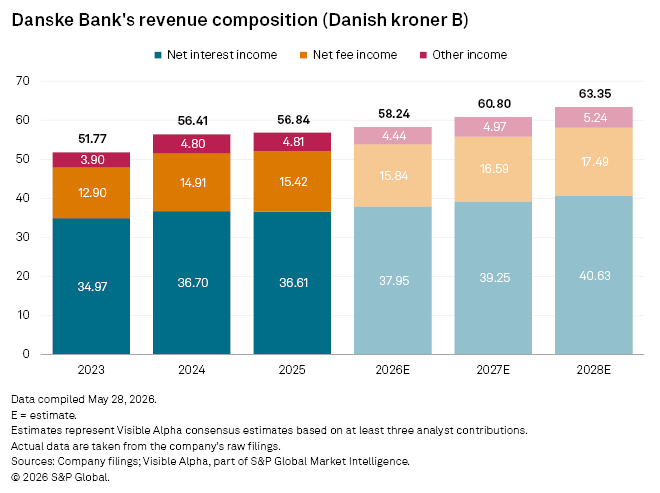
Revenue is expected to total 63.35 billion kroner in 2028, growing in each of the next three years from 56.84 billion kroner in 2025, according to Visible Alpha consensus estimates. Net fee income is poised to grow at a compound annual growth rate of 4.29% in 2028 versus 2025, outpacing the 3.53% growth in net interest income.
Cost efficiency through AI
The more ambitious targets come as Danske Bank seeks to move past historical controversies, most notably a money laundering scandal at its former Estonian arm that wiped nearly half of its share price in 2018. The lender folded its banking activities in the Baltics and Russia in 2019, and a corporate probation with the US Department of Justice related to the Estonia matter ended in December 2025.
Danske Bank has adequately addressed its shortcomings and risks have dramatically decreased, according to Morningstar analyst Niklas Kammer. Profits have increased, overcoming higher costs due to improvements in anti-money laundering processes, Kammer said in a May 26 note.
The bank has announced cost-cutting measures, expecting its investments in AI to drive cost efficiency. It announced 420 redundancies in February and 262 more in late May, mostly in Denmark.
Danske Bank has committed 2 billion kroner for additional AI projects, which should help shave 3.5 percentage points from its cost-to-income ratio, according to Chief AI Officer Kasper Davidsen. The company is also looking to reduce manual processes in the credit process by 40%, he said at a London conference in late May.
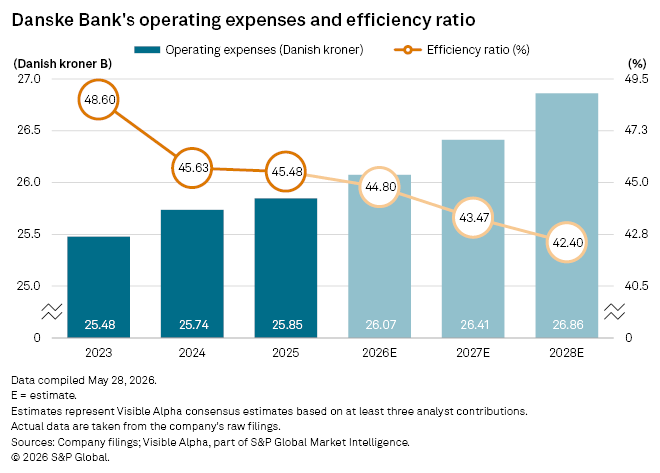
Although Danske Bank's total expense pool is projected to rise to 26.86 billion kroner in 2028 from 25.85 billion kroner in 2025, the group is still likely to be more cost-efficient. Its cost-to-income ratio is projected to improve to 42.4% in 2028, better than its guidance, according to Visible Alpha estimates.
As of June 9, US$1 was equivalent to 6.46 Danish kroner.
Visible Alpha is a part of S&P Global Market Intelligence.