23 Jun, 2026
Affordability at heart of Kim's campaign for Calif. insurance commissioner

By Tom Jacobs
|
California Insurance Commissioner candidate Jane Kim delivers remarks during the state Democratic Party convention at Moscone Center in San Francisco on Feb. 21. |
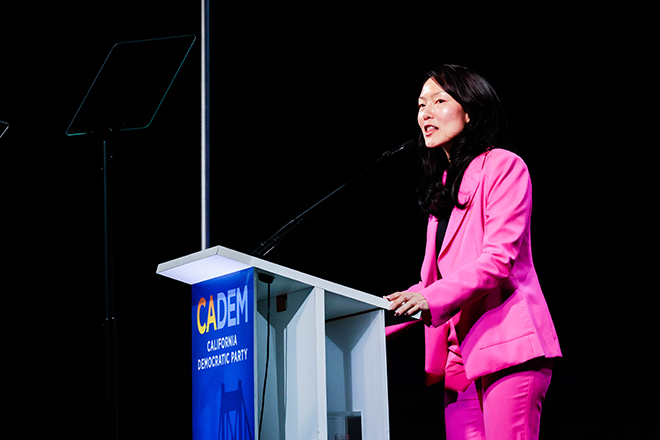
Jane Kim's goal of making insurance affordable and available for Californians is the centerpiece of her campaign to become the state's ninth insurance commissioner.
Kim, a former member of the San Francisco Board of Supervisors, and departing state Sen. Ben Allen, both Democrats, were the top vote-getters in the state's all-party primary on June 9. They will face off in the general election in November, with the winner succeeding Ricardo Lara, the current commissioner who has served in the position since 2019.
Lara's efforts to improve the state insurance market through initiatives such as the Sustainable Insurance Strategy and changes in the ratemaking process drew some praise from Kim. However, while Lara recognized an insurance availability issue and worked with insurers to keep them in the market, his efforts did not go far enough to address the affordability issue, Kim said.
"You can offer all the expensive policies in the world, but if working-class, middle-class and fixed-income homeowners can't afford it, it's not actually increasing availability, and I think the Sustainable Insurance Strategy missed the mark on that," Kim said in an interview. "We have to make insurance both affordable and available."
Single-payer solution
Among the proposals Kim has put forward during her campaign is the creation of a state-run, single-payer disaster insurance program, which would be separate from homeowners insurance issued by the admitted market. Coverage would be automatic and universal, with every home, regardless of condition, moving into a single risk pool, with the owners paying premiums based on factors such as property value or risk.
Kim said that what California now has is "risk-pool fragmentation," with "healthy" homes in one pool and other homes in another pool. She said that including everyone would create "a secure and stable pool," with a portion of the collected premiums invested into resiliency, floodproofing and fireproofing efforts.
"The state couldn't reduce the risk of their portfolio by canceling coverage on the riskiest homes, so they would actually have to invest in prevention," Kim said. "One of the misaligned incentives right now is that the for-profit market prices risk, but they don't actually address risk, and the only way to make insurance affordable and available is to address risk, which is prevention."
Intermittent communications
Kim said that insurers have been "reaching out" since she declared her candidacy. The majority of those chats were about insurers' priorities, such as reducing wait times for rate approvals, introducing new financial products and using telematics. Her policy proposals, however, were not a significant part of those conversations.
The disaster insurance proposal, Kim said, is designed to take on the riskiest aspect of insurers' portfolios to "stabilize the market so that insurers can provide home insurance broadly and affordably."
Kim's disaster insurance proposal would not be the first in California to use a single-payer system. In 1990, the state enacted the California Residential Earthquake Recovery Fund (CRERF), a mandatory state-run program that provided payments to residential property owners for structural damage caused by earthquakes to help cover the 10% earthquake deductible on private insurance policies.
However, CRERF was short-lived as it was repealed in 1992. The state auditor said in a report to the legislature that the program was structurally and financially insolvent.
Wildfire fallout
The election has become more significant in the wake of the 2025 Los Angeles wildfires, which broke out Jan. 7, 2025, amid extreme drought conditions and powerful winds and were not fully contained until the end of the month. The blazes scorched over 57,000 acres, destroyed more than 18,000 structures, caused 31 deaths and resulted in over $40 billion in insured losses.
The largest blazes over that period — the Palisades fire and Eaton fire — were the two costliest wildfires in US history, with estimated insured losses of $23 billion and $17.5 billion, respectively. The aftereffects of the fires, apart from insured losses, included battles over insurers' rate increases and legal challenges alleging reduction of coverage and slow claims handling.
Among those legal challenges is the enforcement action that Lara has brought against State Farm General Insurance Co., alleging that the State Farm Mutual Automobile Insurance Co. subsidiary committed widespread violations when handling claims from the Los Angeles wildfires.
A California Department of Insurance (CDI) review concluded that State Farm General allegedly committed 398 violations in 114 of the 220 claims examined, including delayed investigations, underpayment of claims, repeated reassignment of adjusters, improper handling of smoke-damage claims and poor communication.
State Farm asked for a June 14 deadline to respond to the charges, with the hearing before an administrative law judge set to commence within 30 days of receipt of the response. CDI requested a range of penalties, which must be approved by the judge, from a $5,000 fine per violation, or $10,000 for "willful violations," to a possible suspension of State Farm's certificate of authority, which allows it to do business in California.
When asked about the current investigation, Kim said her approach to handling any such future investigations would be to prioritize the homeowners.
"I believe this office should be a champion for consumers," Kim said.
Insurance crossroads
Kim said she has distinguished her campaign from her rivals by offering proposals, "including policy proposals with revenue to actually address risk."
"Most candidates are really focused on how they can restructure rules and tinker with the system in order to address what I think is the systematic failure of a system that is not designed for conditions of today, meaning accelerating climate disaster and, to a lesser extent, inflation," Kim said.
Kim views the chance to become insurance commissioner as a meaningful opportunity, given the office's role at the intersection of California's affordability, climate and housing crises.
"[I]f California isn't able to solve these crises, we, as a state, are not going to be an economically viable state for everyday people," Kim said.