18 May, 2026
NextEra and Dominion Announce Merger to Create Largest US Regulated Utility, Citing Electricity Demand Growth
By Darren Sweeney and Abbie Bennett
What is the primary driver for the NextEra-Dominion merger?
NextEra Energy Inc. and Dominion Energy Inc. are merging in a landmark all-stock transaction, driven by what their leaders describe as a "meteoric rise" in US electricity demand. The deal aims to create the world's largest regulated electric utility with a market capitalization exceeding $249 billion. The increased scale is expected to enhance the combined company's ability to finance, build, and operate new infrastructure more efficiently to meet this growing demand.
Why is scale critical for utilities amid rising electricity demand?
The current inflection point in US electricity demand, unseen in generations, creates an enormous opportunity set for utility providers. According to company leadership, achieving greater scale is essential to enhance the customer value proposition. A larger, combined entity can leverage superior buying and financing power, a more robust supply chain, and operational efficiencies to build projects faster and meet demand without sacrificing reliability or affordability.
Key Insights
- NextEra Energy Inc. plans to acquire Dominion Energy Inc. in an all-stock deal, creating the world's largest regulated electric utility with a combined market capitalization of over $249 billion and an enterprise value of $420 billion.
- The primary driver for the merger is the significant increase in US electricity demand, particularly from data centers in Dominion's Virginia territory.
- The combined company, operating as NextEra Energy, will have an operating portfolio of 110 GW, with projections to grow to as much as 260 GW by 2032, and an annual capital spending plan of about $59 billion from 2027 to 2032.
- Under the deal terms, Dominion shareholders will receive 0.8138 share of NextEra for each Dominion share. NextEra shareholders will own approximately 74.5% of the combined company.
- The merger is subject to shareholder and regulatory approvals, including from the Federal Energy Regulatory Commission (FERC), the Nuclear Regulatory Commission (NRC), and state commissions in Virginia, North Carolina, and South Carolina.
What is the strategic rationale behind the utility sector's blockbuster merger?
The leaders of NextEra Energy Inc. and Dominion Energy Inc. view the meteoric rise in US electricity demand as a key factor in their blockbuster merger.
Details of the All-Stock Transaction Juno Beach, Florida-headquartered NextEra plans to acquire Richmond, Virginia-headquartered Dominion in an all-stock deal that will create the world's largest regulated electric utility, the companies said May 18.
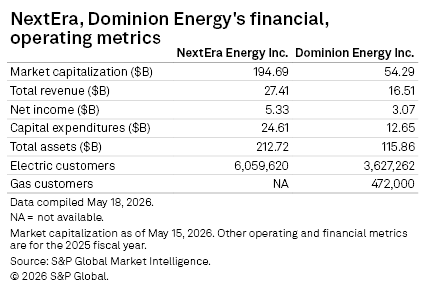
Valuation and Market Impact The combined company will have a market capitalization of more than $249 billion and rate base of $138 billion, according to an investor presentation. The transaction has an enterprise value of $420 billion.
Executive Perspective on the Merger "Our country is at an inflection point. Demand for electricity is increasing unlike anything we've seen in generations," NextEra Chairman, President and CEO John Ketchum said on a May 18 call to discuss the merger. "The opportunity set is enormous. Meeting it requires us to enhance our customer value proposition. That starts with scale."
The Role of Scale in Efficiency That greater scale will enable the combined company to "buy, build, finance and operate more efficiently," Ketchum said.
Commitment to Reliability and Affordability Projects will be built faster and more efficiently to meet demand "without sacrificing reliability or affordability," added Ketchum, who will serve as chairman and CEO of the combined company.
Post-Merger Synergies The company will have better, more efficient buying and financing power, and a robust supply chain post-merger, executives said.
Initial Market Reaction Dominion stock soared on the news, opening up more than 10% at $68.20, with shares trading up about 8% at 2 p.m. ET.
NextEra's Stock Performance NextEra's shares dipped more than 2% at $91.03 at the opening bell, and were down about 7% at 2 p.m. ET.
How will the combined company operate?
Projected Capital Spending The combined company is expected to have annual capital spending of about $59 billion from 2027 to 2032, Dominion Chair, President and CEO Robert Blue said on the call.
New Leadership Structure Blue will serve as president and CEO of regulated utilities.
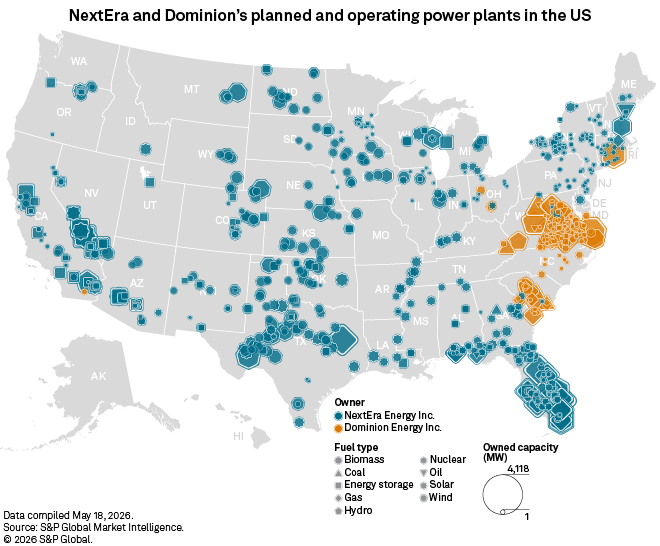
Future Generating Capacity The combined utility, operating under the NextEra Energy name, would have an operating portfolio of 110 gigawatts, which executives said could more than double — growing to as much as 260 GW — by 2032.
A Unified Vision "We believe we can accomplish more together than we can apart," Ketchum said.
Customer Transition Plan The transition will be seamless for customers of both companies, executives said.
Dual Headquarters and Regional Presence The companies will maintain dual headquarters in Juno Beach, Florida, and Richmond, Virginia. Dominion Energy South Carolina Inc.'s operational headquarters will remain in Cayce, South Carolina.
Regulated Operations and Growth Focus The operations of the combined company will be more than 80% regulated with a focus on the fast-growing states of Florida, North Carolina, South Carolina and Virginia, "supporting expected 11% annual growth in regulatory capital employed," the companies said.
Projected Earnings Growth The combined entity is also expected to drive more than 9% adjusted earnings per share growth through 2032, anchored by a large-load pipeline of more than 130 GW.
Dominion's Market Position and Assets Dominion has a market cap of approximately $54 billion, with its Dominion Energy Virginia segment serving the largest data center market in the world. The company provides generation, distribution and transmission of electricity to about 2.8 million customers in Virginia and North Carolina. Dominion Energy South Carolina generates, transmits and distributes electricity to about 800,000 customers in portions of South Carolina and distributes natural gas to about 500,000 customers in the state.
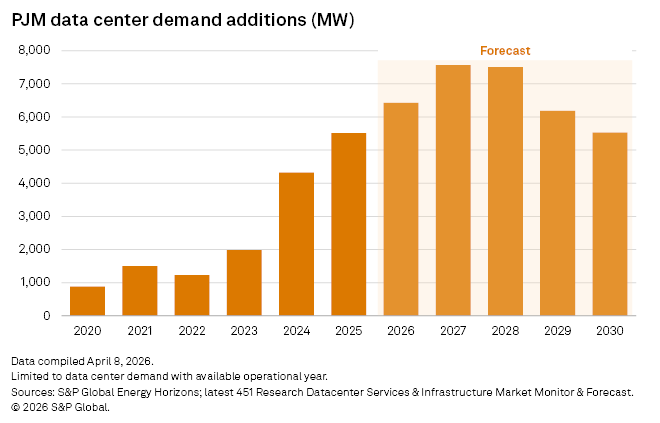
Data Center Demand in Virginia Dominion Energy Virginia now has about 51 GW of data center capacity in various stages of authorization and contracting, which includes about 10.4 GW under electric service agreements, management said May 1 on its first-quarter earnings call.
Leveraging the New Platform for Growth "I don't think it's any secret that we're seeing rapid growth in sales in Virginia and in the [Dominion transmission zone of PJM]," Blue said. "We have a robust plan in order to meet that demand. But with this platform, with the ability to buy, build and operate and finance more efficiently, we've got opportunities on behalf of our customers to serve that load."
NextEra's Market Position and Assets NextEra has a market cap of approximately $195 billion. The company operates through its Florida Power & Light Co. and NextEra Energy Resources LLC segments.
NextEra's Existing Infrastructure The company owns approximately 35,963 megawatts of net generating capacity, along with 93,000 miles of transmission and distribution lines. It serves approximately 6 million customer accounts on the east and lower west coasts of Florida.
Serving Large-Load Customers "The combined company will have the unmatched opportunity to be the leading partner to large-load customers in the US," Ketchum said.
A New Market Leader The newly combined company would be number-one in the US in total power generation, the world leader in renewables and energy storage, the leading US gas generator and the second-largest US nuclear generator, executives said.
Ranking in the US Energy Sector The company would be the third-largest in the US energy sector by market cap, behind Exxon Mobil Corp. and Chevron Corp.
Addressing PJM Market Dynamics There is also potential to accelerate Dominion's capital plan to meet Virginia's energy storage goals, while removing capacity deficit and a reliance on the PJM Interconnection market, Ketchum said. Dominion's Virginia utility is in the PJM market.
The Role of Incumbent Utilities "It's going to be up to the incumbent utilities to really help drive and solve the problem here," Ketchum said of PJM market volatility. "It creates an enormous opportunity to build more generation."
Competitive Advantage "It's going to be really, really tough for any of our peers or any of our competitors to do it as efficiently as we can," Ketchum added.
What are the merger's terms and potential obstacles?
Customer Bill Credits Deal terms include $2.25 billion in bill credits spread out over a two-year period for Dominion's customers in Virginia, North Carolina and South Carolina, the companies said in a joint news release.
Shareholder Compensation Under terms of the agreement, Dominion shareholders will receive 0.8138 share of NextEra for each share of Dominion they own at the close of the transaction. In addition, Dominion shareholders will continue to receive the company's quarterly dividend through closing along with a one-time cash payment of $360 million.
Analyst Questions on Timing Analysts at Jefferies, however, questioned why Dominion "is willing to sell right as the prospects are improving rather than in the depths of the business review."
Context of Dominion's Business Review Dominion concluded a lengthy "top-to-bottom" business review in February 2024 that included the sale of a 50% noncontrolling stake in the 2,587-MW Coastal Virginia Offshore Wind project to global alternative investment firm Stonepeak Partners LP in a $2.6 billion transaction.
Future of the Offshore Wind Project Executives said they feel good about the prospect of completing the offshore wind project. Dominion recently lowered the project's overall cost estimate by $100 million to $11.4 billion and stuck with its first half of 2027 target for full completion of the 176-turbine project off the coast of Virginia Beach.
Commitment to Project Completion "Given the investment that's been made there, it's the right thing to do to finish it," Ketchum said.
Analyst Views on Strategic Fit and Regulatory Hurdles Analysts agreed that the deal makes strategic sense as a way for NextEra to gain a foothold in the PJM region, but differed on whether regulatory approvals could be a key obstacle to completion.
Concerns Over Regulatory Scrutiny "We would expect heightened regulatory scrutiny to any tie-up given the current backdrop of affordability nationally," Barclays analysts wrote in a May 17 report.
Potential Scrutiny in Virginia The Virginia General Assembly would also likely scrutinize any residential rate impacts, according to Evercore analysts.
Optimistic Outlook on Regulatory Approval CreditSights, meanwhile, does not anticipate "strong regulator pushback" in Virginia or South Carolina, and Mizuho analysts noted that both states' merger approval standard of "in the public interest" is "typically easier to achieve than states with a 'net benefit' criteria."
Federal Approval and Antitrust Concerns When it comes to federal approvals, KeyBanc analysts said state regulation and the deal's "wide geographic footprint … should mitigate antitrust concerns."
Ownership Structure of the Combined Company Upon completion of the merger, NextEra shareholders will own approximately 74.5% of the combined company, and Dominion shareholders will own approximately 25.5%.
Termination Fee Clauses If Dominion terminates the deal following a change of board recommendation, a decision to enter into an alternative transaction or failure to receive shareholder approval, the company will be required to pay NextEra a $2.24 billion termination fee. Likewise, NextEra will be required to pay Dominion a termination fee of $6.52 billion under similar circumstances.
Key Regulatory Approvals Required The deal is also subject to approval from the Federal Energy Regulatory Commission, the Nuclear Regulatory Commission and the expiration or termination of the waiting period under the Hart-Scott-Rodino Antitrust Improvements Act.
State-Level Regulatory Hurdles In addition, Dominion and NextEra must receive regulatory approval from the Virginia State Corporation Commission, the North Carolina Utilities Commission and the Public Service Commission of South Carolina.
Termination Fee for Regulatory Failure If the merger is terminated as a result of failure to receive regulatory approval, NextEra must pay Dominion a $4.83 billion termination fee.
Projected Timeline for Closing "I feel terrific about our ability to close the merger in 12 to 18 months," Ketchum said.
How S&P Capital IQ Pro Supports Power and Utility Sector Analysis
Navigating major market shifts, such as the proposed merger between NextEra Energy and Dominion, requires comprehensive data and in-depth analysis. S&P Capital IQ Pro provides essential tools for understanding the implications of such transactions. Our platforms offer detailed company financials, including market capitalization and enterprise value, as mentioned in this article. Clients can leverage our M&A transaction data to analyze deal terms, termination fees, and shareholder value. Furthermore, our regulatory research and energy market data provide critical context on the hurdles and opportunities involved, from state commission approvals in Virginia and the Carolinas to market dynamics within PJM Interconnection.
Key Questions About the NextEra-Dominion Merger
What are the financial terms of the merger?
Dominion shareholders will receive 0.8138 share of NextEra for each share they own, plus a one-time cash payment of $360 million. The deal creates a company with a market capitalization over $249 billion and an enterprise value of $420 billion. NextEra shareholders will own about 74.5% of the combined company.
What is the strategic rationale for the deal?
The merger is primarily a response to rising US electricity demand, especially from data centers. The combined company aims to leverage its increased scale to "buy, build, finance and operate more efficiently," build projects faster, and become a leading partner to large-load customers.
What are the potential regulatory hurdles?
The deal requires approval from multiple federal and state bodies, including the Federal Energy Regulatory Commission (FERC), the Nuclear Regulatory Commission (NRC), and state utility commissions in Virginia, North Carolina, and South Carolina. Analysts anticipate heightened regulatory scrutiny regarding national affordability and residential rate impacts, though some believe the "in the public interest" standard in key states may be achievable.
What is the projected timeline for the merger's completion?
Company leadership is confident in their ability to close the merger within 12 to 18 months, pending all necessary shareholder and regulatory approvals.