13 May, 2026
SBA 7(a) lending rebounds in Q1 2026 as banks adjust to policy changes
By Arpita Banerjee and Xylex Mangulabnan
The US Small Business Administration 7(a) loan market showed signs of stabilization in the first quarter after dipping to a four-year low in the fourth quarter of 2025.
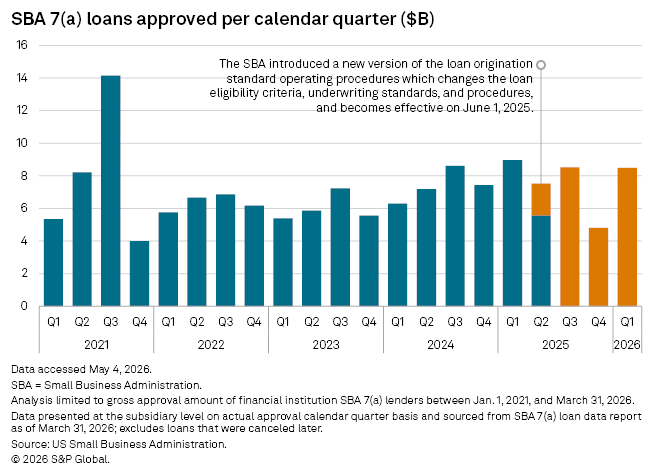
SBA 7(a) loan approvals reached $8.49 billion in the first quarter, nearly doubling the prior quarter's $4.80 billion and landing precisely where it stood a year ago before new lending rules roiled the market, according to S&P Global Market Intelligence data. The SBA 7(a) loan market experienced significant volatility following several changes to its policies and procedures in the past year, bankers said on first-quarter earnings calls.
The nation's top US bank SBA lender, Live Oak Bancshares Inc. unit Live Oak Banking Co., experienced a dip in production following changes in mid-2025, with third-quarter 2025 and fourth-quarter 2025 production falling to $38 million each from $72 million in the second quarter of 2025.
Production recovered some in the first quarter, increasing to $56 million, according to an April 23 investor presentation. The company expects further improvement, targeting at least $750 million in production annually moving forward, partly due to an AI-loan origination program currently in pilot, President William Losch said during the company's first-quarter earnings call April 23.
"The SBA changed the [standard operating procedure] back in midyear of 2025, which it essentially went back to what the rules had been before. So they had loosened the rules for smaller dollar loans, then they tightened them back up. So it just caused a little bit of a backup in our ability to generate those loans efficiently. But as you can see, we're on the rise again," Losch said.
In June 2025, the SBA 7(a) program experienced several notable changes, like tightening underwriting standards and restoring lender fees for small-dollar loans — undoing changes from the Biden administration.
Live Oak is seeing opportunities to gain market share as competitors exit the lending segment and experience credit quality issues, Losch said. "We're finding more opportunities to do more business in the $500,000 and below," he said.
In another recent change, the SBA announced in March that only US citizens and US nationals will be able to access SBA loans, barring foreign nationals and non-citizens from the loan type. That announcement came a week after a similar change making it so that small businesses accessing SBA loans must be 100% owned by US citizens — rescinding the earlier policy allowing up to 5% non-citizen ownership.
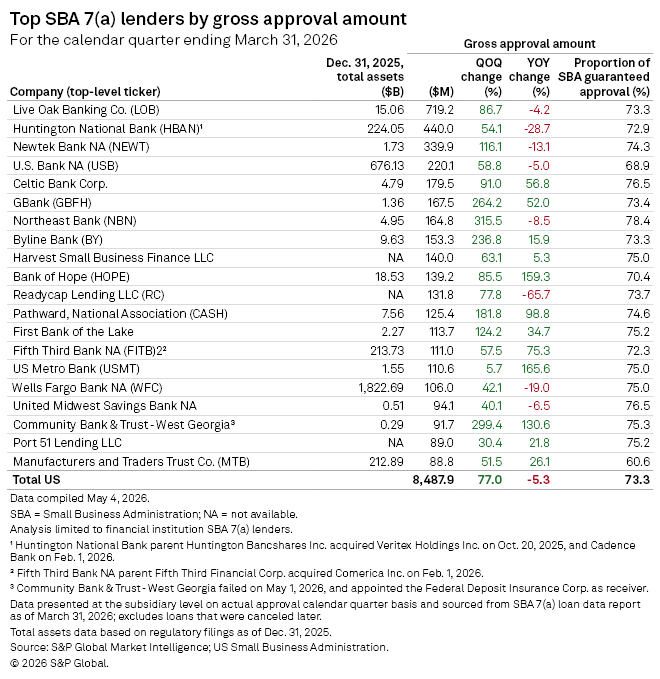
Citizenship lending changes led to a 10% to 20% dip in SBA volume in 2025, NewtekOne Inc. President, Chairman and CEO Barry Sloane said on the company's earnings call. NewtekOne's unit Newtek Bank NA was the third-largest SBA lender, with gross approved loans increasing 116.1% quarter over quarter but declining 13.1% year over year.
"We believe that we will get back to the volumes we had previously. But 2025 was a challenging year for 7(a)," Sloane said on the April 30 earnings call.
The SBA is still in the crosshairs of the administration's agenda, as Trump's fiscal year 2027 budget proposal, released in April, aims to sharply reduce SBA discretionary funding, a roughly 67% cut from the 2026 enacted level, and impose a new administrative fee on lenders that participate in the agency's guaranteed business lending programs.
Other top SBA 7(a) lenders
As of March 31, the appetite for small-dollar SBA 7(a) loans was strong, with 12 of the top 20 SBA 7(a) lenders recording quarter-over-quarter and year-over-year increases in gross approval amounts. All 20 banks posted quarter-over-quarter increases in gross approvals.
Huntington Bancshares Inc. unit Huntington National Bank was the second-largest lender, with $440 million of gross approved loans, representing a 54.1% quarterly increase and 28.7% yearly decline.
Community Bank & Trust - West Georgia, which failed on May 1, posted a 299.4% quarter-over-quarter increase, the largest among the group, and 130.6% year-over-year increase, the third-largest jump. A recent report from American Banker said the bank had 58 noncurrent SBA loans as of March 31, according to an SBA database. However, it was unclear how many of those loans were on the bank's books when it failed, according to the report.
Of all the US states and territories, Maryland recorded the largest year-over-year increase in SBA 7(a) loans, up 222.2% to $23.9 million, and Washington DC had the second-largest year-over-year increase, 95.8% to about $3.9 million.