18 May, 2026
Qualitas Energy explores German PPA market as renewables subsidies evolve

|
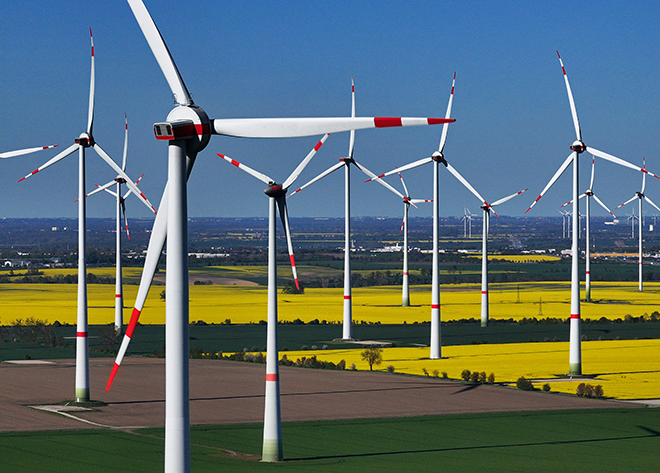
The German government is planning to introduce contracts for difference support for onshore wind in a move away from the existing sliding premium mechanism. |
Germany's overhaul of its renewable energy auction design is prompting some developers to explore power purchase agreements as an alternative revenue stream, even if government-backed tenders are set to remain the most competitive offtake route.
Spanish fund manager Qualitas Energy, which has more than 3 gigawatts of late-stage wind projects in Germany, is accelerating preparations for a potential uptick in PPA interest, despite the continued dominance of support tenders under the country's EEG green energy law, according to Borja Caruana, the company's head of operations and industry for Germany.
"What is still more competitive? The EEG. But the market might evolve to develop complementary alternatives through PPAs," Caruana said in an April 23 interview with Platts, part of S&P Global Energy, at trade association WindEurope's annual conference in Madrid.
Qualitas recently laid out a €10 billion investment plan through 2029 after launching its latest fund, the €3.25 billion Qualitas Energy Fund VI, at the end of 2025.
The company has been analyzing PPA opportunities in Germany for some time, with that work now "increasing momentum," Caruana added.
The comments come as Europe's largest economy prepares to switch to a two-sided contract for difference (CFD) auction design as part of reforms to the EEG that are expected to pass before the summer parliamentary break.
Caruana said Qualitas is exploring whether PPAs could serve as an alternative or complement to CFDs, drawing on experience from other European markets where the company has deployed corporate offtake agreements.
"We have a spirit of being first-movers," Caruana said. "There might be, at a certain point of time, a [PPA market], and we will be prepared for that."
Germany's current 20-year sliding premium support mechanism for large-scale onshore wind and solar provides developers with a floor price — determined by the tenders — and allows them to capture the upside if power prices are high.
In contrast, CFDs would give developers a fixed price for their power by providing support when wholesale prices fall below their strike price but requiring them to repay revenues when prices go above it.
Caruana expects a "smooth" transition to two-sided CFDs for most market participants.
"If you, as a project owner, are not considering those windfall profits for your business case, it's not a big deal," Caruana said.
Germany has awarded about 35 GW of onshore wind contracts since 2023 under the current sliding premium system.
Its most recent onshore wind tender awarded 3.45 GW of contracts at an average price of €55.40/megawatt-hour, the lowest price since February 2018. The tender was the first of four to take place in 2026 under the current design before CFDs are expected to come in.
The Platts index for a standard 10-year onshore wind PPA in Germany was pegged at €61.48/MWh on May 14, having gone above the tender price for the first time in January.
Clarity needed on grids package
As well as the EEG reforms, consultation is in the final stages on a so-called grids package that aims to address growing congestion on Germany's electricity network.
The package has come under scrutiny from the renewables industry over its proposed 3% redispatch provision, which would limit new capacity in saturated grid areas. It also proposes giving grid operators new powers to prioritize connection requests and tie capacity reservations to project milestones.
Caruana acknowledged that the grid is becoming a "bottleneck" in Germany and called on policymakers to provide clarity on what the final rules will look like.
"Anything which is disrupting and not following specific business logic on the grid side could jeopardize the market," Caruana said.
The executive said "grandfathering rules" for those projects already in development would be a "reasonable" approach for the government to take.
"We have to order the traffic here, but without putting unnecessary risk on the projects that have already been in development for the last four years with a clear goal of connecting and helping Germany to produce more clean energy," Caruana said.
Qualitas has 500 megawatts of wind capacity in operation, with another 513 MW under construction after a spate of recent successes in tenders.