27 May, 2026
Private credit exposure grows as insurers eye higher yields, diversification
Insurers across the US and Europe are increasing their exposure to private market assets, including private credit.
US life insurers' private placement bonds accounted for 23.4% of insurers' total admitted bonds in 2025, up from 18.3% in 2021, according to a report from Market Intelligence.
In Europe, insurers' private credit exposure stood at 5.8% of total assets in the second quarter of 2025, the highest level since the fourth quarter of 2016, according to the European Insurance and Occupational Pensions Authority.
Chasing yield
Insurers, particularly US life underwriters, are increasing allocations to private credit in pursuit of higher yields and broader portfolio diversification, according to Carmi Margalit, managing director, sector lead US life insurance at S&P Global Ratings.
"There is enhanced yield in private credit compared to a similarly rated public bond," Margalit said. In some cases, the yield differences between private credit assets and public bonds can be upward of 200 basis points. Private markets also allow insurers to access certain assets that are difficult to get access to in public markets, such as asset-backed finance and middle-market lending to small and medium businesses, he said.
Concerns around private credit loan defaults, highlighted by the surge in redemption requests in April from investors in private credit fund manager Blue Owl Capital Inc., come with the higher yield.
Illiquidity is a major risk when investing in private credit, Margalit said. While public investment-grade bonds benefit from deep secondary markets, private credit can be difficult to sell, especially during periods of market stress. That creates potential challenges for insurers needing to raise cash quickly.
Another concern is complexity, Margalit added. Private credit structures are often more intricate than traditional public bonds, involving securitizations, fund financing and other non-standard features. This can make risks harder to assess and manage beyond the underlying borrower's credit quality.
That said, private credit is typically a long-term allocation and would not be insurers' primary source of contingent liquidity in a stress scenario, according to Ammar Khan, principal at Oliver Wyman Actuarial.
"Liquidity needs arising from large claims events are more commonly addressed through overall balance-sheet management, including liquid reserves, reinsurance and broader asset-liability planning," Khan said in written commentary.
 |
- Download a spreadsheet with data featured in this story. - Read about trends in private equity exits in the UK and EU. - Explore more private market headlines. |
Top allocators
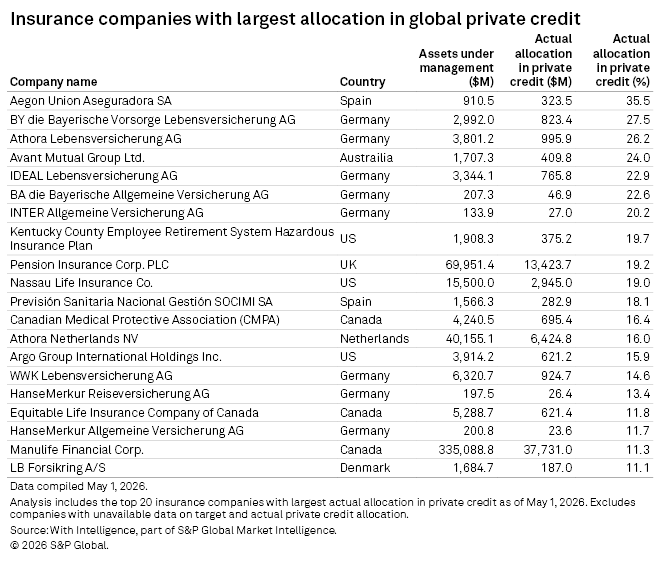
As of May 1, the 20 global insurers with the largest exposures to private credit collectively hold $67.67 billion in the asset class, with allocations ranging from 11% to 35.50% of total assets, according to data from With Intelligence, part of S&P Global Market Intelligence.
European insurers dominate the list, which could be due to a wider definition of private credit in the region, said Volker Kudszus, managing director and sector lead insurance ratings EMEA at S&P Global Ratings.
"In the US, you regard as private credit what is privately placed and has a private letter rating," Kudszus said. "In Europe, everything where the underlying is something like privately placed or unrated is already private credit."
Canada-based Manulife Financial Corp. reported the largest value of actual allocation to private credit at $37.73 billion, or 11.30% of total assets. Some of the company's active private credit fund investments include KKR & Co. Inc.'s KKR Dislocation Opportunities Fund, Harvest Partners LP's Harvest Partners Structured Capital Fund II LP and The Carlyle Group Inc.'s Carlyle Credit Opportunities Fund II LP, according to With Intelligence data.
The UK's Pension Insurance Corp. PLC also showed a sizable private credit book. The company reported private credit allocation of $13.42 billion, equal to 19.20% of its assets.
Spain-based Aegon Union Aseguradora SA reported the highest share of private credit. Its private credit book comes in at $323.5 million within total assets of $910.5 million.
Increasing exposure
Insurance companies are expected to further ratchet up investments in private credit, but at a gradual pace, as they look to diversify their portfolios, enhance yield and match liabilities, according to Khan.
"Participation is likely to continue, especially where private credit supports yield objectives and liability matching," Khan said. "We are seeing a more measured stance, with insurers placing additional weight on liquidity terms, portfolio concentrations, valuation discipline and capital considerations. The outlook points to steady rather than uniform growth."