26 May, 2026
Poland's Orlen seeks out partner for 2nd Baltic Sea wind farm

|
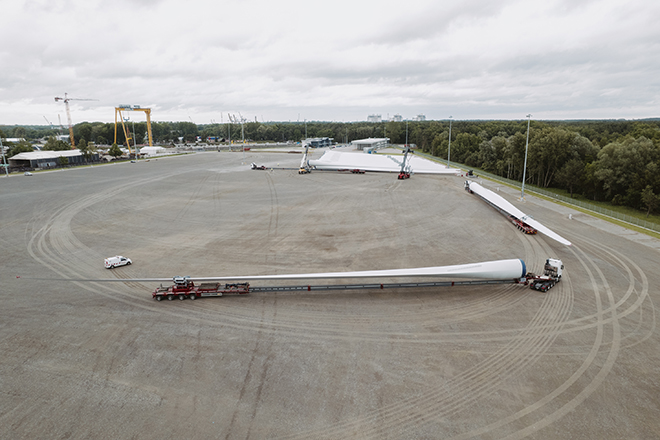
Orlen Neptun's offshore wind installation terminal in Świnoujście, Poland, above, is the first facility of its kind in the country. Launched in 2025, it aims to serve the company's pipeline of projects in the Baltic Sea. |
Polish state-controlled oil refiner Orlen SA hopes to lock down a financial partner in 2027 for its second offshore wind farm in Poland's Baltic Sea ahead of signing contracts for key components, according to Janusz Bil, CEO of the company's offshore wind business, Orlen Neptun.
Orlen is looking for a utility or independent power producer to take a stake of up to 50% in its 900-megawatt Baltic East wind farm, one of three projects awarded 25-year government offtake contracts in Poland's first competitive offshore wind auction in late 2025.
The company is aiming to replicate the model from its 1.2-gigawatt Baltic Power wind farm, its maiden venture into offshore wind, which saw it partner with Canada's Northland Power Inc.
The project, with a total budget of around €4.73 billion, is expected to begin generating power later in 2026, becoming Poland's first offshore wind farm in operation.
"Like Baltic Power, Baltic East will be developed in collaboration with a joint venture partner," Bil said in an interview with Platts, part of S&P Global Energy, acknowledging that Orlen does not yet have a long track record in offshore wind.
"That's the main driver why we need a partner, but we also need a partner to share risks, to raise capital, and to bring skills," Bil said.
Orlen estimates that 70%–80% of the costs of Baltic East will be funded through project finance debt, with the remainder coming as equity from Orlen and its prospective partner. Orlen already secured 2.6 billion Polish zlotys in EU funds via state-owned Bank Gospodarstwa Krajowego to go toward Baltic East.
'Attractive' economics
Bil, who previously held roles in Poland's energy sector with Sweden's Vattenfall AB and Germany's RWE AG, expects Baltic East's long-term subsidy support to make it an "attractive" prospect for potential suitors.
The project was awarded a contract for difference (CFD) in the December 2025 auction at a price of 476.88 zlotys/megawatt-hour for 25 years.
Two other wind farms, developed by local utility PGE Polska Grupa Energetyczna SA and a joint venture between Norway's Equinor ASA and Brookfield Corp.-owned Polenergia SA, also won contracts at slightly higher prices.
The auction represented the second phase of Poland's offshore wind development, coming after 5.9 GW of projects — including Baltic Power — were awarded 25-year CFDs on a first-come, first-served basis in 2021.
The CFD price in December's auction is somewhat higher than the 319.60 zlotys/MWh contracts awarded to the initial projects, even after inflation is factored in.
Bil attributed the increase to macroeconomic factors, with capital costs having risen in the years since the first wave of development. It also reflects the fact developers in Poland are required to pay for a wind farm's grid connection, unlike other markets like Germany and France.
The executive hopes the premium price will help stimulate local content in Poland, acknowledging that supply chain bottlenecks are a potential risk for the project.
While Orlen has secured its CFD price, it has not yet locked in costs for key components like turbines and cables.
"So there is a risk of higher prices for key components," Bil said.
Broader pipeline
Orlen's supply chain procurement for Baltic East is underway. Tender packages for foundations and the onshore substation are already live, and the rest to begin later this year, the company said.
Contracts will be ready to be signed in late 2028 or early 2029, with a final investment decision targeted for 2029. Offshore installation is set to begin in 2031, and commercial operation is anticipated by 2032.
Beyond Baltic East, Orlen also has four other seabed licenses in Poland's Baltic Sea, which collectively make up the more than 4-GW Baltic West project.
Bil said Orlen is working to get the Baltic West sites "auction-ready" by 2027, when the Polish government plans to run another auction for 4 GW. Two subsequent rounds of 2 GW each will be held in 2029 and 2031.
"Altogether, our plan is to build 5–6 GW of offshore wind in the Baltic Sea, which will contribute to the overall government plan to reach 18 GW by 2040," Bil said.
The Polish Wind Energy Association puts Poland's total offshore wind potential at 33 GW, with the technology potentially contributing as much as 57% of the country's total electricity demand by 2040 amid a shift away from coal.
Analysts at S&P Global Energy Horizons see Polish offshore wind capacity reaching 12.4 GW by 2035.
"The Baltic Sea has been lagging behind the North Sea for a long time," Bil said. "But it's changing fast."
As of May 25, US$1 was equivalent to 3.63 Polish zlotys.