04 May, 2026
'Party is over' in European offshore wind as developers turn cautious

|
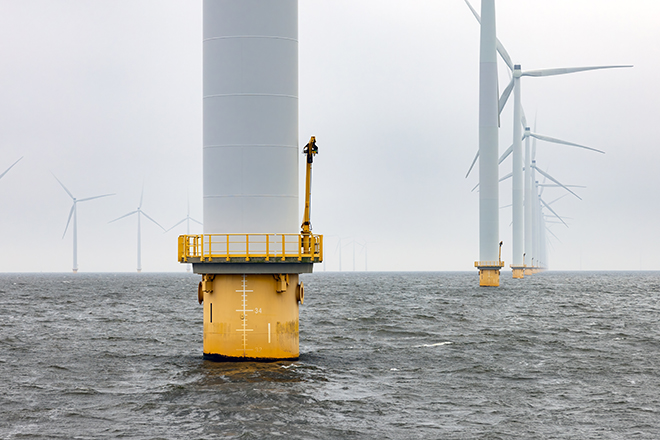
Adam Thomsen of Skyborn Renewables expects European offshore wind developers to be more focused geographically, driven by financial, organizational or supply chain limitations. |
European offshore wind developers are coming to terms with a new era of caution and selectivity, as financial constraints and supply chain limitations combine to create an environment in which potential projects outnumber the capital, equipment and workforce available to build them, according to a senior executive at Skyborn Renewables GmbH.
"I'm not saying it's a free-for-all, but the dynamics have changed," Adam Thomsen, Skyborn's chief development officer, said in an April 22 interview with Platts, part of S&P Global Energy, on the sidelines of trade association WindEurope's annual conference in Madrid.
The shift marks a reversal from previous years, when developers competed fiercely against each other in government-run auctions, in some cases writing multibillion-euro checks for the rights to develop projects.
Those days are firmly in the past, with many nations finding it increasingly difficult to attract bids. Auctions in major offshore wind markets including the UK, Germany, the Netherlands and France have all drawn blanks in recent times, prompting a redesign of bidding frameworks.
The failed auctions have raised concerns about whether Europe can meet its ambitious offshore wind targets, including a pledge made at the North Sea Summit in January to develop 300 gigawatts of offshore wind capacity by 2050.
Governments now recognize they must actively court developers rather than simply wait for bids, Thomsen said.
"Before, you were in a situation where you saw developers competing for auctions. You will still see that, but you will probably also see markets competing for developers," the executive said.
The transformation follows a painful adjustment period for the industry, which expanded aggressively during an era of near-zero interest rates and rapid turbine technology improvements. That environment has fundamentally changed as costs surged, supply chains tightened and financing conditions deteriorated.
"That disruption made everyone realize that the party is over," Thomsen said. "You've got to be much more cautious with the bets that you're making."
Several developers now face "hangovers" from long-term commitments made on assumptions that failed to materialize, the executive added.
"Everyone knows you don't want to get into that tough spot again," Thomsen said. "People are being much more realistic in terms of what can be done without overextending their balance sheet."
Developers becoming selective
Amid abundant project opportunities but constrained resources, Thomsen expects offshore wind developers to be more focused geographically, driven by financial, organizational or supply chain limitations.
"There are a number of factors that make it difficult to participate in all of these [markets], so I think developers will need to be selective, for sure," Thomsen said.
That trend is already playing out. Denmark's Ørsted A/S, one of the world's largest offshore wind developers, has sharpened its geographical focus in offshore wind to prioritize Europe, having previously developed projects in the US and Asia.
Elsewhere, Norway's Equinor ASA and Germany's RWE AG have also exited certain countries to focus on their core offshore wind markets.
Skyborn, which is owned by BlackRock Inc.'s Global Infrastructure Partners, sees the "best opportunities" in countries with strong track records in offshore wind where harnessing the resource "makes sense," according to Thomsen.
The company has projects in operation or under construction in Germany and France. It also owns 50% stakes in two Ørsted projects in the US — South Fork Offshore Wind, which is in operation, and Revolution Wind, which is under construction — but new projects there are unlikely amid pushback from the Trump administration.
Skyborn's most advanced development project — the nearly 1-gigawatt Gennaker wind farm in Germany's Baltic Sea — is set to reach a final investment decision in the coming months.
"Offshore wind has stronger fundamentals in the north [of Europe] than if you go to the Mediterranean, where you have less wind, deeper waters, and frankly, a lot of sun," Thomsen said. "If it's driven by sound market fundamentals that the country needs the energy, and they really don't have that many good [options], we think that that will last through an election cycle."