31 May, 2026
Japan's megabanks up provisions on economic uncertainty after record earnings
By Yuzo Yamaguchi and Beenish Bashir
Japan's three megabanks raised their loan-loss provisions due to concerns that a prolonged US-Israel war with Iran could hamper global economies.
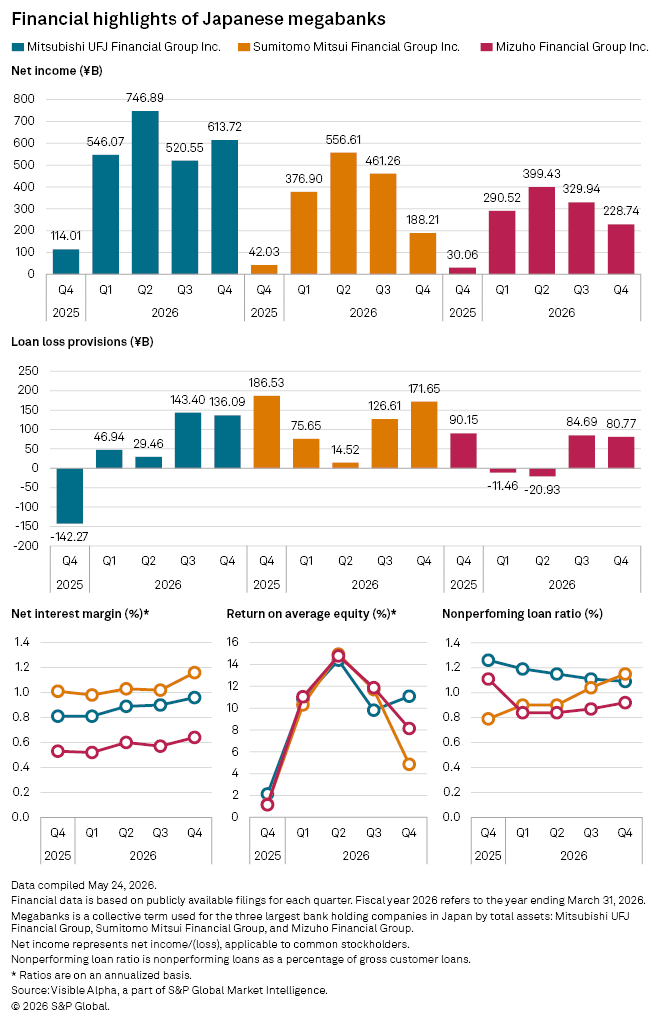
Aggregate loan-loss provisions at Mitsubishi UFJ Financial Group Inc., Sumitomo Mitsui Financial Group Inc. and Mizuho Financial Group Inc. totaled ¥877.40 billion in the fiscal year ended on March 31, according to S&P Global Market Intelligence calculations, increasing from a combined ¥504.88 billion reported in the previous year.
"The only concern we have is that the Middle-East conflict would have significant impact on corporate executives' mindset," Masahiro Kihara, Mizuho's CEO, said at a press briefing on May 19, four days after the bank reported record high earnings.
Record earnings
All three lenders posted record earnings in the year ended March 31 and expect further growth in the current year as their margins benefit from the Bank of Japan's rate hike policy. The central bank increased its policy rate by 25 basis points to 0.75% in December 2025, its highest level in three decades. The hike was the fourth since its exit from negative interest rates in March 2024. Economists expect the terminal rate to reach 1.5% by January 2028.
Japan, along with the rest of the world, faces inflationary pressures from the war, which has restricted the movement of ships in the Strait of Hormuz, pushing up global oil prices. Japan's central bank maintained its policy rate at its April meeting due to the uncertainties.
MUFG more than tripled its loan-loss provision year on year to ¥355.89 billion in the fiscal year through March, Market Intelligence data shows. SMFG's provisions increased to ¥388.44 billion from ¥344.55 billion over the same period. Mizuho's loan-loss provision swelled to ¥133.07 billion from ¥51.60 billion.
"Overall, we're coming under negative pressure" from the Middle-East conflict, Toru Nakashima, SMFG's CEO, said during its earnings press conference on May 13.
War uncertainties
Banking executives are struggling to assess the impact of the war on the Japanese economy as negotiations between the US and Iran are yet to produce a definitive deal, said Hideo Oshima, a senior economist at Japan Research Institute, a unit of SMFG. "Banks are facing upward pressure on credit risk."
Meanwhile, the megabanks posted record-high earnings in the fiscal year that ended on March 31.
MUFG's net income attributable to the parent company grew to ¥2.427 trillion, from ¥1.863 trillion in the previous year. Similarly, SMFG's earnings increased to ¥1.583 trillion from ¥1.178 trillion, and Mizuho's net income climbed to ¥1.249 trillion, the first time to top ¥1.0 trillion, from ¥885.4 billion a year ago.
As of May 29, US$1 was equivalent to ¥159.18.